  | |
| Observation data Epoch J2000 Equinox J2000 | |
|---|---|
| Constellation | Taurus |
| Right ascension | 03h 46m 02.90033s1 |
| Declination | +24° 31′ 40.4284″1 |
| Apparent magnitude (V) | 6.432 |
| Characteristics | |
| Evolutionary stage | main sequence1 |
| Spectral type | A0 Vn3 |
| B−V color index | −0.020±0.0062 |
| Astrometry | |
| Radial velocity (Rv) | +6.9±1.32 km/s |
| Proper motion (μ) | RA: +19.5821 mas/yr Dec.: −44.8781 mas/yr |
| Parallax (π) | 7.4231±0.0359 mas1 |
| Distance | 439 ± 2 ly (134.7 ± 0.7 pc) |
| Absolute magnitude (MV) | 1.002 |
| Details | |
| Radius | 3.14 R☉ |
| Luminosity | 63.62 L☉ |
| Surface gravity (log g) | 4.209±0.1135 cgs |
| Temperature | 11,817±1915 K |
| Metallicity [Fe/H] | −0.16 dex |
| Rotational velocity (v sin i) | 2326 km/s |
| Other designations | |
| Sterope II7, 22 Tau, BD+24°556, GC 4506, HD 23441, HIP 17588, HR 1152, SAO 761648 | |
| Database references | |
| SIMBAD | data |

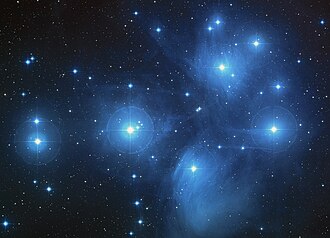
22 Tauri is a component of the Sterope double star in the Pleiades open cluster. 22 Tauri is the star's Flamsteed designation. It is situated near the ecliptic and thus is subject to lunar occultation.9 The star has an apparent visual magnitude of 6.43,2 which is near the lower threshold of visibility to the naked eye. Anybody attempting to view the object is likely to instead see the Sterope pair as a single elongated form of magnitude 5.6.10 Based upon an annual parallax shift of 7.42 mas,1 this star is located 439 light years away from the Sun. It is moving further from the Earth with a heliocentric radial velocity of +7 km/s.2
This star traditionally shared the name Sterope or Asterope with 21 Tauri, and has sometimes been called Sterope II,7 but the IAU Working Group on Star Names officially approved the name Asterope for 21 Tauri.11
This is an ordinary A-type main-sequence star with a stellar classification of A0 Vn.3 The 'n' suffix indicates the spectrum displays "nebulous" absorption lines due to rapid rotation. This is confirmed by a high projected rotational velocity of 232 km/s.6 The star is radiating sixty times the Sun's luminosity from its photosphere at an effective temperature of 11,817 K.5
References
References
- Vallenari, A.; et al. (Gaia collaboration) (2023). "Gaia Data Release 3. Summary of the content and survey properties". Astronomy and Astrophysics. 674: A1. arXiv:2208.00211. Bibcode:2023A&A...674A...1G. doi:10.1051/0004-6361/202243940. S2CID 244398875. Gaia DR3 record for this source at VizieR.
- Anderson, E.; Francis, Ch. (2012), "XHIP: An extended hipparcos compilation", Astronomy Letters, 38 (5): 331, arXiv:1108.4971, Bibcode:2012AstL...38..331A, doi:10.1134/S1063773712050015, S2CID 119257644.
- Cowley, A.; et al. (April 1969), "A study of the bright A stars. I. A catalogue of spectral classifications", Astronomical Journal, 74: 375–406, Bibcode:1969AJ.....74..375C, doi:10.1086/110819.
- Pasinetti Fracassini, L. E.; et al. (February 2001), "Catalogue of Apparent Diameters and Absolute Radii of Stars (CADARS)", Astronomy and Astrophysics, 367 (2) (Third ed.): 521–524, arXiv:astro-ph/0012289, Bibcode:2001A&A...367..521P, doi:10.1051/0004-6361:20000451, S2CID 425754.
- David, Trevor J.; Hillenbrand, Lynne A. (2015), "The Ages of Early-Type Stars: Strömgren Photometric Methods Calibrated, Validated, Tested, and Applied to Hosts and Prospective Hosts of Directly Imaged Exoplanets", The Astrophysical Journal, 804 (2): 146, arXiv:1501.03154, Bibcode:2015ApJ...804..146D, doi:10.1088/0004-637X/804/2/146, S2CID 33401607.
- Gebran, M.; et al. (2016), "A new method for the inversion of atmospheric parameters of A/Am stars", Astronomy & Astrophysics, 589: A83, arXiv:1603.01146, Bibcode:2016A&A...589A..83G, doi:10.1051/0004-6361/201528052, S2CID 118549566.
- Allen, Richard Hinckley (1963), Star names - Their Lore and Meaning, Dover Books, p. 407, retrieved 2016-09-14.
- "22 Tau". SIMBAD. Centre de données astronomiques de Strasbourg. Retrieved November 21, 2018.
- Schmidtke, P. C.; Africano, J. L. (2011), "KPNO Lunar Occultation Summary. III", The Astronomical Journal, 141 (1): 10, Bibcode:2011AJ....141...10S, doi:10.1088/0004-6256/141/1/10.
- Schaaf, Fred; Myers, Doug (2012), Seeing the Sky: 100 Projects, Activities & Explorations in Astronomy, Dover Books on Astronomy, Courier Corporation, p. 56, ISBN 978-0486488882
- "IAU Catalog of Star Names". Retrieved 13 November 2025.