  | |
| Observation data Epoch J2000 Equinox J2000 | |
|---|---|
| Constellation | Ophiuchus |
| Right ascension | 16h 49m 50.01604s1 |
| Declination | −10° 46′ 58.7775″1 |
| Apparent magnitude (V) | 4.642 |
| Characteristics | |
| Spectral type | F6IV3 |
| U−B color index | +0.074 |
| B−V color index | +0.474 |
| Astrometry | |
| Radial velocity (Rv) | −1.605 km/s |
| Proper motion (μ) | RA: +72.331 mas/yr Dec.: −78.801 mas/yr |
| Parallax (π) | 31.27±2.16 mas1 |
| Distance | 104 ± 7 ly (32 ± 2 pc) |
| Absolute magnitude (MV) | 2.132 |
| Orbit6 | |
| Period (P) | 35.5 ± 1.5 yr |
| Semi-major axis (a) | 0.460 ± 0.030″ |
| Eccentricity (e) | 0.8 ± 0.2 |
| Inclination (i) | 74 ± 11° |
| Longitude of the node (Ω) | 118 ± 9° |
| Periastron epoch (T) | 1981.2 ± 1.7 |
| Argument of periastron (ω) (secondary) | 34 ± 26° |
| Details | |
| 20 Oph A | |
| Mass | 1.707 M☉ |
| Radius | 3.07 R☉ |
| Luminosity | 12.062 L☉ |
| Surface gravity (log g) | 3.898 cgs |
| Temperature | 6,4178 K |
| Metallicity [Fe/H] | +0.138 dex |
| Rotational velocity (v sin i) | 11.39 km/s |
| 20 Oph B | |
| Mass | 0.8 ± 0.26 M☉ |
| Other designations | |
| BD−10°4394, FK5 1438, GC 22643, HIP 82369, HR 6243, HD 151769, SAO 160118 | |
| Database references | |
| SIMBAD | data |
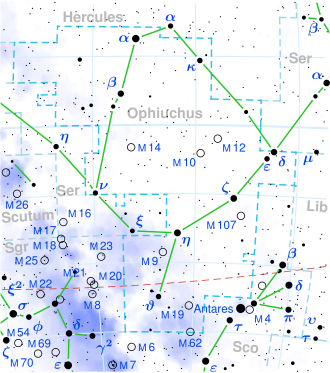
20 Ophiuchi is a class F6IV3 (yellow-white subgiant) star in the constellation Ophiuchus. Its apparent magnitude is 4.642 and it is approximately 104 light years away based on parallax.1 It lies near the star Zeta Ophiuchi.
20 Ophiuchi is an astrometric binary. The primary star is a late F-type subgiant star. It has a mass 1.72 times that of the Sun.6 The companion star regularly perturbs the primary star, causing it to wobble around the barycenter. From this, an orbital period of 35.5 years has been calculated. The secondary star is 0.8 times the mass of the Sun, and it may be a white dwarf or red dwarf.6
References
References
- Van Leeuwen, F. (2007). "Validation of the new Hipparcos reduction". Astronomy and Astrophysics. 474 (2): 653–664. arXiv:0708.1752. Bibcode:2007A&A...474..653V. doi:10.1051/0004-6361:20078357. S2CID 18759600. Vizier catalog entry
- Anderson, E.; Francis, Ch. (2012). "XHIP: An extended hipparcos compilation". Astronomy Letters. 38 (5): 331. arXiv:1108.4971. Bibcode:2012AstL...38..331A. doi:10.1134/S1063773712050015. S2CID 119257644. Vizier catalog entry
- Gray, R. O.; Corbally, C. J.; Garrison, R. F.; McFadden, M. T.; Bubar, E. J.; McGahee, C. E.; O'Donoghue, A. A.; Knox, E. R. (2006). "Contributions to the Nearby Stars (NStars) Project: Spectroscopy of Stars Earlier than M0 within 40 pc--The Southern Sample". The Astronomical Journal. 132 (1): 161–170. arXiv:astro-ph/0603770. Bibcode:2006AJ....132..161G. doi:10.1086/504637. S2CID 119476992.
- Mallama, A. (2014). "Sloan Magnitudes for the Brightest Stars". The Journal of the American Association of Variable Star Observers. 42 (2): 443. Bibcode:2014JAVSO..42..443M.Vizier catalog entry
- Gontcharov, G. A. (2006). "Pulkovo Compilation of Radial Velocities for 35 495 Hipparcos stars in a common system". Astronomy Letters. 32 (11): 759–771. arXiv:1606.08053. Bibcode:2006AstL...32..759G. doi:10.1134/S1063773706110065. S2CID 119231169.
- Gontcharov, G.A.; Kiyaeva, O.V. (2010). "Photocentric orbits from a direct combination of ground-based astrometry with Hipparcos II. Preliminary orbits for six astrometric binaries". New Astronomy. 15 (3): 324–331. arXiv:1606.08182. Bibcode:2010NewA...15..324G. doi:10.1016/j.newast.2009.09.006.
- Allende Prieto, C.; Lambert, D. L. (1999). "Fundamental parameters of nearby stars from the comparison with evolutionary calculations: Masses, radii and effective temperatures". Astronomy and Astrophysics. 352: 555–562. arXiv:astro-ph/9911002. Bibcode:1999A&A...352..555A. Vizier catalog entry
- Wu, Yue; Singh, H. P.; Prugniel, P.; Gupta, R.; Koleva, M. (2010). "Coudé-feed stellar spectral library – atmospheric parameters". Astronomy & Astrophysics. 525: A71. arXiv:1009.1491. Bibcode:2011A&A...525A..71W. doi:10.1051/0004-6361/201015014. S2CID 53480665.
- De Medeiros, J. R.; Mayor, M. (1999). "A catalog of rotational and radial velocities for evolved stars". Astronomy and Astrophysics Supplement Series. 139 (3): 433. arXiv:astro-ph/0608248. Bibcode:1999A&AS..139..433D. doi:10.1051/aas:1999401. Vizier catalog entry