 | |
| Discovery1 | |
|---|---|
| Discovered by | PMO NEO Survey Program |
| Discovery site | Purple Mountain Obs. |
| Discovery date | 6 February 2008 |
| Designations | |
| 2009 FW54 | |
| Orbital characteristics2a | |
| Epoch 27 April 2019 (JD 2458600.5) | |
| Uncertainty parameter 1 | |
| Observation arc | 14.72 yr (5,375 d) |
| Aphelion | 3192 AU 2049 AU (barycentric) |
| Perihelion | 14.5 AU |
| 1603.44 AU 1032 AU (barycentric) | |
| Eccentricity | 0.9909 |
| 64207 yr 33100 yr (barycentric) | |
| 0.0453° | |
| 0° 0m 0s / day | |
| Inclination | 77.986° |
| 341.48° | |
| ≈ 16 March 20116 | |
| 195.57° | |
| Jupiter MOID | 9.311 AU |
| Saturn MOID | 5.45 AU1 |
| Uranus MOID | 3.32 AU1 |
| TJupiter | 0.9860 |
| Physical characteristics | |
| 19.97 | |
| 7.121 | |
(668643) 2012 DR30 is a trans-Neptunian object and centaur with an extremely eccentric orbit that brings it from the inner Oort cloud, the outermost region of the Solar System. It was discovered on 6 February 2008 by astronomers at Purple Mountain Observatory in Nanking, China.1 It measures approximately 188 kilometers (120 miles) in diameter.
Description
Using an epoch of February 2017, it has the second-largest heliocentric semi-major axis of a minor planet not detected outgassing like a comet.8 (2014 FE72 has a larger heliocentric semi-major axis.) 2012 DR30 does have a barycentric semi-major axis of 1032 AU.9a For the epoch of July 2018 2012 DR30 will have its largest heliocentric semi-major axis of 1644 AU.
| Orbital evolution | ||
| Yeara (epoch) |
Barycentric Aphelion (Q) (AU) |
Orbital period years |
|---|---|---|
| 1950 | 2000 | 32000 |
| 2050 | 2049 | 33100 |
2012 DR30 passed 5.7 AU from Saturn in February 2009 and came to perihelion in March 2011 at a distance of 14.5 AU from the Sun (inside the orbit of Uranus).2 In 2018, it will move from 18.2 AU to 19.1 AU from the Sun.7 It comes to opposition in late March. With an absolute magnitude (H) of 7.1,1 the object has a published diameter of 185 and 188 kilometers, respectively.45
With an observation arc of 14.7 years,2 it has a well constrained orbit. It will not be 50 AU from the Sun until 2047. After leaving the planetary region of the Solar System, 2012 DR30 will have a barycentric aphelion of 2049 AU with an orbital period of 33100 years.a In a 10 million year integration of the orbit, the nominal (best-fit) orbit and both 3-sigma clones remain outside 12.2 AU (qmin) from the Sun.3 Summary of barycentric orbital parameters are:
- Semi-major axis: ~1032 AUa
- aphelion: ~2049 AUa
- period: ~33,100 yra
Archived data from the JPL SBDB and MPC.bc
Comparison
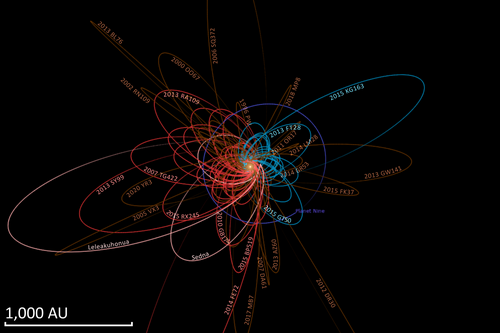
See also
See also
Notes
Notes
References
References
- "2012 DR30". Minor Planet Center. Archived from the original on 15 February 2017. Retrieved 19 November 2018.
- "JPL Small-Body Database Browser: (2012 DR30)" (2014-12-17 last obs.). Jet Propulsion Laboratory. Archived from the original on 27 July 2020. Retrieved 19 November 2018.
- Marc W. Buie. "Orbit Fit and Astrometric record for 12DR30". SwRI – Space Science Department. Archived from the original on 5 February 2016. Retrieved 1 February 2016.
- Kiss, Cs.; Szabó, Gy.; Horner, J.; Conn, B. C.; Müller, T. G.; Vilenius, E.; et al. (July 2013). "A portrait of the extreme solar system object 2012 DR30". Astronomy and Astrophysics. 555: 13. arXiv:1304.7112. Bibcode:2013A&A...555A...3K. doi:10.1051/0004-6361/201321147. S2CID 54021504.
- Johnston, Wm. Robert (7 October 2018). "List of Known Trans-Neptunian Objects". Johnston's Archive. Archived from the original on 23 October 2019. Retrieved 19 November 2018.
- JPL Horizons Archived 28 November 2020 at the Wayback Machine Observer Location: @sun
- "AstDyS 2012DR30 Ephemerides". Department of Mathematics, University of Pisa, Italy. Archived from the original on 3 May 2024. Retrieved 14 February 2017. (Distance to Sun [R] from first day of 2016 to first day of 2020. Assuming average apparent magnitude for 2017.)
- "JPL Small-Body Database Search Engine: Asteroids and a > 100 (AU)". JPL Solar System Dynamics. Archived from the original on 29 November 2020. Retrieved 15 October 2014.
- Horizons output. "Barycentric Osculating Orbital Elements for 2012 DR30". Archived from the original on 28 November 2020. Retrieved 6 March 2014. (Solution using the Solar System Barycenter and barycentric coordinates. Select Ephemeris Type:Elements and Center:@0)
- Kaib, Nathan A.; Becker, Andrew C.; Jones, R. Lynne; Puckett, Andrew W.; Bizyaev, Dmitry; Dilday, Benjamin; et al. (April 2009). "2006 SQ372: A Likely Long-Period Comet from the Inner Oort Cloud". The Astrophysical Journal. 695 (1): 268–275. arXiv:0901.1690. Bibcode:2009ApJ...695..268K. doi:10.1088/0004-637X/695/1/268. S2CID 16987581.
External links
External links
- 2012 DR30 - Ein Transneptun mit ungewöhnlicher Bahn, www.spektrum.de, March 2012 (in German)
- Mysterious solar system object 2012 DR30: period ~50,000 years, inclination 75°, perihelion 14 AU
- Transneptunian Object 2012 DR30 – Is it a comet?
- Images 2012 DR30
- 2012 DR30 Archived 15 January 2020 at the Wayback Machine (Seiichi Yoshida)
- Webcite archive of Epoch 2016-Jan-13 with aphelion (Q) of 2789 AU
- (668643) 2012 DR30 at AstDyS-2, Asteroids—Dynamic Site
- (668643) 2012 DR30 at the JPL Small-Body Database