| Discovery1 | |
|---|---|
| Discovered by | Catalina Sky Survey Richard A. Kowalski |
| Discovery date | 4 February 2011 |
| Designations | |
| Orbital characteristics2 | |
| Epoch 13 January 2016 (JD 2457400.5) | |
| Uncertainty parameter 5 | |
| Observation arc | 12.4 hours3 (35 observations used) |
| Aphelion | 1.0087 AU (150.90 Gm) (Q) |
| Perihelion | 0.66454 AU (99.414 Gm) (q) |
| 0.83661 AU (125.155 Gm) (a) | |
| Eccentricity | 0.20567 (e) |
| 0.77 yr (279.5 d) | |
| 18.607° (M) | |
| 1.2880°/day (n) | |
| Inclination | 5.2445° (i) |
| 315.23° (Ω) | |
| 335.40° (ω) | |
| Earth MOID | 0.000166307 AU (24,879.2 km) |
| Jupiter MOID | 4.09715 AU (612.925 Gm) |
| Physical characteristics | |
| Dimensions | ~2 meters (79 in) |
| 14.2 (2011 peak)4 | |
| 32.12 | |
2011 CQ1 is a meteoroid discovered on 4 February 2011 by Richard A. Kowalski, at the Catalina Sky Survey.1 On the same day the meteoroid passed within 0.85 Earth radii (5,480 kilometers (3,410 mi) of Earth's surface, and was perturbed from the Apollo class to the Aten class of near-Earth objects.5 With a relative velocity of only 9.7 km/s,2 had the asteroid passed less than 0.5 Earth radii from Earth's surface, it would have fallen as a brilliant fireball. The meteoroid is between 80 centimeters (31 in) and 2.6 meters (100 in) wide.5 The meteoroid was removed from the Sentry Risk Table on 5 February 2011.6
| Parameter | Epoch | aphelion (Q) |
perihelion (q) |
Semi-major axis (a) |
eccentricity (e) |
Period (p) |
inclination (i) |
Longitude ascending node (Ω) |
Mean anomaly (M) |
Argument of perihelion (ω) |
|---|---|---|---|---|---|---|---|---|---|---|
| Units | AU | (days) | (°) | |||||||
| Pre-flyby | 2011-Jan-26 | 1.347 | 0.9096 | 1.128 | 0.1940 | 437.9 | 1.073° | 135.4° | 310.9° | 58.59° |
| Post-flyby | 2011-Feb-08 | 1.009 | 0.6624 | 0.8360 | 0.2076 | 279.2 | 5.296° | 315.4° | 220.6° | 335.1° |
It was not until 2020 QG on 16 August 2020 that a non-impacting closer approach to Earth was observed.
Animation of 2011 CQ1's orbit - 2011 flyby
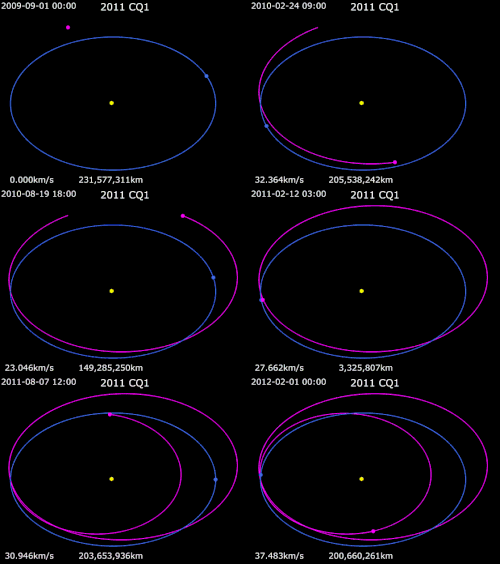
Around the Sun
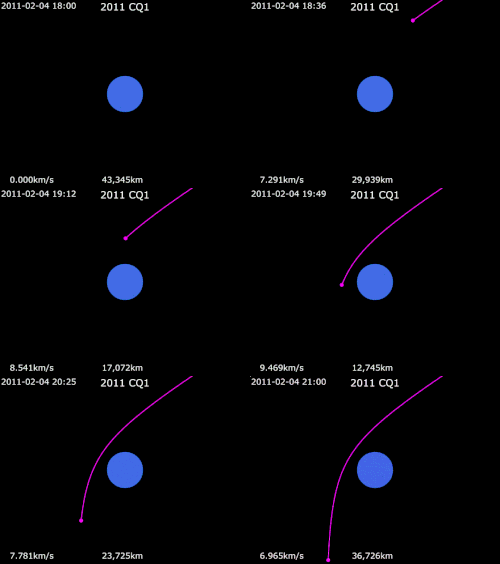
Around the Earth
Sun · 2011 CQ1 · Earth
See also
See also
| Asteroid | Date | Distance from surface of Earth |
Uncertainty in approach distance |
Observation arc | Reference |
|---|---|---|---|---|---|
| 2025 UC11 | 2025-10-30 12:11 | 237 km | ±11 km | 1 day (41 obs) | data |
| 2020 VT4 | 2020-11-13 17:21 | 368 km | ±11 km | 5 days (34 obs) | data |
| 2020 QG | 2020-08-16 04:09 | 2939 km | ±11 km | 2 days (35 obs) | data |
| 2021 UA1 | 2021-10-25 03:07 | 3049 km | ±10 km | 1 day (22 obs) | data |
| 2023 BU | 2023-01-27 00:29 | 3589 km | ±<1 km | 10 days (231 obs) | data |
| 2011 CQ1 | 2011-02-04 19:39 | 5474 km | ±5 km | 1 day (35 obs) | data |
| 2019 UN13 | 2019-10-31 14:45 | 6235 km | ±189 km | 1 day (16 obs) | data |
| 2008 TS26 | 2008-10-09 03:30 | 6260 km | ±970 km | 1 day (19 obs) | data |
| 2004 FU162 | 2004-03-31 15:35 | 6535 km | ±13000 km | 1 day (4 obs) | data |
References
References
- "MPEC 2011-C12 : 2011 CQ1". IAU Minor Planet Center. 4 February 2011. Retrieved 27 February 2013. (K11C01Q)
- "JPL Close-Approach Data: (2011 CQ1)" (last observation: 2011-02-04; arc: 1 day). Archived from the original on 28 June 2021. Retrieved 31 March 2016.
- "2011 CQ1". Minor Planet Center. Retrieved 21 August 2020.
- "2011 CQ1 Ephemerides for 4 February 2011". NEODyS (Near Earth Objects – Dynamic Site). Retrieved 28 February 2013.
- Don Yeomans & Paul Chodas (4 February 2011). "Very Small Asteroid Makes Close Earth Approach on 4 February 2011". News. NASA/JPL Near-Earth Object Program Office. Archived from the original on 2 September 2011. Retrieved 18 September 2011.
- "Date/Time Removed". NASA/JPL Near-Earth Object Program Office. Archived from the original on 2 June 2002. Retrieved 19 March 2012.
External links
External links
- Tiny Asteroid Zips Close By Earth space.com 6 February 2011
- Asteroid makes sharpest turn yet seen in solar system New Scientist 9 February 2011
- Asteroid's Record-Breaking Brush with Earth Changed It Forever Space.com 23 February 2011
- 2011 CQ1 at NeoDyS-2, Near Earth Objects—Dynamic Site
- 2011 CQ1 at ESA–space situational awareness
- 2011 CQ1 at the JPL Small-Body Database