| |||
| Names | |||
|---|---|---|---|
| Preferred IUPAC name
2-Nitropropane | |||
| Identifiers | |||
| |||
3D model (JSmol)
|
|||
| Abbreviations | 2-NP INP i-PrNO2 iPrNO2 iPrNO2 | ||
| ChEBI | |||
| ChemSpider | |||
| ECHA InfoCard | 100.001.100 | ||
| EC Number |
| ||
PubChem CID
|
|||
| UNII | |||
CompTox Dashboard (EPA)
|
|||
| |||
| |||
| Properties | |||
| C3H7NO2 | |||
| Molar mass | 89.094 g·mol−1 | ||
| Appearance | Colorless liquid1 | ||
| Odor | Pleasant, fruity2 | ||
| Density | 0.9821 g/cm3 | ||
| Melting point | −91.3 °C (−132.3 °F; 181.8 K) | ||
| Boiling point | 120.2 °C (248.4 °F; 393.3 K) | ||
| 17 g/L1 | |||
| Solubility | soluble in chloroform | ||
| log P | 0.93 | ||
| Vapor pressure | 13 mmHg (20°C)2 | ||
| Acidity (pKa) | 16.9 (in DMSO) | ||
| −45.73·10−6 cm3/mol | |||
Refractive index (nD)
|
1.3944 (20 °C) | ||
| Viscosity | 0.721 cP | ||
| Hazards | |||
| Occupational safety and health (OHS/OSH): | |||
Main hazards
|
Health hazard | ||
| GHS labelling: | |||
  
| |||
| H226, H302, H332, H350 | |||
| P203, P210, P233, P240, P241, P242, P243, P261, P264, P270, P271, P280, P301+P317, P303+P361+P353, P304+P340, P317, P318, P330, P370+P378, P403+P235, P405, P501 | |||
| NFPA 704 (fire diamond) | |||
| Flash point | 24 °C (75 °F; 297 K) (open cup) 39 °C (closed cup) | ||
| 428 °C (802 °F; 701 K) | |||
| Explosive limits | 2.6–11.0%2 | ||
| Lethal dose or concentration (LD, LC): | |||
LD50 (median dose)
|
720 mg/kg | ||
LC50 (median concentration)
|
2703 ppm (mouse, 2 hr) 400 ppm (rat, 6 hr)3 | ||
LCLo (lowest published)
|
714 ppm (cat, 5 hr) 2381 ppm (rabbit, 5 hr) 4622 ppm (guinea pig, 5 hr) 2353 ppm (cat, 1 hr)3 | ||
| NIOSH (US health exposure limits): | |||
PEL (Permissible)
|
TWA 25 ppm (90 mg/m3)2 | ||
REL (Recommended)
|
Ca2 | ||
IDLH (Immediate danger)
|
Ca [100 ppm]2 | ||
Except where otherwise noted, data are given for materials in their standard state (at 25 °C [77 °F], 100 kPa).
| |||

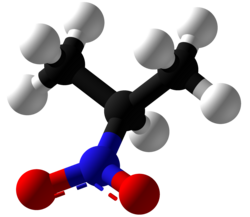


2-Nitropropane (2-NP) is an organic compound with the formula (CH3)2CH(NO2). It is used as a solvent.4 It is a colorless liquid and is classified as a nitro compound.
Preparation
2-Nitropropane is produced by the high-temperature vapor-phase nitration of propane, usually with impurities of 1-nitropropane. 2-Nitropropane is also produced as a volatile by-product that can be captured during Leonard's ring-closure hydantoin preparation.5
Uses
2-Nitropropane is used as a solvent or additive in inks, paints, adhesives, varnishes, polymers, resins, fuel, and coatings.6 It is also used as a feedstock for other industrial chemicals,6 and also in the synthesis of pharmaceuticals such as phentermine, chlorphentermine, and teclozan. It serves as an oxidant in the Hass–Bender oxidation process.
Safety
2-Nitropropane is a constituent of tobacco smoke.7 Based on studies in animals, it is reasonably anticipated to be a human carcinogen6 and it is listed as an IARC Group 2B carcinogen.8
References
References
- Record in the GESTIS Substance Database of the Institute for Occupational Safety and Health
- NIOSH Pocket Guide to Chemical Hazards. "#0460". National Institute for Occupational Safety and Health (NIOSH).
- "2-Nitropropane". Immediately Dangerous to Life or Health Concentrations. National Institute for Occupational Safety and Health.
- Markofsky, S. B. (2000). "Nitro Compounds, Aliphatic". Ullmann's Encyclopedia of Industrial Chemistry. Weinheim: Wiley-VCH. doi:10.1002/14356007.a17_401.pub2. ISBN 978-3527306732.
- M. J. Leonard; A. R. Lingham; J. O. Niere; N. R. C. Jackson; P. G. McKay; H. M. Hϋgel (6 Mar 2014). "Alternative synthesis of the anti-baldness compound RU58841" (PDF). RSC Advances. 4 (27): 14143–14148. Bibcode:2014RSCAd...414143L. doi:10.1039/c4ra00332b. S2CID 55586351.
- "2-Nitropropane". Report on Carcinogens (PDF) (Report) (Twelfth ed.). National Toxicology Program, Department of Health and Human Services. 2011. p. 300. Archived from the original (PDF) on 2012-01-20. Retrieved 2012-06-13.
- Talhout, Reinskje; Schulz, Thomas; Florek, Ewa; Van Benthem, Jan; Wester, Piet; Opperhuizen, Antoon (2011). "Hazardous Compounds in Tobacco Smoke". International Journal of Environmental Research and Public Health. 8 (12): 613–628. doi:10.3390/ijerph8020613. ISSN 1660-4601. PMC 3084482. PMID 21556207.
- "Agents Classified by the IARC Monographs" (PDF). Archived from the original (PDF) on 2011-10-25. Retrieved 2012-06-13.