 | |
 | |
| Clinical data | |
|---|---|
| Other names | 2-MT; 2-Me-T; 2-Methyl-T |
| Drug class | Serotonin receptor agonist |
| ATC code |
|
| Identifiers | |
| |
| CAS Number | |
| PubChem CID | |
| ChemSpider | |
| ChEMBL | |
| CompTox Dashboard (EPA) | |
| ECHA InfoCard | 100.018.498 |
| Chemical and physical data | |
| Formula | C11H14N2 |
| Molar mass | 174.247 g·mol−1 |
| 3D model (JSmol) | |
| |
| |
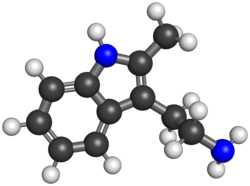
2-Methyltryptamine (2-MT, 2-Me-T, or 2-methyl-T) is a serotonin receptor agonist of the tryptamine family.123 It shows dramatically reduced activity at serotonin receptors compared to tryptamine23 and mixed effects in terms of psychedelic-like effects in animals.13
Pharmacology
Pharmacodynamics
2-MT shows affinity (Ki) for the serotonin 5-HT1A and 5-HT2A receptors, with Ki values of 1,095 nM and 7,774 nM, respectively.23 These affinities were respectively 34-fold and 3.2-fold lower than those of tryptamine in the same study.23 It also acts as an agonist of the serotonin 5-HT1A and 5-HT2A receptors, with EC50Tooltip half-maximal effective concentration values of 12,534 nM and 4,598 nM, respectively.3 These activational potencies were respectively 14-fold and 19-fold lower than those of tryptamine in the same study.3
It does not produce conditioned place preference (CPP), self-administration, or changes in locomotor activity in rodents.1 Findings on whether 2-MT produces the head-twitch response (HTR), a behavioral proxy of psychedelic effects, are mixed.132 In one study, it produced the HTR at a dose of 3 mg/kg intraperitoneally, and this was completely blocked by the serotonin 5-HT2A receptor antagonist ketanserin.1 In another study, both tryptamine and 2-MT did not produce the HTR at a dose of 3 mg/kg intraperitoneally.32
Chemistry
Derivatives
A number of derivatives of 2-MT are known, including:4
- 2,α-Dimethyltryptamine (2,α-DMT or 2-Me-αMT)
- 2,N,N-Trimethyltryptamine (2,N,N-TMT or 2-Me-DMT)
- 2-Methyl-N,N-diethyltryptamine (2-Me-DET)
- 5-Methoxy-2,N,N-trimethyltryptamine (5-MeO-2,N,N-TMT or 2-Me-5-MeO-DMT)
These drugs were synthesized and tested by Alexander Shulgin.4 He found that the drugs in this group became orally active but generally produced no or only mild psychedelic effects (with the exception of 2-Me-5-MeO-DMT).4 Instead, they caused effects like tactile enhancement and auditory distortion, among others.4
A few other derivatives, including 2-methyl-DiPT, 2-methyl-iPALT, 2-methyl-5-MeO-DALT, and 2-methyl-5-F-DALT, are also known.456
Further derivatives of 2-MT include the following:
- 2-Methyl-5-HT (a moderately selective serotonin 5-HT3 receptor full agonist)
- 2-Methyl-5-chloro-DMT (ST-1936; a selective serotonin 5-HT6 receptor agonist)
- 2-Ethyl-5-methoxy-DMT (EMDT; a selective serotonin 5-HT6 receptor agonist)
EMD-386088 (2-methyl-5-chloro-3-(1,2,3,6-tetrahydropyridin-4-yl)-1H-indole) isn't technically a tryptamine but is very similar and is a serotonin 5-HT6 receptor partial agonist as well as having moderate affinity for the serotonin 5-HT3 receptor and acting as a dopamine reuptake inhibitor.
Yet another related compound is 2-HO-NMT, a tryptamine alkaloid.
References
References
- Abiero A, Ryu IS, Botanas CJ, Custodio RJ, Sayson LV, Kim M, et al. (January 2020). "Four Novel Synthetic Tryptamine Analogs Induce Head-Twitch Responses and Increase 5-HTR2a in the Prefrontal Cortex in Mice". Biomolecules & Therapeutics. 28 (1): 83–91. doi:10.4062/biomolther.2019.049. PMC 6939696. PMID 31230432.
- Chen X, Li J, Yu L, Maule F, Chang L, Gallant JA, et al. (October 2023). "A cane toad (Rhinella marina) N-methyltransferase converts primary indolethylamines to tertiary psychedelic amines". The Journal of Biological Chemistry. 299 (10) 105231. doi:10.1016/j.jbc.2023.105231. PMC 10570959. PMID 37690691.
- Chen X, Li J, Yu L, Dhananjaya D, Maule F, Cook S, et al. (10 March 2023), Bioproduction platform using a novel cane toad (Rhinella marina) N-methyltransferase for psychedelic-inspired drug discovery (PDF), doi:10.21203/rs.3.rs-2667175/v1, retrieved 17 March 2025
- Shulgin A, Shulgin A (September 1997). TiHKAL: The Continuation. Berkeley, California: Transform Press. ISBN 0-9630096-9-9. OCLC 38503252.
- Klein LM, Cozzi NV, Daley PF, Brandt SD, Halberstadt AL (November 2018). "Receptor binding profiles and behavioral pharmacology of ring-substituted N,N-diallyltryptamine analogs". Neuropharmacology. 142: 231–239. doi:10.1016/j.neuropharm.2018.02.028. PMC 6230509. PMID 29499272.
- US 20240277665A1, Daley PF, Cozzi NV, Callaway WB, "Asymmetric allyl tryptamines", issued 4 March 2024, assigned to Alexander Shulgin Research Institute Inc.