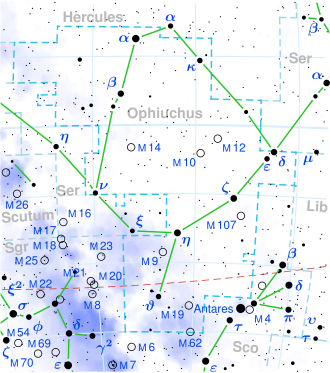
  | |
| Observation data Epoch J2000 Equinox J2000 | |
|---|---|
| Constellation | Ophiuchus |
| Right ascension | 16h 36m 21.44969s1 |
| Declination | −02° 19′ 28.5130″1 |
| Apparent magnitude (V) | 5.772 |
| Characteristics | |
| Spectral type | K1 V3 |
| U−B color index | +0.50 |
| B−V color index | +.82 |
| Variable type | BY Draconis |
| Astrometry | |
| Radial velocity (Rv) | −13.11±0.121 km/s |
| Proper motion (μ) | RA: +456.058 mas/yr1 Dec.: −309.224 mas/yr1 |
| Parallax (π) | 101.0719±0.0501 mas1 |
| Distance | 32.27 ± 0.02 ly (9.894 ± 0.005 pc) |
| Absolute magnitude (MV) | 5.57 ± 0.052 |
| Details | |
| Mass | 0.910±0.0074 M☉ |
| Radius | 0.770±0.0124 R☉ |
| Luminosity | 0.457±0.0084 L☉ |
| Surface gravity (log g) | 4.62±0.024 cgs |
| Temperature | 5,248±105 K |
| Metallicity | 102% Sun6 |
| Metallicity [Fe/H] | +0.03±0.014 dex |
| Rotation | 21.3 days7 |
| Rotational velocity (v sin i) | 2.4±1.02 km/s |
| Age | 1.0–1.98 Gyr |
| Other designations | |
| 12 Oph, V2133 Oph, BD−01 3220, BD−02 4211, FK5 1433, GJ 631, HD 149661, HIP 81300, HR 6171, SAO 141269, LHS 3224, LTT 6632, PLX 37739 | |
| Database references | |
| SIMBAD | data |
| ARICNS | data |
12 Ophiuchi is a variable star 32.3 light-years away in the constellation Ophiuchus. No companions have yet been detected in orbit around this star, and it remains uncertain whether or not it possesses a dust ring.10
This star is categorized as a BY Draconis variable, with variable star designation V2133. The variability is attributed to large-scale magnetic activity on the chromosphere (in the form of starspots) combined with a rotational period that moved the active regions into (and out of) the line of sight. This results in low amplitude variability of 12 Ophiuchi's luminosity. The star also appears to display rapid variation in luminosity, possibly due to changes in the starspots.11 Measurements of the long-term variability show two overlapping cycles of starspot activity (compared to the Sun's single, 11-year cycle.) The periods of these two cycles are 4.0 and 17.4 years.12
This star was among the top 100 target stars for NASA's canceled Terrestrial Planet Finder mission.13
Its abundance of heavy elements (elements heavier than helium) is nearly identical to that of the Sun. The surface gravity is equal to , which is somewhat higher than the Sun's.6 The space velocity is 30 km/s relative to the Solar System. The high rotation period and active chromosphere are indicative of a relatively young star.1415
References
References
- Vallenari, A.; et al. (Gaia collaboration) (2023). "Gaia Data Release 3. Summary of the content and survey properties". Astronomy and Astrophysics. 674: A1. arXiv:2208.00211. Bibcode:2023A&A...674A...1G. doi:10.1051/0004-6361/202243940. S2CID 244398875. Gaia DR3 record for this source at VizieR.
- Fuhrmann, Klaus (February 2008). "Nearby stars of the Galactic disc and halo - IV". Monthly Notices of the Royal Astronomical Society. 384 (1): 173–224. Bibcode:2008MNRAS.384..173F. doi:10.1111/j.1365-2966.2007.12671.x.
- Houk, N.; Swift, C. (1999). "Michigan Catalogue of Two-dimensional Spectral Types for the HD Stars". Michigan Spectral Survey. 5. Bibcode:1999MSS...C05....0H.
- Soubiran, C.; Creevey, O. L.; Lagarde, N.; Brouillet, N.; Jofré, P.; Casamiquela, L.; Heiter, U.; Aguilera-Gómez, C.; Vitali, S.; Worley, C.; de Brito Silva, D. (2024-02-01). "Gaia FGK benchmark stars: Fundamental Teff and log g of the third version". Astronomy and Astrophysics. 682: A145. Bibcode:2024A&A...682A.145S. doi:10.1051/0004-6361/202347136. ISSN 0004-6361.
- Rathsam, Anne; Meléndez, Jorge; Carvalho Silva, Gabriela (2023-09-01). "Lithium depletion in solar analogs: age and mass effects". Monthly Notices of the Royal Astronomical Society. 525 (3): 4642–4656. arXiv:2309.00471. Bibcode:2023MNRAS.525.4642R. doi:10.1093/mnras/stad2589. ISSN 0035-8711.
- Flynn, C.; Morel, O. (1997). "Metallicities and kinematics of G and K dwarfs". Monthly Notices of the Royal Astronomical Society. 286 (3): 617–625. arXiv:astro-ph/9609017. Bibcode:1997MNRAS.286..617F. doi:10.1093/mnras/286.3.617. S2CID 15818154.
- Soon, Willie; Frick, Peter; Baliunas, Sallie (1999). "Lifetime of Surface Features and Stellar Rotation: A Wavelet Time-Frequency Approach". The Astrophysical Journal. 510 (2): L135–L138. arXiv:astro-ph/9811114. Bibcode:1999ApJ...510L.135S. doi:10.1086/311805. S2CID 9517804.
- Mamajek, Eric E.; Hillenbrand, Lynne A. (November 2008). "Improved Age Estimation for Solar-Type Dwarfs Using Activity-Rotation Diagnostics". The Astrophysical Journal. 687 (2): 1264–1293. arXiv:0807.1686. Bibcode:2008ApJ...687.1264M. doi:10.1086/591785. S2CID 27151456.
- "* 12 Oph". SIMBAD. Centre de données astronomiques de Strasbourg. Retrieved 25 March 2025.
- H. J. Habing; P. Bouchet; C. Dominik; T. Encrenaz; A. Heske; M. Jourdain de Muizon; et al. (1996). "First results from a photometric infrared survey for Vega-like disks around nearby main-sequence stars". Astronomy and Astrophysics. 315: L233–L236. Bibcode:1996A&A...315L.233H.
- J. D. Dorren; E. F. Guinan; E. F. (1982). "Evidence for starspots on single solar-like stars". Astronomical Journal. 87: 1546–1557. Bibcode:1982AJ.....87.1546D. doi:10.1086/113245.
- "H-K Project: Activity Cycles". Mount Wilson Observatory. Archived from the original on 2007-02-09. Retrieved 2006-12-04.
- "V2133 / 12 Ophiuchi". SolStation. Archived from the original on 30 September 2023. Retrieved 2006-12-01.
- H. J. Rocha-Pinto; B. V. Castilho; W. J. Maciel (2002). "Chromospherically young, kinematically old stars". Astronomy & Astrophysics. 384 (3): 912–924. arXiv:astro-ph/0112452. Bibcode:2002A&A...384..912R. doi:10.1051/0004-6361:20011815. S2CID 16982360.
- G. F. Porto de Mello; E. F. del Peloso; L. Ghezzi (2006). "Astrobiologically interesting stars within 10 parsecs of the Sun". Astrobiology. 6 (2): 308–331. arXiv:astro-ph/0511180. Bibcode:2006AsBio...6..308P. doi:10.1089/ast.2006.6.308. PMID 16689649. S2CID 119459291.