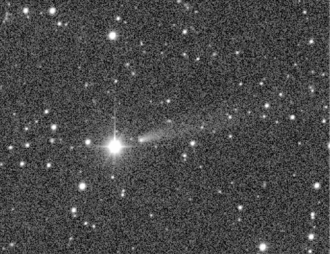
 Comet 125P/Spacewatch photographed from the Zwicky Transient Facility on 3 June 2024 | |
| Discovery1 | |
|---|---|
| Discovered by | Spacewatch Tom Gehrels |
| Discovery site | Kitt Peak Observatory |
| Discovery date | 8 September 1991 |
| Designations | |
| P/1991 R2, P/1996 F1 | |
| 1990 XXIX, 1991x | |
| Orbital characteristics34 | |
| Epoch | 11 August 2015 (JD 2457245.5) |
| Observation arc | 33.12 years |
| Number of observations | 1,297 |
| Aphelion | 4.728 AU |
| Perihelion | 1.523 AU |
| Semi-major axis | 3.126 AU |
| Eccentricity | 0.51269 |
| Orbital period | 5.526 years |
| Inclination | 9.988° |
| 153.19° | |
| Argument of periapsis | 87.145° |
| Mean anomaly | 161.39° |
| Last perihelion | 7 March 2024 |
| Next perihelion | 15 September 20292 |
| TJupiter | 2.975 |
| Earth MOID | 0.554 AU |
| Jupiter MOID | 0.810 AU |
| Physical characteristics3 | |
Mean radius | 0.83 km (0.52 mi)5 |
| Comet total magnitude (M1) | 12.9 |
| Comet nuclear magnitude (M2) | 16.7 |
125P/Spacewatch is a Jupiter-family comet with a 5.53-year orbit around the Sun. It was discovered on 8 September 1991 by Tom Gehrels using the 0.91 m Spacewatch telescope at the Kitt Peak National Observatory.6 It was the first comet discovered with the use of a CCD,7 and also the faintest comet upon discovery up to that point.6 Its nucleus has a diameter of 1.66 km (1.03 mi).5
Observational history
The comet was discovered in images taken by the 0.91 m Spacewatch telescope at the Kitt Peak National Observatory by Tom Gehrels on September 8, 1991, as an essentially stellar object with an apparent magnitude of 21, with a tail more than 5 arcminutes long.1 Brian G. Marsden calculated a parabolic and an elliptical orbit, with the elliptical orbit suggesting an orbital period of 5.58 years and a perihelion date on 18 December 1990.8
The comet was recovered on 21 March 1996 by the Spacewatch telescope from James V. Scotti and J. Montani, with an apparent magnitude of 17.6, a tail measuring 0.66 arcminutes long and a coma measuring 15 arcseconds across. The orbit calculated after the recovery indicates an orbital period of 5.56 years.9 During that apparition the comet experienced an outburst in late July 1996 and brightened to a magnitude of 14.5.6 During the 2002 apparition the comet brightened to a magnitude of 18.6
References
References
- J. V. Scotti; T. Gehrels (10 September 1991). B. G. Marsden (ed.). "Comet Spacewatch (1991x)". IAU Circular. 5341 (1). Bibcode:1991IAUC.5341....1S. ISSN 0081-0304.
- "Horizons Batch for 125P/Spacewatch (90001031) on 2029-Sep-15" (Perihelion occurs when rdot flips from negative to positive). JPL Horizons. Retrieved 16 April 2026. (JPL#58 Soln.date: 2024-Oct-29)
- "125P/Spacewatch – JPL Small-Body Database Lookup". ssd.jpl.nasa.gov. Jet Propulsion Laboratory. Retrieved 2 June 2013.
- "125P/Spacewatch Orbit". Minor Planet Center. Retrieved 17 June 2014.
- G. Tancredi; J. A. Fernández; H. Rickman; J. Licandro (2006). "Nuclear magnitudes and the size distribution of Jupiter family comets". Icarus. 182 (2): 527–549. Bibcode:2006Icar..182..527T. doi:10.1016/j.icarus.2006.01.007.
- G. W. Kronk. "125P/Spacewatch". Cometography.com. Retrieved 2 June 2013.
- "SPACEWATCH® News and History". spacewatch.lpl.arizona.edu. Retrieved 11 August 2024.
- J. V. Scotti; T. Gehrels (12 September 1991). B. G. Marsden (ed.). "Comet Spacewatch (1991x)". IAU Circular. 5343 (1). Bibcode:1991IAUC.5343....1S. ISSN 0081-0304.
- J. V. Scotti; J. Montani; S. Nakano (22 March 1996). B. G. Marsden (ed.). "Comet P/1996 F1 (Spacewatch)". IAU Circular. 6349 (1). Bibcode:1996IAUC.6349....1S. ISSN 0081-0304.
External links
External links
- 125P/Spacewatch at the JPL Small-Body Database
- 125P/Spacewatch at Gary W. Kronk's Cometography
- 125P/Spacewatch at Seiichi Yoshida's website