| Zupaysaurus | |
|---|---|
| |
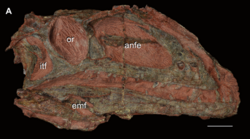
| The skull of Zupaysaurus as seen in right lateral view | |
Scientific classification 
| |
| Kingdom: | Animalia |
| Phylum: | Chordata |
| Class: | Reptilia |
| Clade: | Dinosauria |
| Clade: | Saurischia |
| Clade: | Theropoda |
| Clade: | Neotheropoda |
| Genus: | †Zupaysaurus Arcucci & Coria 2003 |
| Species: | †Z. rougieri
|
| Binomial name | |
| †Zupaysaurus rougieri Arcucci & Coria 2003
| |
Zupaysaurus (/ˌzuːpeɪˈsɔːrəs/; "ZOO-pay-SAWR-us") is an extinct genus of early theropod dinosaur which lived during the Norian stage of the Late Triassic in what is now Argentina. Fossils of the dinosaur were found in the Los Colorados Formation of the Ischigualasto-Villa Unión Basin in northwestern Argentina.
Although a full skeleton has not yet been discovered, Zupaysaurus can be considered a bipedal predator, up to 4 metres (13 ft) long. Originally described as having a pair of tall narrow crests on its skull,1 a later study argued that the "crests" are misplaced bones, and that Zupaysaurus probably had low ridges along the edge of its snout instead.2
Discovery
Discovered in May 1997 by Santiago Reuil ("Vultur"), part of the crew of Guillermo Rougier, it was later described by Arcucci and Coria and published in 2003. The name Zupaysaurus is composed of the Quechua word supay meaning "devil" and the Greek word sauros (σαυρος) meaning "lizard"; thus "devil lizard". In Incan mythology, supay was both the god of death and ruler of the ukhu pacha, the Incan underworld. The type species was named Z. rougieri in the honor of Guillermo Rougier, the scientist who led the expedition which discovered and collected the holotype (original specimen) PULR-076. Zupaysaurus was first described and named in the scientific journal Ameghiniana by Argentine paleontologists Andrea Arcucci and Rodolfo Coria in 2003.1 The original specimen is from the upper part of the Los Colorados Formation, at least 213 million years old (from the late Norian stage of the Late Triassic).3
Only one specimen of Zupaysaurus, the holotype, is confirmed to belong to the genus. Designated PULR-076, it consists of a nearly complete skull, the right shoulder girdle, the lower right leg and ankle, and twelve vertebrae from the neck, back, and hips. Additional material of a smaller individual found at the same site may or may not belong to Zupaysaurus.1 The skull's degree of preservation is good enough that it preserves a braincase, allowing for a reconstruction of Zupaysaurus's brain anatomy via a digital endocast.4
Description
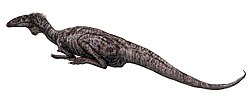
Zupaysaurus was a medium-sized theropod. An adult skull, measured approximately 450 mm (18 in) in length, suggesting a body length of approximately 4 m (13 ft) from its snout to the tip of its tail. In 2010, Gregory S. Paul estimateda length of 6 meters (20 ft) and a weight of 250 kg (550 lbs).5 In 2016 it was given a much smaller size of 4.2 meters (14 ft) and 70 kg (154 lbs).6 Like all theropods, Zupaysaurus walked only on its hindlegs, leaving its forelimbs free to grasp its prey. The length of the neck bones recovered suggests that this genus has a rather long neck.
Skull
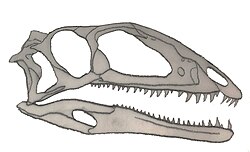
Like the coelophysoids, Zupaysaurus has a kink in its snout, between the toothed premaxillary and maxillary bones of the upper jaw. It is estimated that Zupaysaurus had 24 teeth and an intermandibular hinge in the lower jaw.1
Arcucci and Coria (2003) originally described Zupaysaurus as having two thin parallel crests on top of the skull, similar to theropods like Dilophosaurus and Coelophysis kayentakatae. These crests were thought to have been formed by the nasal bones solely, unlike those of many other theropods which also incorporated the lacrimal bones.1 Crests on the skull were pervasive among theropods and may have been used for communicative purposes such as species or gender recognition.7
However, later analysis of the skull cast doubt on the presence of crests in Zupaysaurus.2 A skull redescription by Ezcurra (2007) identified the "crests" as a displaced right nasal bone, flipped over so its underside is visible in right lateral view. Other cranial ornamentation included a rough lacrimal ridge projecting outwards from the upper edge of the skull. In their original position, the nasal bones would have formed a flat upper edge of the snout, with rough lateral ridges, continuous with the lacrimal ridges.2
A diagnosis is a statement of the anatomical features of an organism (or group) that collectively distinguish it from all other organisms. Some, but not all, of the features in a diagnosis are also autapomorphies. An autapomorphy is a distinctive anatomical feature that is unique to a given organism or group. According to Ezcurra (2007)2 and Ezcurra and Novas (2007),8 Zupaysaurus can be distinguished based on the following characteristics:
- The maxillary fenestra (a hole at the front of the maxilla) is within the antorbital fossa (a lowered surface occupying most of the maxilla)
- The rostral process (front branch) of the lacrimal is ventrally bowed (curved down).2
- The ventral process (lower branch) of the squamosal is kinked.2
- Wide contact between the squamosal and quadratojugal.
- The maxillary-jugal ventral margin (lower edge) describes an obtuse (rather than straight) angle in lateral view.82
- The horizontal ramus (rear lower branch) of the maxilla has parallel dorsal and ventral margins, giving Zupaysaurus an oval-shaped antorbital fenestra.82
- A notch on the dorsal margin of the ascending process (upper branch) of the maxilla, relating to the horizontal ramus of the lacrimal, is rostrally tapering onto the forked caudal tip of the ascending process of the maxilla.82
- The lacrimal has a highly pneumatized antorbital recess8
- The mandible (lower jaw) has a short and square-shaped retroarticular process (the portion behind the jaw joint).8
- The cnemial crest (a ridge at the front of the shin, near the knee) is poorly developed.8
Classification
Zupaysaurus was originally classified as the earliest known tetanuran theropod due to several features of its skull, dentition, and hindlimb. However, several features typical of more basal theropods were also noted by the original authors.1 Analyses by Carano (2005), Tykoski (2005), and Ezcurra and Novas (2005) have classified Zupaysaurus as a coelophysoid related to Segisaurus and probably Liliensternus, though more basal than Coelophysis.91011 Yates (2006) found Zupaysaurus to form a group with Dilophosaurus and Dracovenator, placing it in a monophyletic Dilophosauridae.12 But later studies found Zupaysaurus to be a sister taxon sister to a clade containing dilophosaurids, ceratosaurs and tetanurans.1314
Below is a cladogram based on the phylogenetic analysis conducted by Sues et al. in 2011, showing the relationships of Zupaysaurus:15
| Theropoda |
| ||||||||||||||||||||||||||||||||||||||||||||||||||||||
Paleoecology
Zupaysaurus was discovered in red siliciclastic sediments at the "Quebrada de los Jachaleros" locality within the Los Colorados Formation of the La Rioja province in Argentina. This formation has been shown by magnetostratigraphy to date to the Norian stage of the Late Triassic period, approximately 228 to 208 million years ago.16 A 1998 study assigned it to the slightly younger Rhaetian stage, which was approximately 208 to 201 million years ago.17 More precise dating estimates constrain the Los Colorados Formation between 227 and 213 million years ago, with Zupaysaurus and its contemporary fauna in the upper part of the formation.3 Both specimens assigned to this genus are housed in the collection of the National University of La Rioja in La Rioja, Argentina.1
The Los Colorados Formation was interpreted as an ancient floodplain and it was home to several types of early sauropodomorph dinosaurs (including Riojasaurus, Coloradisaurus, and Lessemsaurus), all of which shared the same paleoenvironment with Zupaysaurus.16 It is recognized as one of the earliest known faunal assemblages dominated by dinosaurs, which were 43% of the number of tetrapod species currently known. The non-dinosaurs that inhabited this locality included pseudosuchians, therapsids like Cynodontia, other early reptiles, and possible archosaurs.
References
References
- Arcucci, A.B. & Coria R.A. 2003. A new Triassic carnivorous dinosaur from Argentina. Ameghiniana 40(2):217-228.
- Ezcurra, Martín D. (2007). "The cranial anatomy of the coelophysoid theropod Zupaysaurus rougieri from the Upper Triassic of Argentina". Historical Biology. 19 (2): 185–202. doi:10.1080/08912960600861467. ISSN 0891-2963.
- Kent, Dennis V.; Santi Malnis, Paula; Colombi, Carina E.; Alcober, Oscar A.; Martínez, Ricardo N. (2014-06-03). "Age constraints on the dispersal of dinosaurs in the Late Triassic from magnetochronology of the Los Colorados Formation (Argentina)". Proceedings of the National Academy of Sciences. 111 (22): 7958–7963. doi:10.1073/pnas.1402369111. ISSN 0027-8424. PMC 4050597. PMID 24843149.
- Paulina-Carabajal, Ariana; Ezcurra, Martín D.; Novas, Fernando E. (2019). "New information on the braincase and endocranial morphology of the Late Triassic neotheropod Zupaysaurus rougieri using computed tomography data". Journal of Vertebrate Paleontology. 39 (3) e1630421. doi:10.1080/02724634.2019.1630421. ISSN 0272-4634.
- Paul, Gregory S. (2010). The Princeton Field Guide to Dinosaurs. New Jersey: Princeton University Press. pp. 75.
- Molina-Pérez & Larramendi (2016). Récords y curiosidades de los dinosaurios Terópodos y otros dinosauromorfos. Spain: Larousse. p. 253.
- Currie, P.J. & Zhao X. 1993. A new carnosaur (Dinosauria, Theropoda) from the Jurassic of Xinjiang, People's Republic of China. Canadian Journal of Earth Sciences 30: 2037-2081.
- Ezcurra, Martin D.; Novas, Fernando E. (2007). "Phylogenetic relationships of the Triassic theropod Zupaysaurus rougieri from NW Argentina". Historical Biology. 19 (1): 35–72. doi:10.1080/08912960600845791. ISSN 0891-2963.
- Ezcurra, M.D. & Novas, F.E. 2005. Phylogenetic relationships of the Triassic theropod Zupaysaurus rougieri from NW Argentina. Presented in August 2005 during the II Latin American Congress of Vertebrate Paleontology Archived May 4, 2006, at the Wayback Machine in Rio de Janeiro, Brazil. This analysis will be published in peer-reviewed print form later in 2006. A summary of the talk can be seen here.
- Carrano, M.T., Hutchinson, J.R., & Sampson, S.D. 2005. New information on Segisaurus halli, a small theropod dinosaur from the Early Jurassic of Arizona. Journal of Vertebrate Paleontology 25(4): 835-849.
- Tykoski, 2005. Anatomy, ontogeny and phylogeny of coelophysoid theropods. PhD Dissertation. University of Texas at Austin. 553 pp.
- Yates, A.M., 2006 (for 2005). "A new theropod dinosaur from the Early Jurassic of South Africa and its implications for the early evolution of theropods." Palaeontologia Africana, 41: 105-122.
- Smith N.D., Makovicky P. J., Hammer W. R. & Currie P. J. 2007 Osteology of Cryolophosaurus ellioti (Dinosauria: Theropoda) from the Early Jurassic of Antarctica and implications for early theropod evolution. Zool. J. Linn. Soc. 151, 377–421.
- Nesbitt, S. J., Smith, N. D., Irmis, R. B., Turner, A. H., Downs, A., & M. A. Norell. 2009. A complete skeleton of a Late Triassic saurischian and the early evolution of dinosaurs. Science 326:1530-1533.
- Hans-Dieter Sues, Sterling J. Nesbitt, David S. Berman and Amy C. Henrici (2011). "A late-surviving basal theropod dinosaur from the latest Triassic of North America". Proceedings of the Royal Society B 278 (1723): 3459–3464
- Weishampel, D.B., Barrett, P.M., Coria, R.A., Le Loueff, J., Xu X., Zhao X., Sahni, A., Gomani, E.M.P., & Noto, C.R. 2004. Dinosaur distribution. In: Weishampel, D.B., Dodson, P., & Osmólska, H. (Eds.). The Dinosauria (2nd Edition). Berkeley: University of California Press. Pp. 517-606.
- Heckert, A.B. & Lucas, S.G. 1998. Global correlation of the Triassic theropod record. Gaia 15: 63-74. [not printed until 2000]