| Zulip | |
|---|---|
 | |
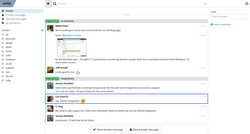 Screenshot of the Zulip web interface | |
| Original authors | Jeff Arnold, Waseem Daher, Jessica McKellar, and Tim Abbott |
| Developer | Zulip Foundation |
| Release | 2012 |
| Written in | Python, JavaScript (web frontend), React Native (iOS and Android), Electron (desktop apps) |
| Operating system | Windows, macOS, Linux, iOS, Android |
| Type | Collaborative software |
| License | Apache License 2.0 |
| Website | zulip |
| Repository | |
Zulip is an open source chat and collaborative software created by Jeff Arnold, Waseem Daher, Jessica McKellar, and Tim Abbott in 2012.12 It is one of the free and open source alternatives to Slack.3
History
In 2014, Dropbox acquired Zulip.2 The service did not receive much attention at Dropbox and the company open sourced Zulip in 2015.4 In 2016, Tim Abbott left Dropbox and established Kandra Lab to continue development of Zulip.54
In 2026, the Zulip Foundation was formed and became the steward of the project. It also became owner of Zandra Labs.6
Software overview
In Zulip, communication occurs in streams (which are like channels in IRC). Each stream can have several topics – Zulip features a unique threading model, in which each message also has a topic, along with the content. Zulip claims that this improves productivity by "making it easy to catch up after a day of meetings". Apart from this, Zulip offers standard features found in collaboration apps like message reactions, message search history, polls, private messaging, group messaging etc. Zulip streams can be private or public – only people invited to a private stream can view messages in it, while anyone within an organization can join a public stream. Messages in Zulip can be sent in plain-text or formatted using Markdown, along with images, links, and file attachments.7 Zulip also offers support for native integrations with hundreds of services, which can extend its functionality.8
Official client apps
Apart from the web interface, Zulip officially supports other clients, all of which are open sourced:
- Mobile apps for iOS and Android.
- A desktop client for Windows, macOS, and Linux.
- A terminal client for Linux, macOS, and Windows (WSL).
References
References
- "This Is What Impactful Engineering Leadership Looks Like". First Round Review. First Round Capital. 17 March 2015. Archived from the original on 2025-10-15. Retrieved 2026-02-10.
- Perez, Sarah (March 17, 2014). "Dropbox Acquires Zulip, A Stealthy Workplace Chat Solution Still In Private Beta". TechCrunch. Archived from the original on 2025-01-25. Retrieved 2026-06-04.
- Ravenscraft, Eric (September 27, 2015). "Zulip is a Free Team Chat Client From Dropbox You Can Host Yourself". Life Hacker. Archived from the original on 2025-07-02. Retrieved 2026-02-10.
- Zaveri, Paayal. "This founder sold his buzzy startup to Dropbox, but the acquisition flopped. Now, six years later, his open-source work chat app is launching new features to rival Slack". Business Insider. Retrieved 2026-06-04.
- "Zulip Responds to the Pandemic with 60-Day Free Trial". The Zulip Blog. 2020-05-27. Retrieved 2026-06-04.
- "Announcing the Zulip Foundation". The Zulip Blog. 2026-05-15. Retrieved 2026-06-04.
- "Features | Zulip". Zulip. Archived from the original on 2025-12-04. Retrieved 2026-02-10.
- "Zulip integrations". Zulip. Archived from the original on 2026-01-29. Retrieved 2026-02-10.