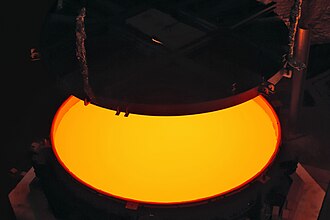
Zerodur is a lithium-aluminosilicate glass-ceramic manufactured by Schott AG. Zerodur has a near zero coefficient of thermal expansion (CTE), and is used for high-precision applications in telescope optics, microlithography machines and inertial navigation systems.
Manufacturing process
Zerodur is produced in a two-step process involving melting and ceramization. Depending on the size of the blanks, each step can take several months.2
First, raw materials including main components of lithium oxide (Li2O), alumina (Al2O3), and silica (SiO2) are melted at high temperatures of around 1600 °C, poured into molds, and annealed in a controlled cooling process that relieves internal stresses that develop during forming.34 Then the glass undergoes a ceramization process involving controlled volume crystallization, which creates high-quartz nano-crystallites of 30 nm to 50 nm.2 The negative CTE of the crystals compensates for the positive CTE of the residual glass matrix, which gives Zerodur its near zero thermal expansion.4
Applications
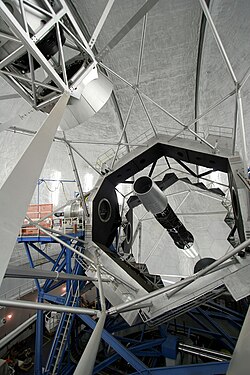
The main applications for Zerodur include telescope optics in astronomy5 and space applications,6 lithography machines for microchips and displays,7 and inertial measurements systems for navigation.89
In astronomy, it is used for mirror substrates in large telescopes such as the Hobby-Eberly Telescope,10 the Keck I and Keck II telescopes,11 the Gran Telescopio Canarias,12 the Devasthal Optical Telescope,13 the European Southern Observatory's 8.2 m Very Large Telescope,14 and the 39 m Extremely Large Telescope.15 It also has been used for the primary mirror of SOFIA's airborne telescope.16
ASA (AstroSysteme Austria) also produces some telescopes with Zerodur.17
In space, it has been used for the imager in Meteosat Earth observation satellites,18 and for the optical bench in the LISA Pathfinder mission.19
In microlithography, Zerodur is used in wafer steppers and scanner machines for precise and reproducible wafer positioning.2021 It is also used as a component in refractive optics for photolithography.22
In inertial measurement units, Zerodur is used in ring laser gyroscopes.23
Properties
Zerodur has both an amorphous (vitreous) component and a crystalline component. Its most important properties24 are:
- The material exhibits a particularly low thermal expansion, with a mean value of 0 ± 0.007×10⁻⁶ K−1 within the temperature range of 0 to 50 °C.25
- High 3D homogeneity25 with few inclusions, bubbles and internal stria.
- Hardness similar to that of borosilicate glass.
- High affinity for coatings.
- Low helium permeability.
- Non-porous.
- Good chemical stability.
- Fracture toughness approximately 0.9 MPa·m1/2.2627
Physical properties
- Dispersion: (nF − nC) = 0.00967
- Density: 2.53 g/cm3 at 25 °C
- Young's modulus: 9.1×10¹⁰ Pa
- Poisson ratio: 0.24
- Specific heat capacity at 25 °C: 0.196 cal/(g·K) = 0.82 J/(g·K)
- Coefficient of thermal expansion (20 °C to 300 °C) : 0.05 ± 0.10×10⁻⁶/K
- Thermal conductivity: at 20 °C: 1.46 W/(m·K)
- Maximum application temperature: 600 °C
- Impact resistance behavior is substantially similar to other glass28
History
Schott began developing glass-ceramics in the 1960s led by Jürgen Petzoldt, in response to demand for low expansion glass ceramics for telescopes.29
In 1966, Hans Elsässer, the founding director of the Max Planck Institute for Astronomy (MPIA), asked the company if it could produce large castings of almost 4 meters using low-expansion glass-ceramic for telescope mirror substrates. In 1969, the MPIA ordered a 3.6 m (12 ft) mirror blank, along with ten smaller mirror substrates. The mirrors were delivered by late 1975,29 and went into operation in 1984 in a telescope at the Calar Alto Observatory in Spain. Further orders for mirror blanks followed.30
References
References
- "Secondary Mirror of ELT Successfully Cast - Largest convex mirror blank ever created". www.eso.org. Retrieved 22 May 2017.
- Sokach, Stephen (July 2020). "ZERODUR: The Highly Technical Glass-Ceramic". techbriefs.com. Retrieved 13 February 2025.
- "Glass-ceramic production is fit for the future". GlassOnWeb. 23 February 2017. Archived from the original on 22 February 2025. Retrieved 13 February 2025.
- Gardopee, George J.; Shen, Da-Wun (October 1982). "Lightweight Zerodur Mirror Technology" (PDF). The Perkin-Elmer Corporation. Retrieved 13 February 2025.
- Döhring, Thorsten (May 2019). "Four decades of ZERODUR mirror substrates for astronomy". In Jiang, Wenhan; Geyl, Roland; Cho, Myung K.; Wu, Fan (eds.). 4th International Symposium on Advanced Optical Manufacturing and Testing Technologies: Large Mirrors and Telescopes. Proceedings of the SPIE. Vol. 7281. doi:10.1117/12.831423. Retrieved 10 May 2024.
- Carré, Antoine (May 2023). "Comprehensive review of the effects of ionizing radiations on the ZERODUR® glass ceramic". Journal of Astronomical Telescopes, Instruments, and Systems. 9 (2). doi:10.1117/1.JATIS.9.2.024005.
- "SCHOTT Strengthens Glass Substrate Portfolio". Printed Electronics Now. September 29, 2023.
- Sokach, Stephen (July 2020). "ZERODUR: The Highly Technical Glass-Ceramic". Tech Briefs. Retrieved 10 May 2024.
- "Zerodur". Mindrum Precision. Retrieved 10 May 2024.
- "Hobby-Eberly Telescope | McDonald Observatory". mcdonaldobservatory.org. Retrieved 2024-07-12.
- "A Mirror's Perfect Reflection". W.M. Keck Observatory. 28 May 2010. Retrieved 10 May 2024.
- "Description of the GTC". Gran Telescopio CANARIAS. Retrieved 10 May 2024.
- "3.6 m DOT Telescope". ARIES. Retrieved July 7, 2024.
- "Very Large Telescope". ESO. Retrieved 10 May 2024.
- "Mirrors and Optical Design". ESO. Retrieved 10 May 2024.
- Krabbe, Alfred (June 2000). "SOFIA telescope". In Melugin, Ramsey K.; Roeser, Hans-Peter (eds.). Airborne Telescope Systems. Proceedings of the SPIE. Vol. 4014. p. 276. arXiv:astro-ph/0004253. Bibcode:2000SPIE.4014..276K. doi:10.1117/12.389103. Retrieved 10 May 2024.
- "ASA 2.5-Meter Telescope AZ2500". Observatory Solutions. Retrieved 2025-01-08.
- "MTG (Meteosat Third Generation) - eoPortal". www.eoportal.org. Retrieved 2024-07-12.
- "LISA Technology Package Optical Bench Interferometer During Calibration". ESA. Retrieved 10 May 2024.
- Hartmann, Peter. "SCHOTT – Ultra low expansion glass ceramic ZERODUR" (PDF). Max-Planck-Institut für Astronomie. p. 49. Archived from the original (PDF) on 2024-02-26. Retrieved 10 May 2024.
- Jedamzik, Ralf (2014). "Glass ceramic ZERODUR enabling nanometer precision". In Lai, Kafai; Erdmann, Andreas (eds.). Optical Microlithography XXVII. Proceedings of the SPIE. Vol. 9052. pp. 90522I. Bibcode:2014SPIE.9052E..2IJ. doi:10.1117/12.2046352.
- Mitra, Ina (September 2022). "ZERODUR: a glass-ceramic material enabling optical technologies". Optical Materials Express. 12 (9): 3563. doi:10.1364/OME.460265. Retrieved 10 May 2024.
- Pinckney, Linda R. (2003). "Glass-Ceramics". Encyclopedia of Physical Science and Technology (Third ed.). pp. 807–816. doi:10.1016/B0-12-227410-5/00293-3. ISBN 978-0-12-227410-7. Retrieved 10 May 2024.
- "Technical Details ZERODUR®". schott.com. Retrieved 6 September 2024.
- Hartmann, Peter; Jedamzik, Ralf; Carré, Antoine; Krieg, Janina; Westerhoff, Thomas (24 March 2006). "Glass ceramic ZERODUR®: Even closer to zero thermal expansion: A review, part 2". Journal of Astronomical Telescopes, Instruments, and Systems. 7 (2). doi:10.1117/1.JATIS.7.2.020902.
- Viens, Michael J (April 1990). "Fracture Toughness and Crack Growth of Zerodur". NASA Technical Memorandum 4185. NASA. Retrieved 6 September 2024.
- Hartmann, P. (18 December 2012). "ZERODUR - Deterministic Approach for Strength Design" (PDF). Optical Engineering. 51 (12) 124002. NASA. Bibcode:2012OptEn..51l4002H. doi:10.1117/1.OE.51.12.124002. S2CID 120843972. Retrieved 11 September 2013.
- Senf, H; E Strassburger; H Rothenhausler (1997). "A study of Damage during Impact in Zerodur" (PDF). Le Journal de Physique IV. 7: C3-1015-C3-1020. doi:10.1051/jp4:19973171. Retrieved 31 August 2011.
- Pannhorst, Wolfgang (1995). "Chapter 4: Zerodur® - A Low Thermal Expansion Glass Ceramic for Optical Precision Applications". In Bach, Hans (ed.). Low Thermal Expansion Glass Ceramics. Springer. pp. 107–121. ISBN 3-540-58598-2.
- Lemke, Dietrich. Im Himmel über Heidelberg - 50 Jahre Max-Planck-Institut für Astronomie in Heidelberg (1969 – 2019) (PDF) (in German). Berlin, Heidelberg.