 A traditional Yule log made with chocolate filled with raspberry jam | |
| Alternative names | Bûche de Noël |
|---|---|
| Course | Dessert |
| Region or state | Francophone countries, especially France |
| Serving temperature | Cold |
| Main ingredients | Genoise or other sponge cake, chocolate buttercream, or other icing |
A Yule log or bûche de Noël (French pronunciation: [byʃ də nɔɛl] ⓘ) is a traditional Christmas cake, often served as a dessert, especially in France, Belgium, Luxembourg, Switzerland, Lebanon, Vietnam,1 and Quebec, Canada. Variants are also served in the United States, United Kingdom, Cambodia, Scandinavia, Portugal, Spain, and Japan.
Made of sponge cake, to resemble a miniature actual Yule log, it is a form of sweet roulade. The cake emerged in the 19th century, probably in France, before spreading to other countries.2 It is traditionally made from a genoise, generally baked in a large, shallow Swiss roll pan, iced, rolled to form a cylinder, and iced again on the outside. The most common combination is basic yellow sponge cake and chocolate buttercream, though many variations that include chocolate cake, ganache, and icings flavored with espresso or liqueurs exist.
Yule logs are often served with one end cut off and set atop the cake, or protruding from its side to resemble a chopped off branch. A bark-like texture is often produced by dragging a fork through the icing, and powdered sugar sprinkled to resemble snow.3 Other cake decorations may include actual tree branches, fresh berries, and mushrooms made of meringue or marzipan.
The name bûche de Noël originally referred to the Yule log itself, and was transferred to the dessert after that custom had fallen out of popular use. References to it as bûche de Noël or, in English, Yule Log, can be found from at least the Edwardian era (for example, F. Vine, Saleable Shop Goods (1898 and later).4
The tradition of the Yule log
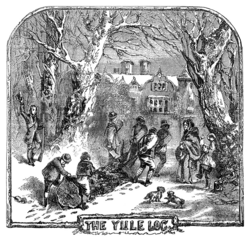
The yule log is a specially selected log burnt on a hearth as a winter tradition in regions of Europe, and subsequently North America. Other than involving a log, the exact tradition varies widely from country to country, and from region to region within a country. Differences can arise on which day the tradition happens on, how the log is to be selected, which type of wood is used, where the ritual takes place, how long the log is burned for, if prayers are said, if offerings are made, if the log is decorated, if something is done with the ashes/charcoal afterwards, or even if the log is burnt at all. In English, the ritual is most commonly referred to as the Yule log, though it was first called the Christmas log, including in its first mention in England in 1648.5 Most other languages use names which translate as "Christmas Log", "Christmas block", or "Kalends log", but there are many other variations. 56
The earliest description of ritual resembling the yule log comes from the 6th century Spanish bishop Martin of Braga in his work De correctione rusticorum.76 8
| Latin text | Translation9 |
|---|---|
|
|
This ritual being described by Martin of Braga, involving putting a log in hearth, and placing food and wine on it, is believed to be the same ritual that we call the Yule log today. The tradition of placing food and wine on the yule log before or during burning is present in descriptions of the practice made in the 20th and 21st centuries in France, Spain, Italy, Croatia, Serbia, Albania, and Montenegro.671011 The food present as part of the offering during this ritual, often sweets, may have morphed into the Yule log cake we have today. Bishop Pirmin, in his book Dicta Abbatis Pirminii, de Singulis Libris Canonicis Scarapsus,written between 710-724 CE, also quotes Martins passage. The scholars Leslie Johnstons and Alexander Tille both suggest that the origin of the yule log comes from a synthesis of Christian practices with the roman holiday of Kalendae Ianuariae in the transitional time between the late antique period and the early Middle Ages.6 12 This rituals presence in a variety of unrelated cultures could be explained by its spread through the territory of late roman empire and its successor states. France, Spain, Croatia, and Latvia also all have regional names for the yule log tradition that mention Kalends.12 Baltic countries, though not once part of the roman empire, are thought to have yule log traditions today because the ritual was introduced to the region as part of the Christianization efforts of the Northern Crusades. 13 A variety of historians and scholars have sought to link the yule logs origins to the Scandinavian holiday of Yule over the centuries, mostly drawing on symbolic similarities, archetypic similarities', and studies of modern-day folklore. Professor Ronald Hutton disagrees with the claim of a Yule origin, pointing to the fact that modern day Scandinavia has no yule log traditions, and that the Icelandic sagas make no references to special logs when taking about fire or feasting during yule.5 Historically, the yule logs first association with the holiday of Yule comes about in John Aubrey's writings between 1650 and 1687s on Christmas when he writes "a large Yule log or Christmas block".5
The first reference of the yule log in connection with Christmas comes from a German manuscript of legal obligations written in 1184 CE, where it records that the manse of Ahlen is entitled to a whole tree for a private festive fire on Christmas eve.5 12 Another early reference can be found in the text Liber statutorum civitatis Ragusii compositus anno, which was written in Dubrovnik in 1272 CE.7 It records that shipmasters and the sailors brought the count of the city a large log on Christmas eve and place it on the fire, for which they are given as reward two gold coins and alcohol.7
For several centuries, in England, it has been customary, during Christmas Eve, to burn a very large log in the hearth1415 which must burn very slowly, ideally lasting through the twelve days of the cycle (until New Year) or at least for three days. The log should preferably come from a fruit tree trunk in the south (plum, cherry, and olive) believed to ensure a good harvest for the following year, but also oak and beech in the north since acorns and beech nuts were food for humans until the end of the Middle Ages.16 When lit, the log is blessed with a branch of boxwood, or bay laurel, kept from Palm Sunday. During combustion, in some regions, the log is sprinkled with wine to ensure a good grape harvest, or with salt to protect against witches. Its embers are often kept to protect the house from lightning or the devil17 and the ashes are spread in the fields to fertilize the soil. Charcoal was also kept throughout the year and used in various remedies. Lit with embers from the previous Christmas log or from Saint John’s Eve, its ashes served as protection (and other popular beliefs) for the household until the following year.18 The Yule log once gathered all the inhabitants of the house, all the guests of the household, parents, and servants, around the family hearth. The blessing of the log with its traditional ceremonies was nothing more than the blessing of fire, at the time of year when the rigors of the season made it more useful than ever.19 This tradition is still respected in some families and various villages in Provence.

In Provençal it is said: “Hide the (old) fire, light the (new) fire; God fills us with joy.” The eldest in the family then sprinkles the wood, either with milk, honey (in memory of the delights of Eden), or wine (in memory of the vineyard cultivated by Noah at the renewal of the world). In Marseille, and throughout Provence, when carrying the Yule log, people repeat three times: “Christmas comes, all good comes.” Then the head of the family, or, in his absence, the eldest, advancing toward the log to bless it, pours wine while invoking the Holy Trinity, saying: “In the name of the Father, and of the Son, and of the Holy Spirit, Amen!”, and lights it. In Burgundy, the father ordered a child to go into a corner of the room to pray to God that the stump “give candy.” Meanwhile, small packets of sweets, candied fruits, and nuts were placed at each end of the log, which the children gathered, believing in good faith that the stump had given them. The sweets were hidden in a hole in the trunk of the log, closed with a cork, or under the log. The winemaker who could not afford to offer sweets put prunes and chestnuts instead.a In Berry, the combined strength of several men was needed to bring and set up the cosse de Nau, as it was usually a huge tree trunk intended to feed the fireplace during the three days of the Christmas festivities. The cosse de Nau had to, if possible, come from an oak free of any pruning and cut down at midnight.19 In Normandy: “At the moment when it is lit, the little children go to pray in a corner of the house so that, they are told, the stump will give them presents; and while they pray, packets of spices, sugared almonds, and candied fruits are placed at each end of this stump!”19
The different names of the Yule log
This enormous stump was called by a thousand different names depending on the regions and dialects: its common name was tréfeu, tréfouet from Latin tres foci, “three fires,” since it was to burn for three days. The cake in the shape of a Yule log was still sometimes called “coquille” or little log, in dialect, the cogneù, at the beginning of the 20th century. In Normandy, souque or chuquet. It is called tronche in Bresse. In Burgundy, suche or gobe of Christmas. In Berry, it is called “cosse de Nau”; cosse meaning “stump,” and Nau meaning “Christmas”,19 in Breton kef nedeleck, in the Vosges galenche de Noë; and also Coque de Noël (Champagne), Choque in Picard). In Argonne, Lorraine, hoche, oche, hoque, toc, mouchon (Angoumois) depending on the village. In Provençal the fire log was called chalendon or calegneaou, cacha fuec, cacha fuòc, calendau, and other names depending on the region, Soc de Nadal (in Languedoc), traditionally wood from a fruit tree. In Limousin, Còssa de Nadau, Sucha de Nadau, Tison de Nadau.20 It is also called bocque in the Ardennes, cachefioc in Roussillon, and capsau in Aquitaine.21
In Catalonia, there is the tradition of the Tió de Nadal.
From Christmas Cake to Yule Log
The old name of the cake seems rather derived from the word cognée (axe) than from the word bûche (log), although this etymology is not entirely certain. In Belgium, on Christmas night, mothers place on the bedside table of their children a cake called cougnou or coignole. It is an oblong pastry, hollowed in its upper and middle part, meant to hold a small plaster or sugar Baby Jesus. In some parts of Lorraine, similar cakes are called cognés. Finally, almost every province of France has its own Christmas cakes, named in different and sometimes unusual ways. These “Christmas cakes” were of a different kind.22
The invention of the Yule log dates back to the 19th century, although no one really knows who originated it, as the many sources contradict one another. Some mention its creation around 1834 by an apprentice pastry chef in Saint-Germain-des-Prés. Others believe that the Yule log was born in Lyon in the 1860s in the kitchen of chocolatier Félix Bonnat. Another theory leads to Pierre Lacam, former ice-cream maker to Prince Charles III of Monaco, who is said to have created it in 1898.23
In any case, the Yule log as a pastry only began to gain popularity after the Liberation, in the years 1945–1950.24
Yule logs as non-Christmas Dessert


The Yule log, at its base, was a sponge cake, spread with buttercream flavored with coffee, chocolate, Grand Marnier (etc.), then rolled up to give it the shape of a log,17 and then covered with a thin layer of buttercream using a piping bag fitted with a “railroad track” tip.
However, nowadays, there are more so-called “fantasy” Yule logs, which are no longer rolled, but made in molds, and filled not with buttercream but with fruit mousses, mascarpone creams, mousseline creams, jelly, crémeux, and many different types of biscuits.
The traditional Yule log, frozen or not, is generally decorated with various attributes (Santa Claus, axe, saw, mushrooms, elfs, etc.) made of sugar or plastic. However, top pastry chefs have mostly ended this era by decorating them simply, in order to turn them into refined entremets.25
Gallery


Notes
Notes
- On this occasion it was said: Alègre, Diéu nous alègre Cachafiô vèn. Diéu nous fague la gràci de vèire Van que vèn' !! Se sian pas mai, que fuguen pas mm ! - Cachafio See: Mireille by Frédéric Mistral chant VII.
References
References
- "Quartz--France's most popular Christmas cake lives on in the bakeries of Vietnam". www.qz.com. 17 December 2016.
- "The Food Timeline--Christmas food history". www.foodtimeline.org. Retrieved 23 December 2020.
- Claiborne, Craig, The New York Times Cookbook, Harper & Row, New York, 1961; ISBN 978-0060107901, p. 545.
- Vine, Frederick T. (1907). Saleable Shop Goods for Counter-tray and Window: (including "popular Penny Cakes") : a Practical Book for All in the Trade. Office of the Baker and Confectioner.
- Hutton, Ronald (1996). The stations of the sun: a history of the ritual year in Britain (reissued ed.). Oxford: Oxford University Press. ISBN 978-0-19-285448-3.
- Johnston, Leslie D. (1939). "The Lares and the Kalends Log". Classical Philology. 34 (4): 342–356. ISSN 0009-837X.
- Dragić, Marko (1 January 2008). "Drvo Badnjak U Kršćanskoj Tradicijskoj Kulturi". Church in the World.
- Martin, of Braga (1883). Martin von Bracara's Schrift De correctione rusticorum; zum ersten Male vollständig und in verbessertem Text herausgegeben. University of California. Christiania, Gedruckt in der Mallingschen Buchdruckerei.
- Gunnell 1995, p. 28. sfn error: no target: CITEREFGunnell1995 (help)
- Vuković, Milan T. (2004). "Божићни празници". Народни обичаји, веровања и пословице код Срба [Serbian folk customs, beliefs, and sayings] (in Serbian) (12 ed.). Belgrade: Sazvežđa. pp. 77, 81–93. ISBN 86-83699-08-0.
- OJQ LABEATET (24 December 2016). Ndezja e Buzmit natën e Krishtlindjes në Kojë të Malësisë së Madhe. Retrieved 11 May 2026 – via YouTube.
- Tille, Alexander (1899). Yule and Christmas, their place in the Germanic year. University of California Libraries. London : D. Nutt.
- Young, Francis (2025). Silence of the gods: the untold history of Europe's last pagan peoples. Cambridge, United Kingdom New York, NY, USA: Cambridge University Press. ISBN 978-1-009-58655-9.
- Noël: histoire et liturgie, coutumes et légendes, littérature et poésie. Desclée, De Brouwer, 1894.
- Au bord de la Tamise, Washington Irving, Lévy, 1863.
- Karin Ueltschi (2012). Histoire véridique du Père Noël du traîneau à la hotte. Éditions Imago. p. 87..
- « Yule logs », column “Cooking notes of Siné Mensuel”, Jean-Claude Ribaut, Siné Mensuel No. 70, page 30, December 2017.
- Maeva Destombes (13 December 2017). "Turkey, foie gras, oysters, Yule log: do you know why we eat them at Christmas?". aleteia.org..
- Origin and history of the Yule log, from “Christmas Eve in all countries” published in 1912.
- Manuel de folklore français contemporain: pt. 2. From the cradle to the grave (end) Arnold van Gennep 1946 - Popular traditions of Provence, Claude Seignolle. books
.google .fr /books?id=5uYYXgiwAUwC&pg=PA85&dq=buche+de+noel&hl=fr&ei=r3ATTe37BtGu8QOSte2ABw&sa=X&oi=book _result&ct=result&resnum=4&ved=0CDcQ6AEwAzge #v=onepage&q&f=false pages 84-87,- the Yule log in “Christmas Traditions” and Provençal-French Dictionary: followed by a French-Provençal vocabulary, J.T. Avril page 23 - Traditional rural society in Limousin: ethnography Albert Goursaud, Maurice Robert. books .google .fr /books?id=mb4k8Jj5DNIC&pg=PA471&dq=buche+de+noel&hl=fr&ei=ZHMTTZe1Ioio8QPk4MD-Bg&sa=X&oi=book _result&ct=result&resnum=9&ved=0CFEQ6AEwCDgo #v=onepage&q&f=false pages 471 and 474, “The Yule log” in “The Traditional Calendar”, Voici: la France de ce mois, Volume 2, Numbers 17 to 21, Voici Press, 1941 - Dumas, Véronique (November 2011). "La bûche de Noël". Historia (in French). p. 98. ISSN 0750-0475.
- www
.inlibroveritas .net /lire /oeuvre13815-chapitre63939 .html La nuit de Noël dans tous les pays by Alphonse Chabot, III, “The cakes” - The Little Book of Christmas. Chronicle Books. 2017. p. 30..
- Christophe Carmarans (25 December 2015). "Réveillon : la bûche de Noël, c'est pas de la tarte". RFI..
- www
.inlibroveritas .net /lire /oeuvre13815-chapitre63939 .html La nuit de Noël dans tous les pays par Alphonse Chabot, III, « Les gâteaux »
- Bibliography
- "la Bûche de Noël" in: Le Calendrier Traditionnel, Voici: la France de ce mois, vol. 2, no. 17–21, Voici Press (1941).
- Albert Goursaud, Maurice Robert, La société rurale traditionnelle en Limousin: ethnographie, pp. 471, 474
- Claude Seignolle, Traditions populaires de Provence, pp. 84-87
- Arnold van Gennep, Manuel de folklore français contemporain, pt. 2, Du berceau à la tombe (1946)
External links
External links
- Buche de Noel (via foodtimeline.org)
- Bûche de Noël in the online Culinary Heritage of Switzerland database.