| Yugh | |
|---|---|
| Sym Ket, Yug | |
| Дьуʼк Dʲuˀk | |
| Pronunciation | [dʲuʔk˥˧] |
| Native to | Russia |
| Region | Yenisei River |
| Ethnicity | 7 Yughs (2020) |
| Extinct | by 19721 2–3 nonfluent speakers (1991)23 3 (2020)4 |
Yeniseian
| |
| Language codes | |
| ISO 639-3 | yug – inclusive codeIndividual code: yuu – (deprecated) |
| Glottolog | yugh1239yugh1240 additional bibliography |
| ELP | Yug |
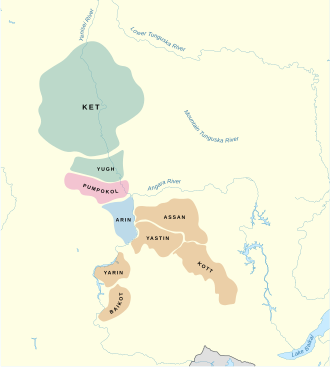 Map of pre-contact Yeniseian languages. | |
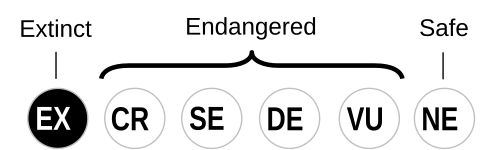 Yug is classified as Extinct by the UNESCO Atlas of the World's Languages in Danger (2010) | |
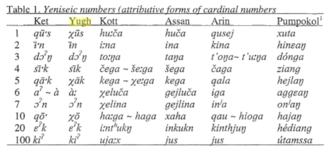
Yugh (/ˈjuːɡ/ YOOG; Yug, Yug: Дьуʼк, romanized: Dʲuˀk,5 Yug pronunciation: [dʲuʔk˥˧]) is a Yeniseian language, closely related to Ket, formerly spoken by the Yugh people, one of the southern groups along the Yenisei River in central Siberia.6 It went extinct by 1972.1 It was once regarded as a dialect of the Ket language, which was considered to be a language isolate, and was therefore called Sym Ket or Southern Ket; however, the Ket considered it to be a distinct language. By the early 1990s there were only two or three nonfluent speakers remaining,2 and the language was virtually extinct. The 2002 census recorded 19 ethnic Yugh in all of Russia.7 In the 2010 census, only one ethnic Yugh was counted, also stating their proficiency in Yugh,8 while in the 2020 census, 7 ethnic Yugh were counted,9 3 of them stating that they were speakers of Yugh.4
Phonology
Vowels
| Front | Central | Back | |
|---|---|---|---|
| Close | i [i] | ɨ [ɨ] | u [u] |
| Close-mid | e [e] | ə [ə] | o [o] |
| Open-mid | ɛ [ɛ] | ʌ [ʌ] | ɔ [ɔ] |
| Open | a [a] |
Consonants
| Labial | Alveolar | Alveolo- | Palatalized | Velar | Uvular | Laryngeal/ Pharyngeal | ||
|---|---|---|---|---|---|---|---|---|
| Plosive | voiceless | p [p] | t [t] | tʼ [tʲ] | k [k] | (q [q]) | ʔ [ʔ] | |
| voiced | b [b] | d [d] | dʼ [dʲ] | g [g] | ||||
| Fricative | voiceless | f [f] | s [s] | š [ʃ] | šʼ [ʃʲ] | χ [χ] | ||
| voiced | (v [v]) | z [z] | ž [ʒ] | žʼ [ʒʲ] | [ɣ] | (R [ʁ]) | ||
| Affricate | (c [t͡s]) | čʼ [t͡ʃ] | ||||||
| Nasal | m [m] | n [n] | nʼ [nʲ] | ŋ [ŋ] | ||||
| Trill | [r] | |||||||
| Lateral | l [l] | lʼ [lʲ] | ||||||
| Approximant | j [j] | |||||||
Notes
Notes
- Vajda, Edward (2024-02-19), "8 The Yeniseian language family", in Vajda, Edward (ed.), The Languages and Linguistics of Northern Asia, De Gruyter, pp. 365–480, doi:10.1515/9783110556216-008, ISBN 978-3-11-055621-6, retrieved 2024-06-26
- Yugh language at Ethnologue (15th ed., 2005)

- Kibrik, Aleksandr E. (March 1991). "The Problem of Endangered Languages in the USSR". Diogenes. 39 (153): 67–83. doi:10.1177/039219219103915305. ISSN 0392-1921.
- Том 5. «Национальный состав и владение языками». Таблица 7. Население наиболее многочисленных национальностей по родному языку
- Werner, Heinrich K. (2012). Vajda, Edward J. (ed.). Dictionary of the Yugh language. Languages of the World/Dictionaries. Vol. 47. Muenchen: Lincom GmbH. p. 94. ISBN 978-3862883639.
- Vajda, Edward J. "The Ket and Other Yeniseian Peoples". Archived from the original on 2019-04-06. Retrieved 2006-10-27.
- 2002 Russian census data
- 2010 Russian census data
- Том 5. «Национальный состав и владение языками». Таблица 1. Национальный состав населения
- Werner, Heinrich (1997). Das Jugische (sym-ketische) (PDF). Veröffentlichungen der societa uralo-altaica. Wiesbaden: Harrassowitz. ISBN 978-3-447-03999-4.
References
References
- Vajda, Edward J. (2002). Yeniseian Peoples and Languages: A History of Yeniseian Studies with an Annotated Bibliography and a Source Guide. Curzon Press. ISBN 0-7007-1290-9.