| Yellow tit | |
|---|---|
| |
Scientific classification 
| |
| Kingdom: | Animalia |
| Phylum: | Chordata |
| Class: | Aves |
| Order: | Passeriformes |
| Family: | Paridae |
| Genus: | Machlolophus |
| Species: | M. holsti
|
| Binomial name | |
| Machlolophus holsti (Seebohm, 1894)
| |

| |
| Synonyms2 | |
|
Parus holsti | |
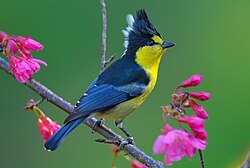
The yellow tit (Machlolophus holsti), also known as Taiwan yellow tit and Formosan yellow tit2 is a species of bird in the family Paridae. It is endemic to central Taiwan.
Its natural habitat is montane temperate forest.
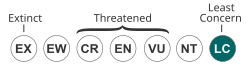
It has a small range, and while the population size is unknown but not believed to be particularly small, and its population is believed to be stable. For these reasons, it is considered Least Concern by the IUCN. Historically, the yellow tit was captured for the pet trade, but there is no evidence this has impacted its wild population.1
The yellow tit was formerly one of the many species in the genus Parus but was moved to Machlolophus after a molecular phylogenetic analysis published in 2013 showed that the members of the new genus formed a distinct clade.34
Its length is 13 cm. The yellow tit is mostly yellow, with a crest. The crest and back are blackish blue-grey.5
References
References
- BirdLife International (2023). "Machlolophus holsti". IUCN Red List of Threatened Species. 2023 e.T22711939A154683394. doi:10.2305/IUCN.UK.2023-1.RLTS.T22711939A154683394.en.
- "Parus holsti". Avibase.
- Johansson, U.S.; Ekman, J.; Bowie, R.C.K.; Halvarsson, P.; Ohlson, J.I.; Price, T.D.; Ericson, P.G.P. (2013). "A complete multilocus species phylogeny of the tits and chickadees (Aves: Paridae)". Molecular Phylogenetics and Evolution. 69 (3): 852–860. doi:10.1016/j.ympev.2013.06.019. PMID 23831453.
- Gill, Frank; Donsker, David (eds.). "Waxwings and their allies, tits & penduline tits". World Bird List Version 6.1. International Ornithologists' Union. Retrieved 15 February 2016.
- Brazil, Mark (2009). Birds of East Asia. A&C Black. p. 314. ISBN 978-0-7136-7040-0.