| XXVI Fighter Command | |
|---|---|
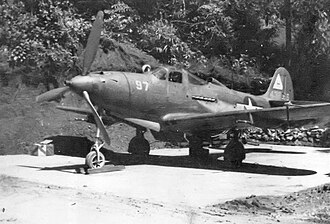 P-39Q Airacobra of the 28th Fighter Squadrona | |
| Active | 1942–1946 |
| Country |  United States United States |
| Branch |  United States Air Force United States Air Force |
| Role | Command of fighter units |
| Part of | Sixth Air Force |
| Engagements | American Theater of World War II |
The XXVI Fighter Command was a formation of the United States Army Air Forces. It was assigned to Sixth Air Force throughout its existence. It was based at Albrook Field, Panama Canal Zone, where it was inactivated on 25 August 1946. It engaged in antisubmarine operations from the Canal Zone.
History
Background
In November 1940, fighter units in the Panama Canal Zone were organized into the 12th Pursuit Wing.1 In May 1941, the 12th Wing's units began operating under the Panama Region, Caribbean Interceptor Command, which became the Panama Region, 6th Interceptor Command, when that command was activated in Puerto Rico on 25 October 1941, and Panama Interceptor Command on 12 December 1941, shortly after the attack on Pearl Harbor. In March 1942, the 12th Wing was inactivated and transferred its mission, personnel and equipment to the newly-formed 26th Interceptor Command.123
Defense of the Panama Canal
The air defense of the Panama Canal proceeded on the assumption that the greatest threat to the canal was from carrier launched low level and dive bombers attacking from the Gatun Lake or Pacific Ocean side of the canal. Its initial equipment was Bell P-39 Airacobras and Curtiss P-40 Warhawks. A decision was made locally to employ American women residing in the Canal Zone as plotters and tellers in the command's fighter information center at Albrook Field. By late 1943, the chance of an attack on the Panama Canal was seen as remote, and operations began to wind down. Most of the command's fighter groups inactivated or transferred and the remaining component squadrons were assigned directly to the command.4
The command participated in joint exercises with United States Navy surface and air forces, some of which exposed serious defects in canal defenses.5
In early 1943, the command assumed an additional role of providing advanced training for fighter pilots destined for overseas assignment. The 30th Fighter Squadron assumed the role of an operational training unit and took over the older P-40B and P-40C Warhawks. Between a quarter and a third of the pilots trained by the 30th moved on to combat assignments with other commands. In 1944, the squadron trained the 1st Brazilian Fighter Squadron, which would deploy to Italy.4
The command was inactivated on 25 August 1946 and disbanded two years later.2b
Lineage
- Constituted as 26th Interceptor Command on 28 February 1942c: Activated on 6 March 1942
- Redesignated: 26th Fighter Command on 15 May 1942
- Redesignated: XXVI Fighter Command c. 18 September 1942
- Inactivated on 25 August 1946
- Disbanded on 8 October 19482
Components
- Groups
- 16th Pursuit Group (later 16th Fighter Group), 6 March 1942 – 1 November 19436
- 32d Fighter Group, 6 March 1942 – 1 November 19437
- 37th Fighter Group,8 18 September 1942 – 1 November 1943
- 53d Pursuit Group (later 53d Fighter Group), 6 March – 26 November 19429
- Squadrons
- 16th Fighter Control Squadron, June 194310
- 24th Fighter Squadron, 1 November 1943 – 25 August 194611
- 28th Fighter Squadron, 1 November 1943 – 25 August 194612
- 29th Fighter Squadron, 1 November 1943 – 8 April 194413
- 30th Fighter Squadron, 1 November 1943 – 25 August 194614
- 31st Fighter Squadron, 1 November 1943 – 8 April 194415
- 32d Fighter Squadron, 13 March 1944 - 25 Aug 194616
- 32nd Fighter Control Squadron, June 194310
- 43d Fighter Squadron, 1 November 1943 – 25 August 194617
- 51st Fighter Squadron, 1 November 1943 – 25 August 194618
- 52d Fighter Squadron, 1 November 1943 – 8 April 1944d
- Other
- 516th Signal Aircraft Warning Regiment, June 194310
- 7th Radar Calibration Detachment, 1 August 1944 – March 194519
Stations
- Albrook Field, Panama Canal Zone, 6 March 1942 – 25 August 19462
Aircraft
- Bell P-39 Airacobra, 19424 – 1944
- Curtiss P-40 Warhawk, 19424 – 1944
- Lockheed P-38 Lightning, 19445 – 1946
Campaign
| Campaign Streamer | Campaign | Dates | Notes |
|---|---|---|---|
 |
Antisubmarine | 21 August 1942 – 2 September 1945 | 2 |
References
References
Notes
- Explanatory notes
- Airplane is Bell P-39Q-20-BE Airacobra, serial 44-3866
- In 1947 the United States Air Force became independent. The Army transferred all Air Corps units, including the command to the USAF.
- Maurer indicates that the unit was constituted as the "XXVI" Interceptor Command. However, the unit was constituted and activated with an arabic number in its name. The use of roman numerals to designate Army Air Forces combat commands did not begin until September 1942. "Air Force Historical Research Agency Organizational Reconds: Types of USAF Organizations". Air Force History Index. 9 January 2008. Retrieved 19 September 2016.
- Maurer indicates the 52d Squadron was assigned to the 32d Fighter Group during this period. However, the group was disbanded on 1 November 1943. Maurer, Combat Squadrons, p. 219. Compare Maurer, Combat Units, p. (assignment to 32d Group terminated in 1943).
- Citations
- Maurer, Combat Units, p. 381
- Maurer, Combat Units, pp. 454-455
- Hagedorn, p. 63
- Hagedorn, p. 64
- Hagedorn, p. 65
- "Factsheet 16 Special Operations Wing". Air Force Historical Research Agency. 4 January 2008. Retrieved 29 December 2021.
- Robertson, Patsy (28 April 2011). "Factsheet 32 Air Expeditionary Group (USAFE)". Air Force Historical Research Agency. Retrieved 30 December 2021.
- Maurer, pp. 454-455 (year only).
- Robertson, Patsy (7 May 2013). "Factsheet 52 Operations Group (USAFE)". Air Force Historical Research Agency. Retrieved 1 January 2022.
- Hagedorn, p. 181
- Maurer, Combat Squadrons, p. 127
- Maurer, Combat Squadrons, p. 143
- Maurer, Combat Squadrons, p. 146
- Maurer, Combat Squadrons, p. 149
- Maurer, Combat Squadrons, p. 153
- Maurer, Combat Squadrons, pp. 157-158
- Maurer, Combat Squadrons, pp. 196-197
- Maurer, Combat Squadrons, pp. 217-21
- Hagedorn, p. 100
Bibliography
This article incorporates public domain material from the Air Force Historical Research Agency
- Hagedorn, Dan (1995). Alae Supra Canalem: Wings Over the Canal. Nashville, TN: Turner Publishing. ISBN 1-56311-153-5.
- Maurer, Maurer, ed. (1983) [1961]. Air Force Combat Units of World War II (PDF) (reprint ed.). Washington, DC: Office of Air Force History. ISBN 0-912799-02-1. LCCN 61060979. Retrieved 17 December 2016.
{{cite book}}: CS1 maint: deprecated archival service (link) - Maurer, Maurer, ed. (1982) [1969]. Combat Squadrons of the Air Force, World War II (PDF) (reprint ed.). Washington, DC: Office of Air Force History. ISBN 0-405-12194-6. LCCN 70605402. OCLC 72556. Archived from the original (PDF) on 20 December 2016. Retrieved 17 December 2016.