| Xiphotheca | |
|---|---|
| |
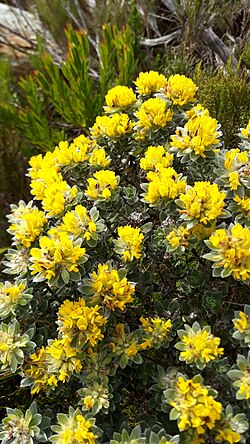
| Xiphotheca fruticosa | |
Scientific classification 
| |
| Kingdom: | Plantae |
| Clade: | Embryophytes |
| Clade: | Tracheophytes |
| Clade: | Spermatophytes |
| Clade: | Angiosperms |
| Clade: | Eudicots |
| Clade: | Rosids |
| Order: | Fabales |
| Family: | Fabaceae |
| Subfamily: | Faboideae |
| Tribe: | Podalyrieae |
| Genus: | Xiphotheca Eckl. & Zeyh. (1836) |
| Species | |
|
See text. | |

| |
Xiphotheca is endemic to the fynbos of South Africa.1
| |
| Synonyms2 | |
| |
Xiphotheca is a genus of flowering plants in the legume family, Fabaceae. It includes 10 species of shrubs endemic to the Cape Provinces of South Africa. They grow in fynbos (Mediterranean-climate shrubland), generally at medium or low elevations, and often species have highly localised ranges.3 The genus belongs to the subfamily Faboideae. The name of the genus is a compound of Ancient Greek ξίφος (ksíphos), which means "sword", and θήκη (thēkē) which can mean "box" or "sheath"—a reference to the shape of the legume pods.1 Members of this genus can be distinguished by:
"(1) the presence of bracteoles in most species; (2) the fusion of the bracts with the base of the pedicel; (3) the laterally compressed pods; and (4) the accumulation of anabasine as a major alkaloid."1
Species
Xiphotheca comprises the following species:214
Section Congestae
- Xiphotheca fruticosa (L.) A. L. Schutte & B.-E. van Wyk
- Xiphotheca guthriei (L. Bolus) A. L. Schutte & B.-E. van Wyk
- Xiphotheca lanceolata (E. Mey.) Eckl. & Zeyh.
- Xiphotheca reflexa (Thunb.) A. L. Schutte & B.-E. van Wyk
Section Xiphotheca
- Xiphotheca canescens (Thunb.) A. L. Schutte & B.-E. van Wyk
- Xiphotheca cordifolia A. L. Schutte & B.-E. van Wyk
- Xiphotheca elliptica (DC.) A. L. Schutte & B.-E. van Wyk
- Xiphotheca phylicoides A. L. Schutte & B.-E. van Wyk
- Xiphotheca tecta (Thunb.) A. L. Schutte & B.-E. van Wyk
References
References
- Schutte AL (1997). "A revision of the genus Xiphotheca (Fabaceae)". Ann Missouri Bot Gard. 84 (1): 90–102. doi:10.2307/2399955. JSTOR 2399955.
- Schutte AL, Van Wyk B-E (1993). "The Reinstatement of the Genus Xiphotheca (Fabaceae)". Taxon. 41 (1): 43–49. doi:10.2307/1223301. JSTOR 1223301.
- [https://powo.science.kew.org/taxon/urn:lsid:ipni.org:names:23831-1 Plants of the World Online. Retrieved 23 September 2023.
- USDA; ARS; National Genetic Resources Program. "GRIN species records of Xiphotheca". Germplasm Resources Information Network—(GRIN) [Online Database]. National Germplasm Resources Laboratory, Beltsville, Maryland. Retrieved 28 February 2014.