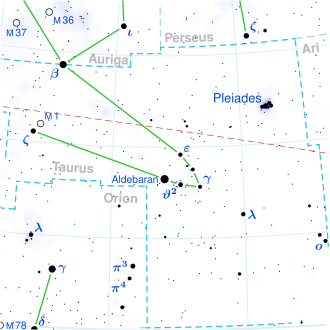
  | |
| Observation data Epoch J2000.0 Equinox ICRS | |
|---|---|
| Constellation | Taurus |
| Right ascension | 03h 27m 10.151s1 |
| Declination | +09° 43′ 57.63″1 |
| Apparent magnitude (V) | 3.73 - 3.812 (5.46 + 5.63 + 4.25)3: 15 |
| Characteristics | |
| Spectral type | B9Vn + B9V + B5V + F5V4 |
| Variable type | Algol2 |
| Astrometry | |
| Proper motion (μ) | RA: 50.58±1.48 mas/yr1 Dec.: −39.54±1.40 mas/yr1 |
| Parallax (π) | 4.96±0.51 mas3: 15 |
| Distance | 216 ly (66.1 pc)5 |
| Orbit5 | |
| Primary | ξ Tau Aa |
| Name | ξ Tau Ab |
| Period (P) | 7.147156 days |
| Semi-major axis (a) | 0.119 au |
| Eccentricity (e) | 0.0014 |
| Inclination (i) | 87.185° |
| Longitude of the node (Ω) | 328.368° |
| Argument of periastron (ω) (secondary) | 116.317° |
| Semi-amplitude (K1) (primary) | 87.79±0.253: 5 km/s |
| Orbit5 | |
| Primary | ξ Tau A |
| Name | ξ Tau B |
| Period (P) | 145.785 days |
| Semi-major axis (a) | 1.093 au |
| Eccentricity (e) | 0.2075 |
| Inclination (i) | 86.554° |
| Longitude of the node (Ω) | 328.349° |
| Argument of periastron (ω) (secondary) | 341.108° |
| Semi-amplitude (K2) (secondary) | 38.37±0.193: 5 km/s |
| Orbit5 | |
| Primary | ξ Tau AB |
| Name | ξ Tau C |
| Period (P) | 18,877.1 days |
| Semi-major axis (a) | 29.44 au |
| Eccentricity (e) | 0.576 |
| Inclination (i) | −23.031° |
| Longitude of the node (Ω) | 102.066° |
| Argument of periastron (ω) (secondary) | 117.949° |
| Details5 | |
| ξ Tau Aa | |
| Mass | 2.250 M☉ |
| Radius | 1.691 R☉ |
| Surface gravity (log g) | 4.337 cgs |
| Temperature | 11,000 K |
| Rotation | 5.860 days |
| Rotational velocity (v sin i) | 14.6 km/s |
| ξ Tau Ab | |
| Mass | 2.154 M☉ |
| Radius | 1.614 R☉ |
| Surface gravity (log g) | 4.355 cgs |
| Temperature | 10,602 K |
| Rotation | 6.148 days |
| Rotational velocity (v sin i) | 13.281 km/s |
| ξ Tau B | |
| Mass | 3.782 M☉ |
| Radius | 2.446 R☉ |
| Surface gravity (log g) | 4.238 cgs |
| Temperature | 14,000 K |
| Rotation | 0.510 days |
| Rotational velocity (v sin i) | 242.262 km/s |
| ξ Tau C | |
| Mass | 1.344 M☉ |
| Radius | 1.424 R☉ |
| Surface gravity (log g) | 4.258 cgs |
| Temperature | 6,487 K |
| Rotation | 1.126 days |
| Rotational velocity (v sin i) | 65.234 km/s |
| Other designations | |
| 2 Tau, HR 1038, HD 21364, BD+09°439, HIP 16083, SAO 1111956 | |
| Database references | |
| SIMBAD | data |
Xi Tauri (ξ Tau, ξ Tauri) is a hierarchical quadruple system7 in the constellation Taurus.
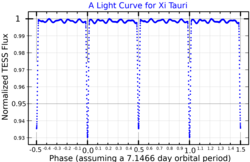
Xi Tauri is a spectroscopic and eclipsing quadruple star. It consists of three blue-white B-type main sequence stars and an F-type main sequence star. Two of the stars form an eclipsing binary system and revolve around each other once every 7.15 days. These in turn orbit the third star once every 145 days. The fourth star is a F star that orbits the other three stars in a roughly fifty-year period and has been resolved optically.9 It may be a binary system itself.5 The brightest and most massive of the four stars is the "third" star, although the eclipsing pair have a greater combined mass and hence are generally considered to be the primary.4
The typical combined apparent magnitude of the system is +3.73, but because the two inner stars eclipse one another during their orbits, it is classified as a variable star, and its brightness varies from magnitude +3.73 to +3.81. Xi Tauri is approximately 210 light years from Earth.1
Nomenclature for the four stars varies. Some sources refer to the faint resolved companion as component C, while others refer to it as B. Similarly, the inner three stars are respectively Aa, Ab, and B, or Aa, Ab, and Ac.47
References
References
- van Leeuwen, F. (2007). "Validation of the new Hipparcos reduction". Astronomy and Astrophysics. 474 (2): 653–664. arXiv:0708.1752. Bibcode:2007A&A...474..653V. doi:10.1051/0004-6361:20078357. S2CID 18759600.Vizier catalog entry Archived 2013-10-02 at the Wayback Machine
- "Xi Tau". AAVSO. Retrieved 2022-07-17.
- Nemravová, J. A.; Harmanec, P.; Brož, M.; Vokrouhlický, D.; Mourard, D.; Hummel, C. A.; Cameron, C.; Matthews, J. M.; Bolton, C. T.; Božić, H.; Chini, R.; Dembsky, T.; Engle, S.; Farrington, C.; Grunhut, J. H. (October 2016). "ξTauri: a unique laboratory to study the dynamic interaction in a compact hierarchical quadruple system". Astronomy and Astrophysics. 594: A55. Bibcode:2016A&A...594A..55N. doi:10.1051/0004-6361/201628860. ISSN 0004-6361.
- Tokovinin, Andrei (2018). "The Updated Multiple Star Catalog". The Astrophysical Journal Supplement Series. 235 (1): 6. arXiv:1712.04750. Bibcode:2018ApJS..235....6T. doi:10.3847/1538-4365/aaa1a5. S2CID 119047709.
- Brož, M.; Doležal, P.; Vokrouhlický, D.; Harmanec, P.; Barlow, B.; Božić, H.; Labadie-Bartz, J.; Kuschnig, R.; Kallinger, T. (2026-05-21). "Configuration of the ξ Tau system constrained by multi-technique observations". Astronomy and Astrophysics. arXiv:2605.22545.
- "ksi Tau -- Star". SIMBAD Astronomical Database. Centre de données astronomiques de Strasbourg. Retrieved 2013-09-29.
- Nemravová, J. A.; et al. (2013). "An Unusual Quadruple System ξ Tauri". Central European Astrophysical Bulletin. 37 (1): 207–216. Bibcode:2013CEAB...37..207N.
- "MAST: Barbara A. Mikulski Archive for Space Telescopes". Space Telescope Science Institute. Retrieved 8 December 2021.
- Rica Romero, F. M. (2010). "Orbital elements for eight binaries. Study of the nature of wide components. I" (PDF). Revista Mexicana de Astronomía y Astrofísica. 46: 263–277. Bibcode:2010RMxAA..46..263R. Archived from the original (PDF) on 2014-02-25. Retrieved 2013-09-30.