 | |
| Names | |
|---|---|
| IUPAC name
Xanthopterin
| |
| Identifiers | |
| |
3D model (JSmol)
|
|
| ChemSpider |
|
| ECHA InfoCard | 100.003.932 |
PubChem CID
|
|
| UNII | |
CompTox Dashboard (EPA)
|
|
| |
| |
| Properties | |
| C6H5N5O2 | |
Except where otherwise noted, data are given for materials in their standard state (at 25 °C [77 °F], 100 kPa).
| |


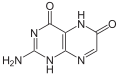
Xanthopterin is a yellow, crystalline solid1 that occurs mainly in the wings of butterflies and in the urine of mammals.1 Small microorganisms convert it into folic acid.2 It is the end product of a non-conjugated pteridine compound3 and inhibits the growth of lymphocytes produced by concanavalin.3 High levels of the chemical were found in patients with liver disease and hemolysis, the latter increasing levels by 35%.45
It was suggested, without direct proof, that the Oriental hornet uses xanthopterin as a light-harvesting molecule to transform light into electrical energy, which explains why the insects are more active when light intensity is greater. It remains an active and controversial area of scientific research (Plotkin et al., Naturwissenschaften (2010) 97:1067–1076).6
References
References
- http://cancerweb.ncl.ac.uk/cgi-bin/omd?xanthopterin
- "Definition of xanthopterin - Merriam-Webster's Medical Dictionary". Archived from the original on December 25, 2007. Retrieved October 17, 2008.
- Qujeq, Durdi; Ahmadi, Homayoun (2001). "Determination of Xanthopterin in Patients with Renal Insufficiency". American Journal of Nephrology. 21 (4): 340–342. doi:10.1159/000046271. PMID 11509808. S2CID 46502262.
- "WikiGenes -". WikiGenes - Collaborative Publishing.
- "WikiGenes -". WikiGenes - Collaborative Publishing.
- Walker, Matt (6 December 2010). "Oriental hornets powered by 'solar energy'". BBC.