| Observation data Epoch J2000 Equinox J2000 | |
|---|---|
| Constellation | Cygnus2 |
| Right ascension | 20h 12m 06.5421s3 |
| Declination | +38° 21′ 17.779″3 |
| Apparent magnitude (V) | 7.504 |
| Characteristics | |
| Evolutionary stage | Wolf–Rayet5 |
| Spectral type | WN6(h)-s5 |
| U−B color index | −0.374 |
| B−V color index | +0.014 |
| Astrometry | |
| Radial velocity (Rv) | −21.66 km/s |
| Proper motion (μ) | RA: −7.547 mas/yr Dec.: −7.387 mas/yr |
| Parallax (π) | 0.4865±0.0337 mas7 |
| Distance | 6,700 ± 500 ly (2,100 ± 100 pc) |
| Absolute magnitude (MV) | −5.635 |
| Details | |
| Mass | 215 M☉ |
| Radius | 5.105 R☉ |
| Luminosity | 600,0005 L☉ |
| Temperature | 70,8005 K |
| Rotation | 378 |
| Age | 4.79 Myr |
| Other designations | |
| V1770 Cyg, AG+38 1977, GSC 03151-01765, BD+37 3821, HD 192163, HIP 99546, GC 28056, SAO 69592. | |
| Database references | |
| SIMBAD | data |

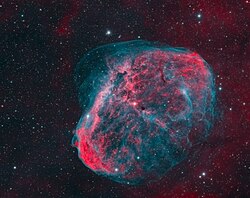
WR 136 is a Wolf–Rayet star located in the constellation Cygnus. It is in the center of the Crescent Nebula. Its age is estimated to be around 4.7 million years and it is nearing the end of its life. Within a few hundred thousand years, it is expected to explode as a supernova.9
According to recent estimations, WR 136 is 600,000 times brighter than the Sun, 21 times more massive, and 5.1 times larger. Its surface temperature is around 70,000 kelvins.5
WR 136 blew off a shell of material with a mass of around 5 M☉ when it became a red supergiant around 120,000–240,000 years ago and this is still expanding at 80 km/s.10 Currently, its fast stellar wind, ejected from the star at around 3.8 million mph (1,700 km/s11), is catching up to the material ejected from the star and shaping it into a shell. Ultraviolet rays emitted from WR 136's hot surface cause the shell to glow.10
There is some evidence WR 136 may be a binary star. Its companion would be a low-mass star of spectral classification K or M that would complete an orbit around the Wolf-Rayet star each 5.13 days, being the progenitor of a low-mass X-ray binary system.12
References
References
- "MAST: Barbara A. Mikulski Archive for Space Telescopes". Space Telescope Science Institute. Retrieved 8 December 2021.
- Roman, Nancy G. (1987). "Identification of a constellation from a position". Publications of the Astronomical Society of the Pacific. 99 (617): 695. Bibcode:1987PASP...99..695R. doi:10.1086/132034. Constellation record for this object at VizieR.
- Van Leeuwen, F. (2007). "Validation of the new Hipparcos reduction". Astronomy and Astrophysics. 474 (2): 653–664. arXiv:0708.1752. Bibcode:2007A&A...474..653V. doi:10.1051/0004-6361:20078357. S2CID 18759600.
- Ducati, J. R. (2002). "VizieR Online Data Catalog: Catalogue of Stellar Photometry in Johnson's 11-color system". CDS/ADC Collection of Electronic Catalogues. 2237: 0. Bibcode:2002yCat.2237....0D.
- Sota, A.; Maíz Apellániz, J.; Morrell, N. I.; Barbá, R. H.; Walborn, N. R.; Gamen, R. C.; Arias, J. I.; Alfaro, E. J.; Oskinova, L. M. (2019). "The Galactic WN stars revisited. Impact of Gaia distances on fundamental stellar parameters". Astronomy & Astrophysics. A57: 625. arXiv:1904.04687. Bibcode:2019A&A...625A..57H. doi:10.1051/0004-6361/201834850. S2CID 104292503.
- Barbier-Brossat, M.; Petit, M.; Figon, P. (1994). "Third bibliographic catalogue of stellar radial velocities (Text in French)". Astronomy and Astrophysics Supplement Series. 108: 603. Bibcode:1994A&AS..108..603B.
- Brown, A. G. A.; et al. (Gaia collaboration) (August 2018). "Gaia Data Release 2: Summary of the contents and survey properties". Astronomy & Astrophysics. 616. A1. arXiv:1804.09365. Bibcode:2018A&A...616A...1G. doi:10.1051/0004-6361/201833051. Gaia DR2 record for this source at VizieR.
- Gräfener, G.; Vink, J. S.; Harries, T. J.; Langer, N. (2012). "Rotating Wolf-Rayet stars in a post RSG/LBV phase". Astronomy & Astrophysics. 547: A83. arXiv:1210.1153. Bibcode:2012A&A...547A..83G. doi:10.1051/0004-6361/201118664. S2CID 55530420.
- Moore, Brian D.; Hester, J. Jeff; Scowen, Paul A. (2000). "Hubble Space Telescope Observations of the Wolf-Rayet Nebula NGC 6888". The Astronomical Journal. 119 (6): 2991. arXiv:astro-ph/0003053. Bibcode:2000AJ....119.2991M. doi:10.1086/301389. S2CID 17769849.
- Mesa-Delgado, A.; Esteban, C.; García-Rojas, J.; Reyes-Pérez, J.; Morisset, C.; Bresolin, F. (2014). "The Trace of the CNO Cycle in the Ring Nebula NGC 6888". The Astrophysical Journal. 785 (2): 100. arXiv:1402.6181. Bibcode:2014ApJ...785..100M. doi:10.1088/0004-637X/785/2/100. S2CID 118596124.
- Hamann, W.-R.; Wessolowski, U.; Koesterke, L. (1994). "Non-LTE spectral analyses of Wolf-Rayet stars: The nitrogen spectrum of the WN6 prototype HD 192163 (WR136)". Astronomy and Astrophysics. 281: 184. Bibcode:1994A&A...281..184H. ISSN 0004-6361.
- Rustamov, D. N.; Cherepashchuk, A. M. (2011). "The Wolf-Rayet star HD 192163 as a possible evolutionary progenitor of a low-mass X-ray binary". Astronomy Reports. 55 (4): 347–358. Bibcode:2011ARep...55..347R. doi:10.1134/S1063772911010069. S2CID 121379439. Retrieved 17 July 2013.
Further reading
Further reading
- Bychkov, K. V.; Sitnik, T. G. (2006). "Stratification of optical emission from NGC 6888 as a trace of the interaction between Wolf-Rayet stellar wind and the shell of a red supergiant". Astronomy Letters. 32 (6): 406. Bibcode:2006AstL...32..406B. doi:10.1134/S1063773706060041. S2CID 123039046.