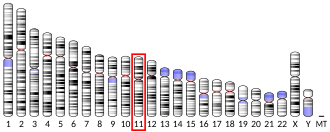



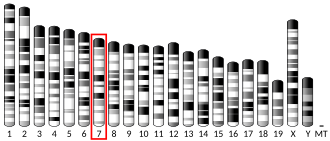

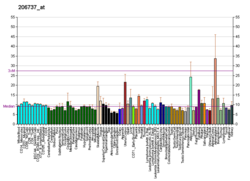
Protein Wnt-11 is a protein that in humans is encoded by the WNT11 gene.56
The WNT gene family consists of structurally related genes that encode secreted signaling proteins. These proteins have been implicated in oncogenesis and in several developmental processes, including regulation of cell fate and patterning during embryogenesis. This gene is a member of the WNT gene family. It encodes a protein showing 97%, 85%, and 63% amino acid identity with mouse, chicken, and Xenopus Wnt11 protein, respectively. This gene plays roles in the development of bones, kidneys,7 and lungs,5 and is associated with early onset osteoporosis. 8
References
References
- GRCh38: Ensembl release 89: ENSG00000085741 – Ensembl, May 2017
- GRCm38: Ensembl release 89: ENSMUSG00000015957 – Ensembl, May 2017
- "Human PubMed Reference:". National Center for Biotechnology Information, U.S. National Library of Medicine.
- "Mouse PubMed Reference:". National Center for Biotechnology Information, U.S. National Library of Medicine.
- Lako M, Strachan T, Bullen P, Wilson DI, Robson SC, Lindsay S (December 1998). "Isolation, characterisation and embryonic expression of WNT11, a gene which maps to 11q13.5 and has possible roles in the development of skeleton, kidney and lung". Gene. 219 (1–2): 101–110. doi:10.1016/S0378-1119(98)00393-X. PMID 9757009.
- "Entrez Gene: WNT11 wingless-type MMTV integration site family, member 11".
- Majumdar A, Vainio S, Kispert A, McMahon J, McMahon AP (July 2003). "Wnt11 and Ret/Gdnf pathways cooperate in regulating ureteric branching during metanephric kidney development". Development. 130 (14). Cambridge, England: The Company of Biologists: 3175–3185. doi:10.1242/dev.00520. PMID 12783789. S2CID 25866889.
- Caetano da Silva C, Edouard T, Fradin M, Aubert-Mucca M, Ricquebourg M, Raman R, et al. (May 2022). "WNT11, a new gene associated with early onset osteoporosis, is required for osteoblastogenesis". Human Molecular Genetics. 31 (10). Oxford University Press (OUP): 1622–1634. doi:10.1093/hmg/ddab349. PMC 9122655. PMID 34875064.
Further reading
Further reading
- Smolich BD, McMahon JA, McMahon AP, Papkoff J (1994). "Wnt family proteins are secreted and associated with the cell surface". Molecular Biology of the Cell. 4 (12): 1267–1275. doi:10.1091/mbc.4.12.1267. PMC 275763. PMID 8167409.
- Kirikoshi H, Sekihara H, Katoh M (2002). "Molecular cloning and characterization of human WNT11". International Journal of Molecular Medicine. 8 (6): 651–656. doi:10.3892/ijmm.8.6.651. PMID 11712081.
- Ouko L, Ziegler TR, Gu LH, Eisenberg LM, Yang VW (June 2004). "Wnt11 signaling promotes proliferation, transformation, and migration of IEC6 intestinal epithelial cells". The Journal of Biological Chemistry. 279 (25): 26707–26715. doi:10.1074/jbc.M402877200. PMC 1351009. PMID 15084607.
- Kim SW, Park JI, Spring CM, Sater AK, Ji H, Otchere AA, et al. (December 2004). "Non-canonical Wnt signals are modulated by the Kaiso transcriptional repressor and p120-catenin". Nature Cell Biology. 6 (12): 1212–1220. doi:10.1038/ncb1191. PMID 15543138. S2CID 19404686.
- Koyanagi M, Haendeler J, Badorff C, Brandes RP, Hoffmann J, Pandur P, et al. (April 2005). "Non-canonical Wnt signaling enhances differentiation of human circulating progenitor cells to cardiomyogenic cells". The Journal of Biological Chemistry. 280 (17): 16838–16842. doi:10.1074/jbc.M500323200. PMID 15701629.
- Garriock RJ, D'Agostino SL, Pilcher KC, Krieg PA (2005). "Wnt11-R, a protein closely related to mammalian Wnt11, is required for heart morphogenesis in Xenopus". Developmental Biology. 279 (1): 179–192. doi:10.1016/j.ydbio.2004.12.013. PMID 15708567.
- Otsuki T, Ota T, Nishikawa T, Hayashi K, Suzuki Y, Yamamoto J, et al. (2005). "Signal sequence and keyword trap in silico for selection of full-length human cDNAs encoding secretion or membrane proteins from oligo-capped cDNA libraries". DNA Research. 12 (2): 117–126. doi:10.1093/dnares/12.2.117. PMID 16303743.
- Panáková D, Werdich AA, Macrae CA (2010). "Wnt11 patterns a myocardial electrical gradient through regulation of the L-type Ca(2+) channel". Nature. 466 (8): 874–878. Bibcode:2010Natur.466..874P. doi:10.1038/nature09249. PMC 2921013. PMID 20657579.