
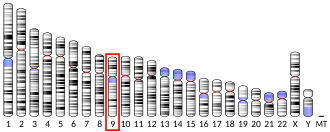





WD repeat-containing protein 5 is a protein that in humans is encoded by the WDR5 gene.56
This gene encodes a member of the WD repeat protein family. WD repeats are minimally conserved regions of approximately 40 amino acids typically bracketed by gly-his and trp-asp (GH-WD), which may facilitate formation of heterotrimeric or multiprotein complexes. Members of this family are involved in a variety of cellular processes, including cell cycle progression, signal transduction, apoptosis, and gene regulation. This protein contains 7 WD repeats. Alternatively spliced transcript variants encoding the same protein have been identified.6
Interactions
WDR5 has been shown to interact with Host cell factor C178 and MLL.7 It also interacts with the long non-coding RNA HOTTIP and to the lncRNA NeST.910 WDR5 is a key determinant for MYC recruitment to chromatin11
References
References
- GRCh38: Ensembl release 89: ENSG00000196363 – Ensembl, May 2017
- GRCm38: Ensembl release 89: ENSMUSG00000026917 – Ensembl, May 2017
- "Human PubMed Reference:". National Center for Biotechnology Information, U.S. National Library of Medicine.
- "Mouse PubMed Reference:". National Center for Biotechnology Information, U.S. National Library of Medicine.
- Gori F, Divieti P, Demay MB (Dec 2001). "Cloning and characterization of a novel WD-40 repeat protein that dramatically accelerates osteoblastic differentiation". J Biol Chem. 276 (49): 46515–22. doi:10.1074/jbc.M105757200. PMID 11551928.
- "Entrez Gene: WDR5 WD repeat domain 5".
- Yokoyama, Akihiko; Wang Zhong; Wysocka Joanna; Sanyal Mrinmoy; Aufiero Deborah J; Kitabayashi Issay; Herr Winship; Cleary Michael L (Jul 2004). "Leukemia proto-oncoprotein MLL forms a SET1-like histone methyltransferase complex with menin to regulate Hox gene expression". Mol. Cell. Biol. 24 (13): 5639–49. doi:10.1128/MCB.24.13.5639-5649.2004. ISSN 0270-7306. PMC 480881. PMID 15199122.
- Wysocka, Joanna; Myers Michael P; Laherty Carol D; Eisenman Robert N; Herr Winship (Apr 2003). "Human Sin3 deacetylase and trithorax-related Set1/Ash2 histone H3-K4 methyltransferase are tethered together selectively by the cell-proliferation factor HCF-1". Genes Dev. 17 (7): 896–911. doi:10.1101/gad.252103. ISSN 0890-9369. PMC 196026. PMID 12670868.
- Wells, Alexandria C.; Pobezinskaya, Elena L.; Pobezinsky, Leonid A. (April 2020). "Non-coding RNAs in CD8 T cell biology". Molecular Immunology. 120: 67–73. doi:10.1016/j.molimm.2020.01.023. ISSN 1872-9142. PMC 7093237. PMID 32085976.
- Wang KC, Yang YW, Liu B, Sanyal A, Corces-Zimmerman R, Chen Y, et al. (2011). "A long noncoding RNA maintains active chromatin to coordinate homeotic gene expression". Nature. 472 (7341): 120–4. Bibcode:2011Natur.472..120W. doi:10.1038/nature09819. PMC 3670758. PMID 21423168.
- Thomas, L. R.; Tansey, W. P. (2015). "Interaction with WDR5 Promotes Target Gene Recognition and Tumorigenesis by MYC". Molecular Cell. 58 (3): 1–13. doi:10.1016/j.molcel.2015.02.028. PMC 4427524. PMID 25818646.
Further reading
Further reading
- Strausberg RL, Feingold EA, Grouse LH, et al. (2003). "Generation and initial analysis of more than 15,000 full-length human and mouse cDNA sequences". Proc. Natl. Acad. Sci. U.S.A. 99 (26): 16899–903. Bibcode:2002PNAS...9916899M. doi:10.1073/pnas.242603899. PMC 139241. PMID 12477932.
- Wysocka J, Myers MP, Laherty CD, et al. (2003). "Human Sin3 deacetylase and trithorax-related Set1/Ash2 histone H3-K4 methyltransferase are tethered together selectively by the cell-proliferation factor HCF-1". Genes Dev. 17 (7): 896–911. doi:10.1101/gad.252103. PMC 196026. PMID 12670868.
- Gori F, Demay MB (2004). "BIG-3, a novel WD-40 repeat protein, is expressed in the developing growth plate and accelerates chondrocyte differentiation in vitro". Endocrinology. 145 (3): 1050–4. doi:10.1210/en.2003-1314. PMID 14657013.
- Ota T, Suzuki Y, Nishikawa T, et al. (2004). "Complete sequencing and characterization of 21,243 full-length human cDNAs". Nat. Genet. 36 (1): 40–5. doi:10.1038/ng1285. PMID 14702039.
- Yokoyama A, Wang Z, Wysocka J, et al. (2004). "Leukemia proto-oncoprotein MLL forms a SET1-like histone methyltransferase complex with menin to regulate Hox gene expression". Mol. Cell. Biol. 24 (13): 5639–49. doi:10.1128/MCB.24.13.5639-5649.2004. PMC 480881. PMID 15199122.
- Gerhard DS, Wagner L, Feingold EA, et al. (2004). "The status, quality, and expansion of the NIH full-length cDNA project: the Mammalian Gene Collection (MGC)". Genome Res. 14 (10B): 2121–7. doi:10.1101/gr.2596504. PMC 528928. PMID 15489334.
- Andersen JS, Lam YW, Leung AK, et al. (2005). "Nucleolar proteome dynamics". Nature. 433 (7021): 77–83. Bibcode:2005Natur.433...77A. doi:10.1038/nature03207. PMID 15635413. S2CID 4344740.
- Wysocka J, Swigut T, Milne TA, et al. (2005). "WDR5 associates with histone H3 methylated at K4 and is essential for H3 K4 methylation and vertebrate development". Cell. 121 (6): 859–72. doi:10.1016/j.cell.2005.03.036. PMID 15960974. S2CID 17521631.
- Dou Y, Milne TA, Tackett AJ, et al. (2005). "Physical association and coordinate function of the H3 K4 methyltransferase MLL1 and the H4 K16 acetyltransferase MOF". Cell. 121 (6): 873–85. doi:10.1016/j.cell.2005.04.031. PMID 15960975. S2CID 14717470.
- Rual JF, Venkatesan K, Hao T, et al. (2005). "Towards a proteome-scale map of the human protein-protein interaction network". Nature. 437 (7062): 1173–8. Bibcode:2005Natur.437.1173R. doi:10.1038/nature04209. PMID 16189514. S2CID 4427026.
- Gori F, Friedman L, Demay MB (2006). "Wdr5, a novel WD repeat protein, regulates osteoblast and chondrocyte differentiation in vivo". Journal of Musculoskeletal & Neuronal Interactions. 5 (4): 338–9. PMID 16340128.
- Lim J, Hao T, Shaw C, et al. (2006). "A protein-protein interaction network for human inherited ataxias and disorders of Purkinje cell degeneration". Cell. 125 (4): 801–14. doi:10.1016/j.cell.2006.03.032. PMID 16713569. S2CID 13709685.
- Ruthenburg AJ, Wang W, Graybosch DM, et al. (2006). "Histone H3 recognition and presentation by the WDR5 module of the MLL1 complex". Nat. Struct. Mol. Biol. 13 (8): 704–12. doi:10.1038/nsmb1119. PMC 4698793. PMID 16829959.
- Couture JF, Collazo E, Trievel RC (2006). "Molecular recognition of histone H3 by the WD40 protein WDR5". Nat. Struct. Mol. Biol. 13 (8): 698–703. doi:10.1038/nsmb1116. PMID 16829960. S2CID 26165068.
- Dou Y, Milne TA, Ruthenburg AJ, et al. (2006). "Regulation of MLL1 H3K4 methyltransferase activity by its core components". Nat. Struct. Mol. Biol. 13 (8): 713–9. doi:10.1038/nsmb1128. PMID 16878130. S2CID 12849159.
- Schuetz A, Allali-Hassani A, Martín F, et al. (2006). "Structural basis for molecular recognition and presentation of histone H3 by WDR5". EMBO J. 25 (18): 4245–52. doi:10.1038/sj.emboj.7601316. PMC 1570438. PMID 16946699.
- Ewing RM, Chu P, Elisma F, et al. (2007). "Large-scale mapping of human protein-protein interactions by mass spectrometry". Mol. Syst. Biol. 3 (1): 89. doi:10.1038/msb4100134. PMC 1847948. PMID 17353931.
- Bryan AF, Wang J, Howard GC, et al. (2020). "WDR5 is a conserved regulator of protein synthesis gene expression". Nucleic Acids Research. 48 (6): 2924–2941. doi:10.1093/nar/gkaa051. PMC 7102967. PMID 31996893.