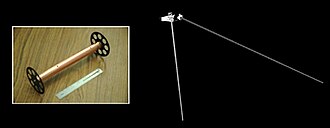



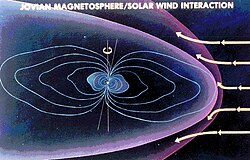

Waves is an experiment on the Juno spacecraft for studying radio and plasma waves.12 It is part of a collection of various types of instruments and experiments on the spacecraft; Waves is oriented towards understanding fields and particles in the Jupiter's magnetosphere.2 Waves is on board the uncrewed Juno spacecraft, which was launched in 2011 and arrived at Jupiter in the summer of 2016.1 The major focus of study for Waves is Jupiter's magnetosphere, which if could be seen from Earth would be about twice the size of a full moon.3 The magnetosphere has a tear drop shape, and that tail extends away from the Sun by at least 5 AU (Earth-Sun distances).3 The Waves instrument is designed to help understand the interaction between Jupiter's atmosphere, its magnetic field, its magnetosphere, and to understand Jupiter's auroras.4 It is designed to detect radio frequencies from 50 Hz up to 40,000,000 Hz (40 MHz),5 and magnetic fields from 50 Hz to 20,000 Hz (20 kHz).6 It has two main sensors: a dipole antenna and a magnetic search coil.6 The dipole antenna has two whip antennas that extend 2.8 meters (110 inches/ 9.1 feet) and are attached to the main body of the spacecraft.67 This sensor has been compared to a rabbit-ear TV antenna.8 The search coil is overall a Mu-metal rod 15 cm (6 in) in length with a fine copper wire wound 10,000 times around it.6 There are also two frequency receivers that each cover certain bands.6 Data handling is done by two radiation-hardened systems on a chip.6 The data handling units are located inside the Juno Radiation Vault.9 Waves is allocated 410 Mbits of data per science orbit.9
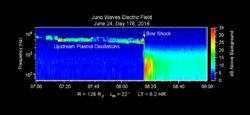
On June 24, 2016, the Waves instrument recorded Juno passing across Jupiter's magnetic field's bow shock.3 It took about two hours for the uncrewed spacecraft to cross this region of space.3 On June 25, 2016, it encountered the magnetopause.3 Juno would go on to enter Jupiter's orbit in July 2016.3 The magnetosphere blocks the charged particles of the solar wind, with the number of solar wind particles Juno encountered dropping 100-fold when it entered the Jovian magnetosphere.3 Before Juno entered it, it was encountering about 16 solar wind particles per cubic inch of space.3
There are various other antennas on Juno, including the communications antennas and the antenna for the Microwave Radiometer.9
Two other instruments help understand the magnetosphere of Jupiter, Jovian Auroral Distributions Experiment (JADE) and Magnetometer (MAG).10 The JEDI instrument measures higher energy ions and electrons and JADE lower energy ones; they are complementary.10 Another object of study is plasma generated by volcanism on the moon Io and Waves should help understand that phenomenon.6
A primary objective of the Juno mission is to explore the polar magnetosphere of Jupiter. While Ulysses briefly attained latitudes of ~48 degrees, this was at relatively large distances from Jupiter (~8.6 RJ). Hence, the polar magnetosphere of Jupiter is largely uncharted territory and, in particular, the auroral acceleration region has never been visited. ...
— A Wave Investigation for the Juno Mission to Jupiter11
One issue that came up in 2002 was when the Chandra X-ray Observatory determined with its high angular resolution that X-rays were coming from Jupiter's poles.12 The Einstein Observatory and Germany's ROSAT previously observed X-rays from Jupiter.12 The new results by Chandra, which took the observations during December 2000, showed X-rays coming from the magnetic north pole, but not the aurorae.12 Roughly every 45 minutes Jupiter sends out a multi-gigawatt X-ray pulse, and this is synchronized with an emission in radio at 1 to 200 kHz.12 The Galileo Jupiter orbiter and Ulysses solar orbiter picked up the radio emissions every 45 minutes.12 The radio emissions were discovered before the X-rays (they have been detected since the 1950s), and there is even a citizen astronomy project organized by NASA called Radio Jove for anyone to listen to Jupiter's radio signals.1314 Kilometric radio radiation was not detected until the Voyager flybys of Jupiter in the late 1970s.14 Two candidates for the source of the X-rays are particles of solar wind and particles from Io.12
Waves was developed at the University of Iowa, and the experiment is led by a research scientist there.8
Sensors
There are two main sensors for Waves, and these field signals to the frequency receivers.6 Both sensors are attached to the main spacecraft body.6
- Dipole antenna
- Magnetic search coil
The MSC is made of a rod of Mu-metal (a ferromagnetic alloy of nickel and iron) wrapped in fine copper wire.6
Frequency receiver
There are two frequency receivers that each cover certain bands, a high band and a low band, which in turn has different receiving sections.6 The receivers are housed in the Juno Radiation Vault along with other electronics.9
Breakdown:6
- High Frequency Receiver6
- High Frequency Receiver ~100 kHz - 40 MHz (Spectrum (High) and Waveform (Low))6
- High Frequency Waveform Receiver6
- Baseband receiver includes:6
- variable-gain amplifier6
- 100 Hz to 3 MHz band-pass filter6
- 12-bit analog-to-digital converter6
- Double sideband heterodyne receiver for 3 to 40 MHz (swept frequency receiver)6
- Baseband receiver includes:6
- Low Frequency Receiver6
All outputs are sent to the Data Processing Unit (DPU)6
Data Processing Unit (DPU)
The output from the frequency receivers is in turn processed by the Juno DPU.6 The DPU has two microprocessors that use field programmable gate arrays are they are both system on chip designs.6 The two chips:6
- Y180 intellectual property core
- Floating point arithmetic unit
The DPU sends data to the main Juno computer for communication with Earth.6 The electronics are in the Juno Radiation Vault along with the receivers.9
Multimedia
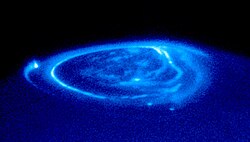
Waves has detected radio emissions from the Jupiter auroras, the most powerful known in the Solar System to date.15
See also
See also
- Other instruments on Juno
- Radio
- Plasma
- Waves in plasmas
- Ulysses (spacecraft)
- Magnetosphere of Jupiter
- Radio astronomy
- FIELDS (investigation on the Parker Solar Probe, launched summer of 2018)
- Plasma Wave Subsystem (Instrument on the Voyager probes)
References
References
- Greicius, Tony (2015-03-13). "Juno Spacecraft and Instruments". NASA. Archived from the original on 2017-05-09. Retrieved 2017-01-04.
- Brown, Geoff (2016-06-30). "NASA's Juno and JEDI prepare to unlock the mysteries of Jupiter". The Hub. Retrieved 2017-01-04.
- Greicius, Tony (2016-06-29). "NASA's Juno Spacecraft Enters Jupiter's Magnetic Field". NASA. Archived from the original on 2022-01-03. Retrieved 2017-01-05.
- "Juno's Instruments | Mission Juno". Mission Juno. Retrieved 2017-01-05.
- Sampl, M.; Oswald, T.; Rucker, H. O.; Karlsson, R.; Plettemeier, D.; Kurth, W. S. (November 2011). "First results of the JUNO/Waves antenna investigations". 2011 Loughborough Antennas & Propagation Conference. pp. 1–4. doi:10.1109/LAPC.2011.6114038. ISBN 978-1-4577-1016-2. S2CID 21869123.
- "The Juno Waves investigation" (PDF). Retrieved November 12, 2022.
- "Jupiter rendezvous". 2016-06-29.
- "Juno, and its University of Iowa-built instrument, about to reach Jupiter | The Gazette". The Gazette. Retrieved 2017-02-08.
- "Key and Driving Requirements for the Juno Payload Suite of Instruments" (PDF). Retrieved November 12, 2022.
- "Press Release - NASA's Juno and JEDI: Ready to Unlock Mysteries of Jupiter". Johns Hopkins Applied Physics Laboratory. June 29, 2016. Archived from the original on March 24, 2017. Retrieved November 12, 2022.
- Kurth, et al - A Wave Investigation for the Juno Mission to Jupiter - 2008
- "Puzzling X-rays from Jupiter | Science Mission Directorate". science.nasa.gov. Retrieved 2017-02-08.
- Sky and Telescope - The Radio Jove Project: Listening in on Jupiter - 2013
- John W. McAnally (2007). Jupiter: and How to Observe It. Springer Science & Business Media. p. 82. ISBN 978-1-84628-727-5.
- "Juno Sends Back Incredible New Images of Jupiter | Planetary Science, Space Exploration | Sci-News.com". Breaking Science News | Sci-News.com. Retrieved 2018-01-24.
External links
External links
- NASA Juno Spacecraft and Instruments Archived 2017-05-09 at the Wayback Machine
- Juno instruments (Videos)