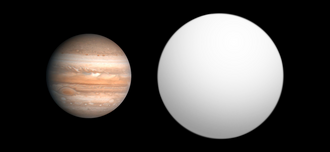
 Size comparison of WASP-1b with Jupiter | |
| Discovery | |
|---|---|
| Discovered by | Cameron et al. 1(SuperWASP and SOPHIE)  South Africa South Africaand  France France |
| Discovery site | SAAO |
| Discovery date | September 25, 2006 |
| Transit | |
| Orbital characteristics | |
| 0.03958 +0.00047 −0.000492 AU | |
| Eccentricity | <0.0132 |
| 2.51994701 ± 0.000000303 d | |
| Inclination | 90.0 ± 1.3°3 |
| 2,456,031.78981±0.000203 | |
| 91.10+170.00 −6.304 | |
| Semi-amplitude | 118.7+1.9 −2.0 m/s2 |
| Star | WASP-1 |
| Physical characteristics | |
| 1.612+0.137 −0.2305 RJ | |
| Mass | 0.948+0.029 −0.0282 MJ |
Mean density | 0.339+0.037 −0.0342 g cm−3 |
| 12.5 m/s2 (41 ft/s2) 1.27 g | |
| Temperature | 1812±14 K |
WASP-1b is an extrasolar planet orbiting the star WASP-1 located 1,300 light-years away in the constellation Andromeda.
Orbit and mass
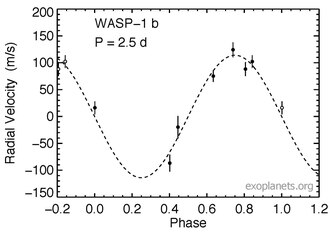
The planet's mass and radius indicate that it is a gas giant with a similar bulk composition to Jupiter. Unlike Jupiter, but similar to many other planets detected around other stars, WASP-1b is located very close to its star, and belongs to the class of planets known as hot Jupiters.
WASP-1 b was discovered via the transit method by SuperWASP, for which the star and planet are named. Follow-up radial velocity measurements confirmed the presence of an unseen companion, and allowed for the mass of WASP-1 b to be determined.1
In 2018, it was discovered via observations of the Rossiter-McLaughlin effect that the orbit of WASP-1b is strongly misaligned with rotational axis of the star by 79.0+4.3
−4.5 degrees, making it a nearly "polar" orbit.6
References
References
- Cameron, A. Collier; Bouchy, F.; Hébrard, G.; Maxted, P.; Pollacco, D.; Pont, F.; Skillen, I.; Smalley, B.; Street, R. A.; West, R. G.; Wilson, D. M.; Aigrain, S.; Christian, D. J.; Clarkson, W. I.; Enoch, B.; Evans, A.; Fitzsimmons, A.; Fleenor, M.; Gillon, M.; Haswell, C. A.; Hebb, L.; Hellier, C.; Hodgkin, S. T.; Horne, K.; Irwin, J.; Kane, S. R.; Keenan, F. P.; Loeillet, B.; Lister, T. A.; Mayor, M. (2007). "WASP-1b and WASP-2b: two new transiting exoplanets detected with SuperWASP and SOPHIE". Monthly Notices of the Royal Astronomical Society. 375 (3): 951–957. arXiv:astro-ph/0609688. Bibcode:2007MNRAS.375..951C. doi:10.1111/j.1365-2966.2006.11350.x. S2CID 735515.
- Bonomo, A. S.; Desidera, S.; Benatti, S.; Borsa, F.; Crespi, S.; Damasso, M.; Lanza, A. F.; Sozzetti, A.; Lodato, G.; Marzari, F.; Boccato, C.; Claudi, R. U.; Cosentino, R.; Covino, E.; Gratton, R. (2017-06-01). "The GAPS Programme with HARPS-N at TNG . XIV. Investigating giant planet migration history via improved eccentricity and mass determination for 231 transiting planets". Astronomy and Astrophysics. 602: A107. arXiv:1704.00373. Bibcode:2017A&A...602A.107B. doi:10.1051/0004-6361/201629882. hdl:2434/512656. ISSN 0004-6361. S2CID 118923163.
- Kokori, A.; et al. (March 1, 2023). "ExoClock Project. III. 450 New Exoplanet Ephemerides from Ground and Space Observations". The Astrophysical Journal Supplement Series. 265 (1): 4. arXiv:2209.09673. Bibcode:2023ApJS..265....4K. doi:10.3847/1538-4365/ac9da4. ISSN 0067-0049. S2CID 252383631.
- Knutson, Heather A.; Fulton, Benjamin J.; Montet, Benjamin T.; Kao, Melodie; Ngo, Henry; Howard, Andrew W.; Crepp, Justin R.; Hinkley, Sasha; Bakos, Gaspar Á.; Batygin, Konstantin; Johnson, John Asher; Morton, Timothy D.; Muirhead, Philip S. (April 2014). "Friends of Hot Jupiters. I. A Radial Velocity Search for Massive, Long-period Companions to Close-in Gas Giant Planets". The Astrophysical Journal. 785 (2): 126. arXiv:1312.2954. Bibcode:2014ApJ...785..126K. doi:10.1088/0004-637X/785/2/126. S2CID 42687848.
- Johns, Daniel; Marti, Connor; Huff, Madison; McCann, Jacob; Wittenmyer, Robert A.; Horner, Jonathan; Wright, Duncan J. (2018-11-01). "Revised Exoplanet Radii and Habitability Using Gaia Data Release 2". The Astrophysical Journal Supplement Series. 239 (1): 14. arXiv:1808.04533. Bibcode:2018ApJS..239...14J. doi:10.3847/1538-4365/aae5fb. ISSN 0067-0049. S2CID 119503072.
- Simpson, E. K.; Pollacco, D.; Cameron, A. Collier; Hébrard, G.; Anderson, D. R.; Barros, S. C. C.; Boisse, I.; Bouchy, F.; Faedi, F.; Gillon, M.; Hebb, L.; Keenan, F. P.; Miller, G. R. M.; Moutou, C.; Queloz, D.; Skillen, I.; Sorensen, P.; Stempels, H. C.; Triaud, A.; Watson, C. A.; Wilson, P. A. (2011). "The spin-orbit angles of the transiting exoplanets WASP-1b, WASP-24b, WASP-38b and HAT-P-8b from Rossiter-Mc Laughlin observations★". Monthly Notices of the Royal Astronomical Society. 414 (4): 3023–3035. arXiv:1011.5664. Bibcode:2011MNRAS.414.3023S. doi:10.1111/j.1365-2966.2011.18603.x. S2CID 46522188.
Further reading
Further reading
- Charbonneau, David; Winn, Joshua N.; Everett, Mark E.; Latham, David W.; Holman, Matthew J.; Esquerdo, Gilbert A.; o’Donovan, Francis T. (2007). "Precise Radius Estimates for the Exoplanets WASP-1b and WASP-2b". The Astrophysical Journal. 658 (2): 1322–1327. arXiv:astro-ph/0610589. Bibcode:2007ApJ...658.1322C. doi:10.1086/512008. S2CID 14099767.
- Shporer, A.; Tamuz, O.; Zucker, S.; Mazeh, T. (2007). "Photometric follow-up of the transiting planet around WASP-1". Monthly Notices of the Royal Astronomical Society. 376 (3): 1296–1300. arXiv:astro-ph/0610556. Bibcode:2007MNRAS.376.1296S. doi:10.1111/j.1365-2966.2007.11537.x. S2CID 12694181.
External links
External links
Media related to WASP-1b at Wikimedia Commons
- "Planet WASP-1 b". Extrasolar Planets Encyclopaedia. Retrieved 2018-11-07.
- BBC News article
- WASP Planets