| Observation data Epoch J2000.0 Equinox J2000.0 | |
|---|---|
| Constellation | Puppis1 |
| Right ascension | 07h 10m 24.06046s2 |
| Declination | −39° 05′ 50.5712″2 |
| Apparent magnitude (V) | 10.4 |
| Characteristics | |
| Evolutionary stage | main sequence2 |
| Spectral type | F6V34 |
| Apparent magnitude (B) | 11.005 |
| Apparent magnitude (V) | 10.515 |
| Apparent magnitude (J) | 9.6255 |
| Apparent magnitude (H) | 9.4395 |
| Apparent magnitude (K) | 9.3745 |
| Astrometry | |
| Radial velocity (Rv) | 38.25±0.222 km/s |
| Proper motion (μ) | RA: −3.735 mas/yr2 Dec.: +25.663 mas/yr2 |
| Parallax (π) | 3.7996±0.0104 mas2 |
| Distance | 858 ± 2 ly (263.2 ± 0.7 pc) |
| Details6 | |
| Mass | 1.330±0.019 M☉ |
| Radius | 1.461±0.015 R☉ |
| Surface gravity (log g) | 4.251±0.003 cgs |
| Temperature | 6,628±66 K |
| Metallicity [Fe/H] | +0.17±0.05 dex |
| Rotational velocity (v sin i) | 11.90±0.317 km/s |
| Age | 1.11±0.14 Gyr |
| Other designations | |
| Dilmun, CD−38 3220, TOI-495, WASP-121, TYC 7630-352-1, 2MASS J07102406-39055065 | |
| Database references | |
| SIMBAD | data |
WASP-121, also known as CD−38 3220 and formally named Dilmun,8 is a magnitude 10.4 star located approximately 858 light-years (263 parsecs) away in the constellation Puppis.1 WASP-121 has a mass and radius similar to the Sun's. It hosts one known exoplanet. Due to the star's strongly titled rotational axis with a stellar inclination angle of 8.1°, the planet's orbit is almost polar.9
The star, although metal-rich in terms of overall contents of heavy elements, is depleted of carbon. The carbon to oxygen molar ratio of 0.23±0.05 for WASP-121 is well below the solar ratio of 0.55.10
Nomenclature
The designation WASP-121 indicates that this was the 121st star found to have a planet by the Wide Angle Search for Planets.
In August 2022, this planetary system was included among 20 systems to be named by the third NameExoWorlds project.11 The approved names, proposed by a team from Bahrain, were announced in June 2023. WASP-121 is named Dilmun after the ancient civilization, and its planet is named Tylos after the ancient Greek name for Bahrain.12
Planetary system
In 2015, the exoplanet WASP-121b was discovered orbiting WASP-121 by the transit method.313 WASP-121b is a hot Jupiter with a mass about 1.18 times that of Jupiter and a radius about 1.81 times that of Jupiter.414 The exoplanet orbits WASP-121, its host star, every 1.27 days.414 Hot water molecules have been found in the stratosphere of WASP-121b (i.e., the atmospheric layer in which temperatures increase as the altitude increases).3141516
| Companion (in order from star) |
Mass | Semimajor axis (AU) |
Orbital period (days) |
Eccentricity | Inclination (°) |
Radius |
|---|---|---|---|---|---|---|
| b / Tylos | 1.170±0.043 MJ | 0.02571±0.00010 | 1.2753 | 0.03 | 87.63 | 1.742±0.006 RJ |
Gallery
-
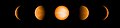 WASP-121b – computer-simulated views (August 2018)
 -
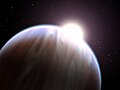 An artist's impression of a hot Jupiter planet
References
References
- Roman, Nancy G. (1987). "Identification of a constellation from a position". Publications of the Astronomical Society of the Pacific. 99 (617): 695. Bibcode:1987PASP...99..695R. doi:10.1086/132034. Constellation record for this object at VizieR.
- Vallenari, A.; et al. (Gaia collaboration) (2023). "Gaia Data Release 3. Summary of the content and survey properties". Astronomy and Astrophysics. 674: A1. arXiv:2208.00211. Bibcode:2023A&A...674A...1G. doi:10.1051/0004-6361/202243940. S2CID 244398875. Gaia DR3 record for this source at VizieR.
- Staff (2015). "Planet WASP-121 b". Extrasolar Planets Encyclopaedia. Retrieved 3 August 2017.
- Staff (2017). "WASP Planets". wasp-planets.net. Retrieved 3 August 2017.
- "WASP-121". SIMBAD. Centre de données astronomiques de Strasbourg. Retrieved 3 August 2017.
- Sing, David K.; Evans-Soma, Thomas M.; Rustamkulov, Zafar; Lothringer, Joshua D.; Mayne, Nathan J.; Schlaufman, Kevin C. (November 2024). "An Absolute Mass, Precise Age, and Hints of Planetary Winds for WASP-121A and b from a JWST NIRSpec Phase Curve". The Astronomical Journal. 168 (6): 231. arXiv:2501.03844. Bibcode:2024AJ....168..231S. doi:10.3847/1538-3881/ad7fe7. ISSN 1538-3881.
- Borsa, F.; Allart, R.; Casasayas-Barris, N.; Tabernero, H.; Zapatero Osorio, M. R.; Cristiani, S.; Pepe, F.; Rebolo, R.; Santos, N. C.; Adibekyan, V.; Bourrier, V.; Demangeon, O. D. S.; Ehrenreich, D.; Pallé, E.; Sousa, S.; Lillo-Box, J.; Lovis, C.; Micela, G.; Oshagh, M.; Poretti, E.; Sozzetti, A.; Allende Prieto, C.; Alibert, Y.; Amate, M.; Benz, W.; Bouchy, F.; Cabral, A.; Dekker, H.; D'Odorico, V.; et al. (2021), "Atmospheric Rossiter–Mc Laughlin effect and transmission spectroscopy of WASP-121b with ESPRESSO", Astronomy & Astrophysics, 645: A24, arXiv:2011.01245, Bibcode:2021A&A...645A..24B, doi:10.1051/0004-6361/202039344, S2CID 226237425
- "2022 Approved Names". NameExoworlds. Retrieved 22 July 2024.
- Bourrier, V.; Ehrenreich, D.; Lendl, M.; Cretignier, M.; Allart, R.; Dumusque, X.; Cegla, H. M.; Suárez-Mascareño, A.; Wyttenbach, A.; Hoeijmakers, H. J.; Melo, C.; Kuntzer, T.; Astudillo-Defru, N.; Giles, H.; Heng, K. (2020). "Hot Exoplanet Atmospheres Resolved with Transit Spectroscopy (HEARTS): III. Atmospheric structure of the misaligned ultra-hot Jupiter WASP-121b". Astronomy & Astrophysics. 635: A205. doi:10.1051/0004-6361/201936640. ISSN 0004-6361.
- Polanski, Alex S.; Crossfield, Ian J. M.; Howard, Andrew W.; Isaacson, Howard; Rice, Malena (2022), "Chemical Abundances for 25 JWST Exoplanet Host Stars with KeckSpec", Research Notes of the American Astronomical Society, 6 (8): 155, arXiv:2207.13662, Bibcode:2022RNAAS...6..155P, doi:10.3847/2515-5172/ac8676
- "List of ExoWorlds 2022". nameexoworlds.iau.org. IAU. 8 August 2022. Retrieved 27 August 2022.
- "2022 Approved Names". nameexoworlds.iau.org. IAU. Retrieved 7 June 2023.
- Delrez, L.; Santerne, A.; Almenara, J.-M.; Anderson, D. R.; Collier-Cameron, A.; Díaz, R. F.; Gillon, M.; Hellier, C.; Jehin, E.; Lendl, M.; Maxted, P. F. L.; Neveu-Vanmalle, M.; Pepe, F.; Pollacco, D.; Queloz, D.; Ségransan, D.; Smalley, B.; Smith, A. M. S.; Triaud, A. H. M. J.; Udry, S.; Van Grootel, V.; West, R. G. (2015), "WASP-121 b: A hot Jupiter close to tidal disruption transiting an active F star", Monthly Notices of the Royal Astronomical Society, 458 (4): 4025–4043, arXiv:1506.02471, doi:10.1093/mnras/stw522
- Landau, Elizabeth; Villard, Ray (2 August 2017). "Hubble Detects Exoplanet with Glowing Water Atmosphere". NASA. Retrieved 2 August 2017.
- Evans, Thomas M.; et al. (2 August 2017). "An ultrahot gas-giant exoplanet with a stratosphere". Nature. 548 (7665): 58–61. arXiv:1708.01076. Bibcode:2017Natur.548...58E. doi:10.1038/nature23266. PMID 28770846. S2CID 205258293.
- Mikal-Evans, Thomas; Sing, David K.; Kataria, Tiffany; Wakeford, Hannah R.; Mayne, Nathan J.; Lewis, Nikole K.; Barstow, Joanna K.; Spake, Jessica J. (2020). "Confirmation of water emission in the dayside spectrum of the ultrahot Jupiter WASP-121b". Monthly Notices of the Royal Astronomical Society. 496 (2): 1638–1644. arXiv:2005.09631. doi:10.1093/mnras/staa1628. S2CID 218684532.