| Observation data Epoch J2000.0 Equinox J2000.0 | |
|---|---|
| Constellation | Auriga1 |
| Right ascension | 06h 30m 32.7966s2 |
| Declination | +29° 40′ 20.264″2 |
| Apparent magnitude (V) | 11.560±0.0683 |
| Characteristics | |
| Spectral type | G0V4 + M3V + M3V5 |
| Apparent magnitude (B) | 12.138±0.0193 |
| Apparent magnitude (R) | ~11.66 |
| Apparent magnitude (J) | 10.477±0.0217 |
| Apparent magnitude (H) | 10.228±0.0227 |
| Apparent magnitude (K) | 10.188±0.0207 |
| Astrometry | |
| Radial velocity (Rv) | 20.62±1.442 km/s |
| Proper motion (μ) | RA: −1.519(19) mas/yr2 Dec.: −6.761(15) mas/yr2 |
| Parallax (π) | 2.4213±0.0166 mas2 |
| Distance | 1,347 ± 9 ly (413 ± 3 pc) |
| Orbit5 | |
| Primary | WASP-12 A |
| Name | WASP-12 BC |
| Period (P) | 393.9 days |
| Semi-major axis (a) | 21±3 AU |
| Details | |
| A | |
| Mass | 1.325+0.026 −0.0188 M☉ |
| Radius | 1.690+0.019 −0.0188 R☉ |
| Luminosity | 4.05+0.54 −0.539 L☉ |
| Surface gravity (log g) | 4.11±0.118 cgs |
| Temperature | 6265±508 K |
| Metallicity [Fe/H] | +0.12±0.078 dex |
| Rotational velocity (v sin i) | <1.98 km/s |
| Age | 3.05±0.328 Gyr |
| Details | |
| B | |
| Mass | 0.38±0.055 M☉ |
| C | |
| Mass | 0.37±0.055 M☉ |
| Other designations | |
| TOI-1725, TIC 86396382, TYC 1891-1178-1, 2MASS J06303279+2940202, UCAC2 422163546 | |
| Database references | |
| SIMBAD | A |
| BC | |
| Exoplanet Archive | data |
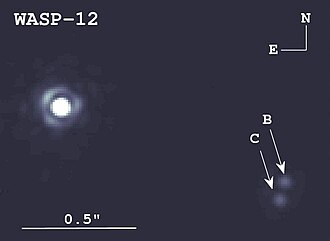
WASP-12 is a magnitude 11 yellow dwarf star located approximately 1347 light-years away2 in the constellation Auriga.6 WASP-12 has a mass and radius similar to the Sun and is known for being orbited by a planet that is extremely hot and has a retrograde orbit around WASP-12. WASP-12 forms a triple star system with two red dwarf companions. Both of them have spectral types of M3V and are only 38% and 37% as massive as the Sun, respectively.5
Planetary system

In 2008, the exoplanet WASP-12b was discovered orbiting WASP-12 by SuperWASP, using the transit method. It is a hot Jupiter completing an orbit around its star in just one day.10 Its high carbon-to-oxygen ratio indicates that rocky planets might have formed in the star system, and it may be a carbon planet.11 It is subject to intensive photo-evaporation, and may be completely destroyed within one billion years from now.12
In 2015, no indications of additional planets were found in the WASP-12 system.9
| Companion (in order from star) |
Mass | Semimajor axis (AU) |
Orbital period (days) |
Eccentricity | Inclination (°) |
Radius |
|---|---|---|---|---|---|---|
| b | 1.465±0.079 MJ | 0.0232±0.00064 | 1.09142030(14)9 | <0.0214 | 83.52±0.03 | 1.937±0.056 RJ |
References
References
- Roman, Nancy G. (1987). "Identification of a constellation from a position". Publications of the Astronomical Society of the Pacific. 99 (617): 695. Bibcode:1987PASP...99..695R. doi:10.1086/132034. Constellation record for this object at VizieR.
- Vallenari, A.; et al. (Gaia collaboration) (2023). "Gaia Data Release 3. Summary of the content and survey properties". Astronomy and Astrophysics. 674: A1. arXiv:2208.00211. Bibcode:2023A&A...674A...1G. doi:10.1051/0004-6361/202243940. S2CID 244398875. Gaia DR3 record for this source at VizieR.
- Henden, A. A.; et al. (2016). "VizieR Online Data Catalog: AAVSO Photometric All Sky Survey (APASS) DR9 (Henden+, 2016)". VizieR On-line Data Catalog: II/336. Originally Published in: 2015AAS...22533616H. 2336. Bibcode:2016yCat.2336....0H. Vizier catalog entry
- Bergfors, C.; Brandner, W.; Daemgen, S.; Biller, B.; Hippler, S.; Janson, M.; Kudryavtseva, N.; Geißler, K.; Henning, T.; Köhler, R. (2013). "Stellar companions to exoplanet host stars: Lucky Imaging of transiting planet hosts". Monthly Notices of the Royal Astronomical Society. 428 (1): 182. arXiv:1209.4087. Bibcode:2013MNRAS.428..182B. doi:10.1093/mnras/sts019.
- Bechter, Eric B.; Crepp, Justin R.; Ngo, Henry; Knutson, Heather A.; Batygin, Konstantin; Hinkley, Sasha; Muirhead, Philip S.; Johnson, John Asher; Howard, Andrew W.; Montet, Benjamin T.; Matthews, Christopher T.; Morton, Timothy D. (2014). "WASP-12b and HAT-P-8b are Members of Triple Star Systems". The Astrophysical Journal. 788 (1): 2. arXiv:1307.6857. Bibcode:2014ApJ...788....2B. doi:10.1088/0004-637X/788/1/2.
- "SIMBAD query result: WASP-12 -- Star". Centre de Données astronomiques de Strasbourg. Retrieved 2009-04-24.
- Skrutskie, Michael F.; Cutri, Roc M.; Stiening, Rae; Weinberg, Martin D.; Schneider, Stephen E.; Carpenter, John M.; Beichman, Charles A.; Capps, Richard W.; Chester, Thomas; Elias, Jonathan H.; Huchra, John P.; Liebert, James W.; Lonsdale, Carol J.; Monet, David G.; Price, Stephan; Seitzer, Patrick; Jarrett, Thomas H.; Kirkpatrick, J. Davy; Gizis, John E.; Howard, Elizabeth V.; Evans, Tracey E.; Fowler, John W.; Fullmer, Linda; Hurt, Robert L.; Light, Robert M.; Kopan, Eugene L.; Marsh, Kenneth A.; McCallon, Howard L.; Tam, Robert; Van Dyk, Schuyler D.; Wheelock, Sherry L. (1 February 2006). "The Two Micron All Sky Survey (2MASS)". The Astronomical Journal. 131 (2): 1163–1183. Bibcode:2006AJ....131.1163S. doi:10.1086/498708. ISSN 0004-6256. S2CID 18913331. Vizier catalog entry
- Leonardi, P.; Nascimbeni, V.; et al. (June 2024). "TASTE. V. A new ground-based investigation of orbital decay in the ultra-hot Jupiter WASP-12b". Astronomy & Astrophysics. 686: A84. arXiv:2402.12120. Bibcode:2024A&A...686A..84L. doi:10.1051/0004-6361/202348363.
- Collins, Karen A.; Kielkopf, John F.; Stassun, Keivan G. (2017). "Transit Timing Variation Measurements of WASP-12b and Qatar-1b: No Evidence of Additional Planets". The Astronomical Journal. 153 (2): 78. arXiv:1512.00464. Bibcode:2017AJ....153...78C. doi:10.3847/1538-3881/153/2/78.
- Hebb, L.; et al. (2009-03-10). "WASP-12b: The Hottest Transiting Extrasolar Planet Yet Discovered". The Astrophysical Journal. 693 (2): 1920–1928. arXiv:0812.3240. Bibcode:2009ApJ...693.1920H. doi:10.1088/0004-637X/693/2/1920.
- Madhusudhan, Nikku; Harrington, Joseph; Stevenson, Kevin B.; Nymeyer, Sarah; Campo, Christopher J.; Wheatley, Peter J.; Deming, Drake; Blecic, Jasmina; et al. (December 8, 2010). "A high C/O ratio and weak thermal inversion in the atmosphere of exoplanet WASP-12b". Nature. 469 (7328): 64–7. arXiv:1012.1603. Bibcode:2011Natur.469...64M. doi:10.1038/nature09602. PMID 21150901. S2CID 4415171..
- Ehrenreich, D.; Désert, J. -M. (2011). "Mass-loss rates for transiting exoplanets". Astronomy and Astrophysics. 529: A136. arXiv:1103.0011. Bibcode:2011A&A...529A.136E. doi:10.1051/0004-6361/201016356.
- Chakrabarty, Aritra; Sengupta, Sujan (July 2019). "Precise Photometric Transit Follow-up Observations of Five Close-in Exoplanets: Update on Their Physical Properties". The Astronomical Journal. 158 (1): 39. arXiv:1905.11258. Bibcode:2019AJ....158...39C. doi:10.3847/1538-3881/ab24dd.
- Bonomo, A. S.; Desidera, S.; et al. (June 2017). "The GAPS Programme with HARPS-N at TNG. XIV. Investigating giant planet migration history via improved eccentricity and mass determination for 231 transiting planets". Astronomy & Astrophysics. 602: A107. arXiv:1704.00373. Bibcode:2017A&A...602A.107B. doi:10.1051/0004-6361/201629882. S2CID 118923163.
External links
External links
- WASP-12b in transit (lightcurve)
- "WASP-12". Exoplanets. Archived from the original on 2009-11-25. Retrieved 2009-05-06.