| Walterosteus | |
|---|---|
| |
| Walterosteus lelievrei | |
Scientific classification 
| |
| Kingdom: | Animalia |
| Phylum: | Chordata |
| Class: | †Placodermi |
| Order: | †Arthrodira |
| Suborder: | †Brachythoraci |
| Family: | †Selenosteidae |
| Genus: | †Walterosteus Stensiö, 1959 |
| Type species | |
| Walterosteus pachyostoides Stensiö 1959
| |
| Species | |
| |
| Synonyms | |
| |
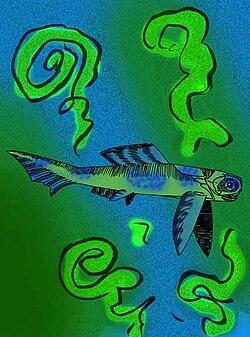
Walterosteus is an extinct genus of small selenosteid arthrodire placoderms known from the Upper Frasnian Kellwasserkalk facies of Late Devonian Germany1: 96 and Morocco.2
Walterosteus is very similar to the other Kellwasserkalk selenosteids. This similarity lead Denison (1978) to synonymize the genus, together with Ottonosteus (O. jaekeli = E. hermanni), into Enseosteus, claiming that the former two genera are too similar to Enseosteus to merit separate genus status.1 Rücklin (2011) agrees with Denison's synonymizing of Ottonosteus, but rejects Denison's synonymization of Walterosteus, claiming how Walterosteus has a contact between the rostral plate and the pineal plate, which Enseosteus does not.2
Etymology
The genus was named by Erik Stensiö to commemorate the contributions done by Walter Gross, a German specialist on Paleozoic fishes, and his important contributions to the understanding of the overall anatomy of arthrodire placoderms.
References
References
- Denison, Robert (1978). Handbook of Paleoichthyology, Volume 2, Placodermi. New York: Gustav Fischer Verlage. p. 98. ISBN 9780895740274.
- RÜCKLIN, MARTIN (January 14, 2011). "First selenosteid placoderms from the eastern Anti-Atlas of Morocco; osteology, phylogeny and palaeogeographical implications". Palaeontology. 56 (1): 25–62. doi:10.1111/j.1475-4983.2010.01026.x.