Walter Ehle | |
|---|---|
 Grave 21-42 | |
| Born | 28 April 1913 |
| Died | 18 November 1943(1943-11-18) (aged 30) |
| Buried | Lommel, Belgium |
| Allegiance |  Nazi Germany Nazi Germany |
Branch |  Luftwaffe Luftwaffe |
Service years | 1935–1943 |
Rank | Major (major) |
| Unit | Condor Legion ZG 1 NJG 1 |
| Commands | II./ NJG 1 |
Conflicts | See battles Spanish Civil War
World War II Air campaigns: |
Walter Ehle (28 April 1913 – 18 November 1943) was a Luftwaffe night fighter ace and recipient of the Knight's Cross of the Iron Cross during World War II. The Knight's Cross of the Iron Cross, and its variants were the highest awards in the military and paramilitary forces of Nazi Germany during World War II. Walter Ehle claimed 39 aerial victories, 35 of them at night.Note 1
Early life and career
Ehle was born on 28 April 1913 in Windhuk in German South West Africa, present-day Windhoek is the capital and largest city of the Republic of Namibia.1
World War II
At the start of the war Ehle flew with 3./ZG 1 and was credited with three daylight kills before the unit was redesignated 3./Nachtjagdgeschwader 1 (NJG 1) and he became a night fighter.
Night fighter career
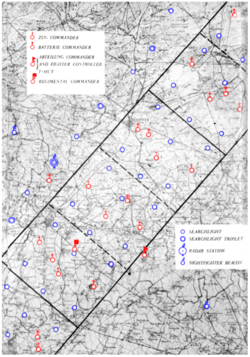
Following the 1939 aerial Battle of the Heligoland Bight, RAF attacks shifted to the cover of darkness, initiating the Defence of the Reich campaign.2 By mid-1940, Generalmajor (Brigadier General) Josef Kammhuber had established a night air defense system dubbed the Kammhuber Line. It consisted of a series of control sectors equipped with radars and searchlights and an associated night fighter. Each sector named a Himmelbett (canopy bed) would direct the night fighter into visual range with target bombers. In 1941, the Luftwaffe started equipping night fighters with airborne radar such as the Lichtenstein radar. This airborne radar did not come into general use until early 1942.3
Group commander
Ehle was appointed Gruppenkommandeur (group commander) of II. Gruppe of NJG 1 on 6 October 1940, succeeding Hauptmann Heinrich Graf von Stillfried und Rattonitz.4 His sixth night victory was a Bristol Blenheim shot down on 2 June 1942, and he had 16 victories in total by the end of 1942.
On 18 November 1943 Walter Ehle's Messerschmitt Bf 110 crashed near St. Trond, Belgium. As he was landing his airfield lights were extinguished; his aircraft crashed and he and his crew, Ofw. Leidenbach (Bordfunker—radio/wireless operator) and Uffz. Derlitzky (Bordschütze—aerial gunner), perished. He was succeeded by Major Eckart-Wilhelm von Bonin as commander of II. Gruppe of NJG 1.4
Major Ehle was awarded the Knight's Cross of the Iron Cross (Ritterkreuz des Eisernen Kreuzes) on 29 August after 31 victories and at the time of his death he was credited with 39. He shot down a total of 38 enemy aircraft of which 35 were at night.
Summary of career
Aerial victory claims
According to Obermaier, Ehle was credited with 39—four daytime and 35 nighttime—aerial victories.5 Foreman, Parry and Mathews, authors of Luftwaffe Night Fighter Claims 1939 – 1945, researched the German Federal Archives and found records for 34 nocturnal victory claims.6 Mathews and Foreman also published Luftwaffe Aces — Biographies and Victory Claims, listing Ehle with 34 claims, including three as a Zerstörer pilot, plus three further unconfirmed claims.7
| Chronicle of aerial victories | ||||||
|---|---|---|---|---|---|---|
|
This and the ♠ (Ace of spades) indicates those aerial victories which made Ehle an "ace-in-a-day", a term which designates a fighter pilot who has shot down five or more airplanes in a single day. | ||||||
| Claim (total) |
Claim (nocturnal) |
Date | Time | Type | Location | Serial No./Squadron No. |
| – 3. Staffel of Zerstörergeschwader 1 –7 | ||||||
| 1 | 6 September 1939 | 05:15 | PZL P.11 | Warsaw | ||
| 2 | 8 September 1939 | —
|
PZL.37 Łoś | Radzymin | ||
| 3 | 1 June 1940 | —
|
Spitfire | vicinity of Dunkirk | ||
| – 3. Staffel of Nachtjagdgeschwader 1 –7 | ||||||
| 4 | 1 | 21 July 1940 | 01:38 | Wellington | 12 km (7.5 mi) northwest of Munster8 | |
| – Stab II. Gruppe of Nachtjagdgeschwader 1 –7 | ||||||
| 5 | 2 | 9 February 1941 | 23:35 | Wellington | 15 km (9.3 mi) west of Nunspeet9 | Wellington T2702/No. 15 Squadron RAF1 |
| 6 | 3 | 11 May 1941 | 00:57 | Wellington | 5 km (3.1 mi) west of Westerhever10 | |
| 7 | 4 | 30 June 1941 | 01:52 | Wellington | 40 km (25 mi) northeast of Bremen11 | |
| 8 | 5 | 30 June 1941 | 02:45 | Stirling | 2 km (1.2 mi) northwest of Ellerbeck11 | |
| 9 | 6 | 2 June 1942 | 02:34 | Blenheim | north-northeast of Brussels12 | Wellington DV763/No. 16 Operational Training Unit13 |
| 10 | 7 | 7 August 1942 | 02:40 | Halifax | 2 km (1.2 mi) southwest of Gruitrode14 | |
| 11 | 8 | 12 August 1942 | 03:12 | Wellington | northwest of Leuven14 | |
| 12 | 9 | 28 August 1942 | 23:02 | Wellington | east of Wihogne15 | |
| 13 | 10 | 28 August 1942 | 23:51 | Wellington | northeast of Liège15 | |
| 14 | 11 | 29 August 1942 | 02:52 | Wellington | Grez-Doiceau16 | |
| 15 | 12 | 2 September 1942 | 04:13 | Stirling | Nossegem (incorrectly spelled "Osseghem" in the reference book)16 | Stirling N3714/No. 218 (Gold Coast) Squadron RAF17 |
| 16 | 13 | 3 September 1942 | 01:59 | Lancaster | 22 km (14 mi) southwest of Liège16 | |
| 17 | 14 | 7 September 1942 | 04:55 | Wellington | 7 km (4.3 mi) south of Tilburg18 | |
| 18 | 15 | 17 September 1942 | 01:08 | Stirling | south of Tirlemont19 | |
| 19 | 16 | 11 April 1943 | 03:45 | Stirling | 1 km (0.62 mi) south of Tongerlo20 | Stirling BK760/No. 7 Squadron RAF21 |
| 20 | 17 | 13 May 1943 | 02:44 | Lancaster | 3 km (1.9 mi) north of Roermond22 | |
| 21♠ | 18 | 26 May 1943 | 01:51 | Halifax | 1 km (0.62 mi) south of Jülich23 | Halifax JB837/No. 77 Squadron RAF24 |
| 22♠ | 19 | 26 May 1943 | 01:52 | Stirling | 2 km (1.2 mi) south of Jülich23 | Stirling EF361/No. 7 Squadron RAF25 |
| 23♠ | 20 | 26 May 1943 | 01:52 | Stirling | 6 km (3.7 mi) south of Jülich23 | Stirling BF534/No. 15 Squadron RAF25 |
| 24♠ | 21 | 26 May 1943 | 01:55 | Stirling | 8 km (5.0 mi) south of Jülich23 | Stirling EH887/No. 218 (Gold Coast) Squadron RAF26 |
| 25♠ | 22 | 26 May 1943 | 02:35 | Wellington | 3 km (1.9 mi) north of Nederweert23 | Wellington HE699/No. 166 Squadron RAF27 |
| 26 | 23 | 30 May 1943 | 00:37 | Halifax | 9 km (5.6 mi) southeast of Aachen28 | |
| 27 | 24 | 30 May 1943 | 01:05 | Halifax | 6 km (3.7 mi) northeast of Jülich28 | |
| 28 | 25 | 17 June 1943 | 01:18 | Lancaster | south-southwest of Jülich29 | |
| 29 | 26 | 22 June 1943 | 02:39 | Halifax | 4 km (2.5 mi) northwest of Bortel30 | |
| 30 | 27 | 29 June 1943 | 02:33 | Stirling | 40 km (25 mi) west-southwest of Diest31 | Stirling EE880/No. 149 Squadron RAF32 |
| 31 | 28 | 28 July 1943 | 01:26 | Lancaster | west-southwest of Bremervörde33 | |
| 32 | 29 | 18 August 1943 | 01:44 | Lancaster | north-northwest of Peenemünde34 | |
| 33 | 30 | 18 August 1943 | 01:46 | Lancaster | north-northwest of Peenemünde34 | |
—
|
31?Note 2 | 28 August 1943 | 02:00 | Stirling | northwest of Nuremberg36 | |
| 34 | 32 | 31 August 1943 | 03:45 | Lancaster | Giesenkirchen37 | |
—
|
33?Note 2 | 3 November 1943 | 14:25 | B-1738 | ||
—
|
34?Note 2 | 3 November 1943 | 19:40 | Lancaster | 30 km (19 mi) west-northwest of Cologne38 | |
Awards
- Aviator badge
- Front Flying Clasp of the Luftwaffe in Gold
- Spanish Cross in Gold with Swords (14 April 1939)7
- Iron Cross (1939) 2nd and 1st Class
- German Cross in Gold on 20 October 1942 as Hauptmann in the II./Nachtjagdgeschwader 139Note 3
- Knight's Cross of the Iron Cross on 29 August 1943 as Major and Gruppenkommandeur of the II./Nachtjagdgeschwader 14041
Notes
Notes
- For a list of Luftwaffe night fighter aces see List of German World War II night fighter aces.
- According to Luftwaffe Aces — Biographies and Victory Claims, this claim was unconfirmed while Luftwaffe Night Fighter Claims 1939 – 1945 confirm this claim.357
- According to Obermaier on 9 November 1942.5
References
References
Citations
- Bowman 2016, p. 26.
- Foreman, Parry & Mathews 2004, p. 9.
- Foreman, Parry & Mathews 2004, p. 27.
- Aders 1978, p. 227.
- Obermaier 1989, p. 106.
- Foreman, Parry & Mathews 2004, pp. 10–125.
- Mathews & Foreman 2014, p. 264.
- Foreman, Parry & Mathews 2004, p. 10.
- Foreman, Parry & Mathews 2004, p. 16.
- Foreman, Parry & Mathews 2004, p. 20.
- Foreman, Parry & Mathews 2004, p. 23.
- Foreman, Parry & Mathews 2004, p. 43.
- Bond 2014, p. 78.
- Foreman, Parry & Mathews 2004, p. 54.
- Foreman, Parry & Mathews 2004, p. 56.
- Foreman, Parry & Mathews 2004, p. 57.
- Stirling N3714.
- Foreman, Parry & Mathews 2004, p. 58.
- Foreman, Parry & Mathews 2004, p. 59.
- Foreman, Parry & Mathews 2004, p. 74.
- Stirling BK760.
- Foreman, Parry & Mathews 2004, p. 79.
- Foreman, Parry & Mathews 2004, p. 82.
- Halifax JB837.
- Stirling EF361.
- Stirling EH887.
- Wellington HE699.
- Foreman, Parry & Mathews 2004, p. 83.
- Foreman, Parry & Mathews 2004, p. 86.
- Foreman, Parry & Mathews 2004, p. 88.
- Foreman, Parry & Mathews 2004, p. 91.
- Stirling EE880.
- Foreman, Parry & Mathews 2004, p. 98.
- Foreman, Parry & Mathews 2004, p. 103.
- Foreman, Parry & Mathews 2004, pp. 107, 125.
- Foreman, Parry & Mathews 2004, p. 107.
- Foreman, Parry & Mathews 2004, p. 108.
- Foreman, Parry & Mathews 2004, p. 125.
- Patzwall & Scherzer 2001, p. 98.
- Fellgiebel 2000, p. 143.
- Scherzer 2007, p. 289.
Bibliography
- Aders, Gebhard (1978). History of the German Night Fighter Force, 1917–1945. London: Janes. ISBN 978-0-354-01247-8.
- Bond, Steve (2014). Wimpy: A Detailed History of the Vickers Wellington in service, 1938-1953. London: Grub Street Publishing. ISBN 978-1-90980-814-0.
- Bowman, Martin (2016). Nachtjagd, Defenders of the Reich 1940–1943. Barnsley, South Yorkshire: Pen and Sword Books. ISBN 978-1-4738-4986-0.
- Fellgiebel, Walther-Peer [in German] (2000) [1986]. Die Träger des Ritterkreuzes des Eisernen Kreuzes 1939–1945 — Die Inhaber der höchsten Auszeichnung des Zweiten Weltkrieges aller Wehrmachtteile [The Bearers of the Knight's Cross of the Iron Cross 1939–1945 — The Owners of the Highest Award of the Second World War of all Wehrmacht Branches] (in German). Friedberg, Germany: Podzun-Pallas. ISBN 978-3-7909-0284-6.
- Foreman, John; Parry, Simon; Mathews, Johannes (2004). Luftwaffe Night Fighter Claims 1939–1945. Walton on Thames: Red Kite. ISBN 978-0-9538061-4-0.
- Mathews, Andrew Johannes; Foreman, John (2014). Luftwaffe Aces — Biographies and Victory Claims — Volume 1 A–F. Walton on Thames: Red Kite. ISBN 978-1-906592-18-9.
- Obermaier, Ernst (1989). Die Ritterkreuzträger der Luftwaffe Jagdflieger 1939 – 1945 [The Knight's Cross Bearers of the Luftwaffe Fighter Force 1939 – 1945] (in German). Mainz, Germany: Verlag Dieter Hoffmann. ISBN 978-3-87341-065-7.
- Patzwall, Klaus D.; Scherzer, Veit (2001). Das Deutsche Kreuz 1941 – 1945 Geschichte und Inhaber Band II [The German Cross 1941 – 1945 History and Recipients Volume 2] (in German). Norderstedt, Germany: Verlag Klaus D. Patzwall. ISBN 978-3-931533-45-8.
- Scherzer, Veit (2007). Die Ritterkreuzträger 1939–1945 Die Inhaber des Ritterkreuzes des Eisernen Kreuzes 1939 von Heer, Luftwaffe, Kriegsmarine, Waffen-SS, Volkssturm sowie mit Deutschland verbündeter Streitkräfte nach den Unterlagen des Bundesarchives [The Knight's Cross Bearers 1939–1945 The Holders of the Knight's Cross of the Iron Cross 1939 by Army, Air Force, Navy, Waffen-SS, Volkssturm and Allied Forces with Germany According to the Documents of the Federal Archives] (in German). Jena, Germany: Scherzers Militaer-Verlag. ISBN 978-3-938845-17-2.
- "Accident description for Halifax JB837". Aviation Safety Network. Retrieved 14 April 2022. The ASN Wikibase is user-generated content and unreliable. Please replace this source.
- "Accident description for Stirling BK760". Aviation Safety Network. Retrieved 14 April 2022. The ASN Wikibase is user-generated content and unreliable. Please replace this source.
- "Accident description for Stirling EE880". Aviation Safety Network. Retrieved 14 April 2022. The ASN Wikibase is user-generated content and unreliable. Please replace this source.
- "Accident description for Stirling EF361". Aviation Safety Network. Retrieved 14 April 2022. The ASN Wikibase is user-generated content and unreliable. Please replace this source.
- "Accident description for Stirling EH887". Aviation Safety Network. Retrieved 14 April 2022. The ASN Wikibase is user-generated content and unreliable. Please replace this source.
- "Accident description for Stirling N3714". Aviation Safety Network. Retrieved 14 April 2022. The ASN Wikibase is user-generated content and unreliable. Please replace this source.
- "Accident description for Wellington HE699". Aviation Safety Network. Retrieved 14 April 2022. The ASN Wikibase is user-generated content and unreliable. Please replace this source.
External links
External links
- TracesOfWar.com
- Luftwaffe 39-45 Archived 2011-02-23 at the Wayback Machine