| Walchia Temporal range: ~
| |
|---|---|
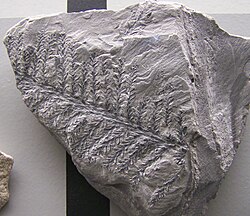
| |
| Walchia piniformis | |
Scientific classification 
| |
| Kingdom: | Plantae |
| Clade: | Embryophytes |
| Clade: | Tracheophytes |
| Clade: | Spermatophytes |
| Clade: | Gymnospermae |
| Division: | Pinophyta |
| Class: | Pinopsida |
| Order: | †Voltziales |
| Family: | †Utrechtiaceae |
| Genus: | †Walchia Sternberg |
| Species | |
| |
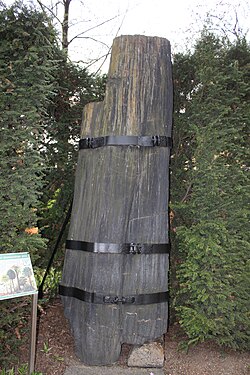
Walchia is a primitive fossil conifer found in upper Pennsylvanian (Carboniferous) and lower Permian (about 310-290 Mya) rocks of Europe and North America. A forest of in-situ Walchia tree-stumps is located on the Northumberland Strait coast at Brule, Nova Scotia.
Besides the Walchia forest, fallen tree trunks, and leaflet impressions, the forest, fossil-rich layer contains numerous, 4-legged, tetrapod fossil trackways.
Individual species
Walchia hypnoides: from the schists of Lodeve; also copper slates of the Zechstein in Mansfeld.
Monuran trackways
At the same time period of 290 mya, another species was making fossil trackways, now preserved in New Mexico; Walchia leaflets are found in the same fossil layers. The Monuran trackways were made by Permian, wingless insects called monurans, (meaning "one-tail"); the insects' means of locomotion was hopping, then walking.
These 290 mya layers contain footprints of the large Dimetrodon, large/small raindrop impact marks, and also these fossil trackways of insects.
References
References
External links
External links
- General articles
- Chemosystematic and microstructural investigations--(including Walchia)
- Book preview-(1854)--W. hypnoides discussion
- Walchia Fossil examples
- Graphic of W. piniformis branchlets, from James D. Dana, "Manual of Geology" [1]
- Photo-High Res; Article – www.news.ucdavis.edu--"A Bumpy Shift from Icehouse to Greenhouse", Fossil from Smithsonian. Walchia went from the 'Uplands' to the lower basins-(floodplain forest region of Brule, Nova Scotia).
- Photo-High Res--4 cm width Leaflet-(Order Voltziales); Article – www.colby.edu-"Carboniferous Paleoecological Scenarios"
- Walchia fossils, with Monuran trackways
- "The Footfalls and Bellyflops of Permian Insects" – (from the Robledo Mountains of New Mexico)