| Wagtail (CMS) | |
|---|---|
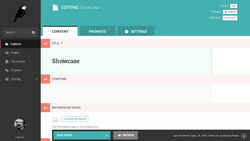 Wagtail interface | |
| Developer | Torchbox |
| Release | February 2014 (2014-02) |
| Stable release | |
| Written in | Python |
| Operating system | Cross-platform |
| Platform | Django |
| Available in | 502 languages |
| Type | Content management system |
| License | 3-clause BSD3 |
| Website | wagtail |
| Repository | |

Wagtail is a free and open source content management system (CMS) written in Python.4 It is popular56 amongst websites using the Django web framework.7 The project is maintained by a team of open-source contributors8 backed by companies around the world.9 The project has a focus on developer friendliness10 as well as ease of use of its administration interface, translated in multiple languages.11
History
The Wagtail project was started in 201412 by Torchbox, a digital agency. The development of the CMS evolved from being the sole action of its creators13 to receiving contributions from 46 external contributors by its version 1.014 in July 2015. Since then, development sprints have been organised15 to foster the community. During those sprints, contributors gather to work on selected topics and steer the project. As of July 2016, 257 people had directly contributed to the code and translations.16 In January 2017, the core development team had increased to nine developers and the main GitHub repository was moved from the Torchbox namespace to a dedicated Wagtail namespace.17
Notable uses
- NASA for the Jet Propulsion Laboratory website 18
- Google blog 19
- The 18F agency of the US Government for beta.FEC.gov
- Peace Corps on their site
- New Zealand Red Cross on their site
- University of Pennsylvania for the Wharton Tech Blog20
- University of Duhok for their site
- California Institute of Technology for their site 21
- University of Tasmania for multiple sites
- Consumer Financial Protection Bureau for their site 22
- The UK's National Health Service migrated their main site to Wagtail, beginning in 2017.2324
- Nebraska Public Media — the state's PBS and NPR stations — use it for their site.
References
References
- "Release 7.4.2". 15 June 2026. Retrieved 16 June 2026.
- "wagtail/wagtail on Transifex". Transifex. Retrieved 2019-11-07.
- "wagtail/wagtail license on GitHub". GitHub.com. Retrieved March 16, 2023.
- "wagtail: Python Package Index". pypi.python.org. Retrieved 2016-07-09.
- "vinta/awesome-python". GitHub. Retrieved 2016-07-09.
- "wagtail/wagtail stargazers". GitHub. Retrieved 2016-07-09.
- "Django Packages - CMS". djangopackages.com. Retrieved 2016-03-01.
- "wagtail/wagtail contributors on GitHub". GitHub. Retrieved 2016-07-09.
- "Developers". madewithwagtail.org. Retrieved 2016-07-09.
- "About Wagtail CMS | Wagtail CMS". Wagtail CMS. Retrieved 2016-07-09.
- "The Wagtail translation project on Transifex". www.transifex.com. Retrieved 2016-07-09.
- "First commit to wagtail/wagtail". GitHub. Retrieved 2016-07-09.
- "wagtail/wagtail contributors list in v0.1". GitHub. Retrieved 2016-07-09.
- "wagtail/wagtail list of contributors for v1.0 on GitHub". GitHub. Retrieved 2016-07-09.
- "springload/wagtail-core-notes for the june 2016 sprint". GitHub. Retrieved 2016-07-09.
- "wagtail/wagtail contributors list". GitHub. Retrieved 2016-07-09.
- "Core team expansion | Wagtail CMS". Wagtail CMS. Retrieved 2017-05-29.
- "Going headless with Wagtail, Nuxt.js and GraphQL". Retrieved 2023-01-10.
- "Google sponsors Wagtail CMS's next-generation web content management experience". Retrieved 2023-01-10.
- "The UK firm behind this buzzy Wordpress competitor is opening an office in Philly - Technical.ly Philly". 2015-11-11. Retrieved 2016-07-18.
- "Embed Form in Caltech Sites". Retrieved 2023-01-10.
- "CFPB Projects". Retrieved 2023-01-10.
- "NHS picks Wagtail CMS to power the next generation of its online services". 11 September 2017.
- "NHS.UK content migration update". NHS Digital. 19 January 2018.