Wadhwan State | |||||||||
|---|---|---|---|---|---|---|---|---|---|
| 1630–1948 | |||||||||
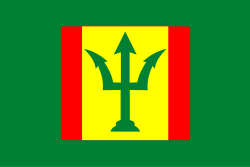 Flag
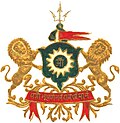 Coat of arms
| |||||||||
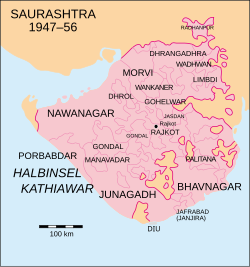 Location of Wadhwan State in Saurashtra | |||||||||
| Capital | Wadhwan | ||||||||
| History | |||||||||
• Established | 1630 | ||||||||
• Accession to the Indian Union | 1948 | ||||||||
| Area | |||||||||
| 1931 | 627 km2 (242 sq mi) | ||||||||
| 1943 | 1,202 km2 (464 sq mi) | ||||||||
| Population | |||||||||
• 1931 | 42,602 | ||||||||
• 1943 | 69,245 | ||||||||
| |||||||||


Wadhwan State was an offshoot of Jhalavad, later became 9-guns Salute princely state during the British Raj. It ruled by the Jhala clan of Rajputs1
The town of Wadhwan in the Saurashtra region of Gujarat was its capital. Its last ruler signed the accession to the Indian Union on 15 February 1948.23
History
Wadhwan State was established in 1630 by Thakore Saheb Rajoji, the grandson of Maharana Raj Saheb Chandra Singhji I of Jhalavad. Rajoji's grandson was Madhav Singh, the ancestor of Zalim Singh Jhala. Madhav Singh went to Hadoti, but his two sons, Arjan Singh and Abhey Singh, returned to Wadhwan.4 Arjan Singh then became the Thakore Saheb of Wadhwan, while Abhey Singh ruled over Chuda State.5 It became a British protectorate in 1807. The rulers of the state bore the title "Thakur Sahib".61
References
References
- Archives, Royal (16 March 2022). "Wadhwan (Princely State)". Royal Archives. Retrieved 6 August 2025.
- Solomon, R. V.; Bond, J. W. (2006). Indian States: A Biographical, Historical, and Administrative Survey. Asian Educational Services. ISBN 978-81-206-1965-4.
- Rathore, Abhinay (1945). "Wadhwan (Princely State)". Rajput Provinces of India. Retrieved 6 August 2025.
- Manager of Publications Delhi. Memoranda On The Indian States 1939.
- The Hind Rajasthan: the annals of the Native States of India. Amritlal G. Shah, Bapawala. 1896.
- Department, India Foreign and Political (1909). Bombay presidency. Office of the Superintendent of Government Printing, India.