| Vulpicida juniperinus | |
|---|---|

| |
Scientific classification 
| |
| Kingdom: | Fungi |
| Division: | Ascomycota |
| Class: | Lecanoromycetes |
| Order: | Lecanorales |
| Family: | Parmeliaceae |
| Genus: | Vulpicida |
| Species: | V. juniperinus
|
| Binomial name | |
| Vulpicida juniperinus (L.) J.-E.Mattsson & M.J.Lai (1993)
| |
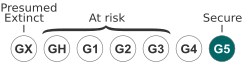
Vulpicida juniperinus is a species of lichen found in the Northern Hemisphere, commonly known as rock sunshine lichen or yellow rock lichen. This species is characterized by its bright yellow, coral-like growth form on exposed ground, often in Arctic or alpine areas.2
Previously thought to be three distinct species, V. juniperinus is now thought of as a single species or a species complex, composed of what used to be V. juniperinus, V. tilesii, and V. tubulosis.34
References
References
- NatureServe. "Vulpicida juniperina". NatureServe Explorer. Arlington, Virginia. Retrieved 12 November 2025.
- "Consortium of Lichen Herbaria - Vulpicida juniperinus". lichenportal.org. Retrieved 2024-09-05.
- Saag, Lauri; Mark, Kristiina; Saag, Andres; Randlane, Tiina (December 2014). "Species delimitation in the lichenized fungal genus Vulpicida (Parmeliaceae, Ascomycota) using gene concatenation and coalescent-based species tree approaches". American Journal of Botany. 101 (12): 2169–2182. doi:10.3732/ajb.1400439. ISSN 0002-9122. PMID 25480713.
- Mark, Kristiina; Saag, Lauri; Saag, Andres; Thell, Arne; Randlane, Tiina (November 2012). "Testing morphology-based delimitation of Vulpicida juniperinus and V. tubulosus (Parmeliaceae) using three molecular markers". The Lichenologist. 44 (6): 757–772. doi:10.1017/S0024282912000448. ISSN 1096-1135.