

Vortiporius, often shortened to Vortipor (Old Welsh: Guortepir, Middle Welsh: Gwrdeber or Gwerthefyr),1 was a king of Dyfed in the early to mid-6th century. He ruled over an area approximately corresponding to modern Pembrokeshire, and Carmarthenshire, Wales. Records from this era are scant, and virtually nothing is known of him or his kingdom. The only contemporary information about Vortiporius comes from the Welsh ecclesiastic Gildas, in a highly allegorical condemnation from his De Excidio et Conquestu Britanniae (English: "On the Ruin and Conquest of Britain"). At the time the work was written (c. 540), Gildas says that Vortiporius was king of Dyfed, that he was grey with age, that his wife had died, and that he had at least one daughter.23
As a legendary king in Geoffrey of Monmouth's 12th-century treatment of the Matter of Britain, the Historia Regum Britanniae, Vortiporius was the successor of Aurelius Conanus and was succeeded by Maelgwn. He is not mentioned in the 9th-century Historia Brittonum attributed to Nennius. Vortiporius appears in the Irish genealogy given in the 8th-century work The Expulsion of the Déisi, in which his name is given as Gartbuir.4 The pedigree given in the Harley MS 5389, written c. 1100, is nearly identical, with his name given as Guortepir.5 In the Jesus College MS. 20, he is called Gwrdeber.6 The genealogy in Expulsion says he was a descendant of Eochaid Allmuir (English: "Eochaid the Foreigner" [literally (from) Overseas]),7 who is said to have led a sept of the Déisi in their settlement of Dyfed c. 270.8
A memorial stone was discovered in 1895 near the church of Castell Dwyran in Carmarthenshire bearing a Christian cross and with inscriptions in both Latin and in ogham.9 Dedicated to Voteporigis in the Latin inscription and Votecorigas in ogham, it was immediately assumed by Rhys that Vortiporius is Voteporix were the same person. He said that the 'r' had been added at a later date, and offered several suppositions as to how this might have happened.10that this referred to Vortiporius. However, this assumption is refuted by modern linguistic analysis by Patrick Sims-Williams11, which notes that the missing 'r' in the first syllable of 'Voteporigis'/'Votecorigas' or Voteporix in nominative is significant, and so the stone must be dedicated to a different person.12 He also adds that dating the stone to the time of Vortiporius may not be valid.12
Gildas
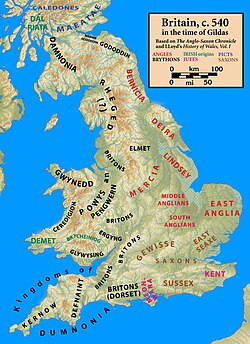
In his De Excidio et Conquestu Britanniae (English: On the Ruin and Conquest of Britain), written c. 540, Gildas makes an allegorical condemnation of 5 British kings by likening them to the beasts of the Christian Apocalypse as expressed in the biblical Book of Revelation, 13:2: the lion, leopard, bear, and dragon.13 In the course of his condemnations, Gildas makes passing reference to the other beasts mentioned in the Apocalypse, such as the eagle, serpent, calf, and wolf. Vortiporius is called "the spotted leopard" and the "tyrant of the Demetians", where Demetia is the ancient name of Dyfed.
Gildas restricts his attention to the kings of Gwynedd (Maelgwn Gwynedd), Dyfed (Vortiporius), Rhos (Cuneglasus may be the Cynlas appears in royal genealogies associated with the region),14 Dumnonia (Constantine), and the unknown region associated with Aurélius Caninus ( probably Caer Gleuon, which nowadays Gloucester ).
The reason for Gildas' disaffection for these individuals is unknown. He was selective in his choice of kings, as he had no comments concerning the kings of the other British kingdoms that were thriving at the time, such as Rheged, Gododdin, Elmet, Powys, or the kingdoms of modern-day southern England. Gildas claims outrage over moral depravity, and begins the condemnation of the five kings with an attack against the mother of one of the kings, calling her an "unclean lioness".1516
Of Vortiporius Gildas says little other than offering condemnation for "sins" and providing the few personal details previously mentioned. He is alleged to be the bad son of a good father. Gildas also attacks his daughter, calling her "shameless",23 and implies that Vortiporius raped or had a sexual relationship with her.17
Geoffrey of Monmouth
Geoffrey's mention of Vortiporius is contained in a brief chapter titled "Uortiporius, being declared king, conquers the Saxons". He says that Uortiporius succeeded Aurelius Conan, and after he was declared king, the Saxons rose against him and brought over their countrymen from Germany in a great fleet, but that these were defeated. Uortiporius then ruled peacefully for four years.18 Geoffrey's fertile imagination is the only source of this information.
The Myvyrian Archaiology of Wales, an early 19th-century collection of Welsh histories, repeats Geoffrey's account, referring to him as 'Gwrthevyr' (though Vortiporius' proper Modern Welsh spelling is Gwrdebyr; here the name has been confused with that of Vortimer, the son of Vortigern).19 In his Britannicarum Ecclesiarum Antiquitates, James Ussher also repeats the account, attributing the information to Geoffrey.20
Family
Vortipor ap Aergol Lawhir ap Triffyn Farfog was the father of a Cyngar 21 and might also belong to the same family as the similarly named Voteporix comemorated on a monument bearing both Latin and Irish ogham inscriptions, dated to the 5th or 6th century, from Castell Dwyran, Carmarthenshire, Wales.

The stone's original location at the church is next to a meadow known locally as Parc yr Eglwys. Local tradition carries the admonition that plowing must not be done near the church. Examination of the meadow showed evidence of large hut-circles. The Latin inscription on the stone reads Memoria Voteporigis Protictoris
The ogham inscription carries only the Goidelic form of his name in the genitive: Votecorigas (early Goidelic did not possess the sound /p/). Protector (spelled here Protictoris, in the genitive) in the Latin inscription may imply a Roman-era honorific bestowed upon his ancestors, retained as a hereditary title into the 6th century. Eric Hamp suggests that Protector may be a Latin translation of Uoteporix (which has essentially the same meaning as the Latin), a "sort of explanatory gloss".22 The ogham inscription in Goidelic shows that Primitive Irish was still in use in this part of Britain at that time, and had not yet died out in South Wales.
Citations
Citations
- Koch, John, Celtic Culture: a historical encyclopedia, ABC-CLIO, 2006, p. 864: "In Old Welsh sources, the name Guortepir, corresponding to the Vorteporius of Gildas...is kept distinct from Guorthemir, but in Middle Welsh texts the two tend to fall together as Gwerthefyr, the former unhistorically taking the form of the latter."
- Giles 1841:27–28, De Excidio, section 31 (in English)
- Giles 1847:246–279, De Excidio, section 31 (in Latin)
- Meyer 1901:112–113, The Expulsion of the Dessi. The Irish form is given as "Tualodor mac Rigin maic Catacuind maic Caittienn maic Clotenn maic Naee maic Artuir maic Retheoir maic Congair maic Gartbuir maic Alchoil maic Trestin maic Aeda Brosc maic Corath maic Echach Almuir maic Arttchuirp". Meyer's translation is "Teudor son of Regin, son of Catgocaun, son of Cathen, son of Cloten, son of Nougoy, son of Arthur, son of Petr, son of Cincar, son of Guortepir, son of Aircol, son of Triphun, son of Áed Brosc, son of Corath, son of Eochaid Allmuir, son of Artchorp".
- Phillimore 1888:171, Harleian MS. 3859, "... Teudos map Regin map Catgocaun map Cathen map Cloten map Nougoy map Arthur map Petr map Cincar map Guortepir map Aircol map Triphun ...".
- Phillimore 1887:86, Pedigrees From Jesus College MS. 20. "... Teudos M. Gwgawn M. Cathen M. Eleothen M. Nennue M. Arthur M. Peder M. Kyngar M. Gwrdeber M. Erbin M. Aircol lawhir M. tryphun M. Ewein vreisc M. Cyndwr bendigeit ...". Ewein vreisc is given here for Áed Brosc given elsewhere, and Erbin is inserted between Gwrdeber and Aircol, where he is not listed elsewhere.
- Dictionary of the Irish Language, Compact Edition, Royal Irish Academy, 1998; allmuir, p. 37, column 289, line 078
- Meyer, Kuno (1896), "Early Relations Between Gael and Brython", in Evans, E. Vincent (ed.), Transactions of the Honourable Society of Cymmrodorion, Session 1895–1896, vol. I, London: Honourable Society of Cymmrodorion, pp. 55–86
- Laws, Edward (1895), "Discovery of the Tombstone of Vortipore, Prince of Demetia", Archaeologia Cambrensis, Fifth Series, vol. XII, London: Chas. J. Clark, pp. 303–306
- }}
- Sims-Williams, Patrick, The Celtic Inscriptions of Britain: Phonology and Chronology (Oxford, 2003), pp. 346-47.
- Sims-Williams, Patrick (2003), The Celtic Inscriptions of Britain: Phonology and Chronology, c. 400 – 1200, Oxford: Blackwell Publishers, pp. 342, 346–347, ISBN 1-4051-0903-3
- *Anonymous (1884), "Revelation 13-2", The Holy Bible, New York: American Bible Society, p. 219 — "And the beast which I saw was like unto a leopard, and his feet were as the feet of a bear, and his mouth as the mouth of a lion: and the dragon gave him his power, and his seat, and great authority." (underlining added)
- Lloyd 1911:133, A History of Wales, Vol. I
- Giles 1841:24–25, De Excidio, sections 28 and 29 (in English)
- Giles 1847:244–245, De Excidio, sections 28 and 29 (in Latin)
- Gildas, De Excidio, Chapter 31, "by the violation of a shameless daughter" (impudentis filiae quodam ineluctabili)
- Giles, John Allen, ed. (1848), "Geoffrey of Monmouth's British History", Six Old English Chronicles, London: George Bell and Sons (published 1900), pp. 89–294
- Jones, Owen; Morganwg, Iolo; Pughe, William Owen, eds. (1801), "Brut G. Ab Arthur", The Myvyrian Archaiology of Wales (Prose), vol. II, London: Jones, Morganwg, and Pughe, p. 359
- Ussher, James (1639), "Caput IV", in Elrington, Charles Richard (ed.), Britannicarum Ecclesiarum Antiquitates (caput XIV-XVII), Dublin: Hodges and Smith (published 1847), p. 56
- Harley MS 3859, "Guortepir map Aircol"
- Hamp, Eric P."Voteporigis Protictoris", in Studia Celtica, 30, 1996, p. 293.
References
References
- Davies, John (1990), A History of Wales (First ed.), London: Penguin Group (published 1993), ISBN 0-7139-9098-8
- Giles, John Allen, ed. (1841), The Works of Gildas and Nennius, London: James Bohn — English translation
- Giles, John Allen, ed. (1847), History of the Ancient Britons, vol. II (Second ed.), Oxford: W. Baxter (published 1854) — in Latin
- Lloyd, John Edward (1911), A History of Wales from the Earliest Times to the Edwardian Conquest, vol. I (2nd ed.), London: Longmans, Green, and Co (published 1912)
- Meyer, Kuno, ed. (1901), "The Expulsion of the Dessi", Y Cymmrodor, vol. XIV, London: Honourable Society of Cymmrodorion, pp. 101–135
- Phillimore, Egerton, ed. (1887), "Pedigrees from Jesus College MS. 20", Y Cymmrodor, vol. VIII, Honourable Society of Cymmrodorion, pp. 83–92
- Phillimore, Egerton (1888), "The Annales Cambriae and Old Welsh Genealogies, from Harleian MS. 3859", in Phillimore, Egerton (ed.), Y Cymmrodor, vol. IX, Honourable Society of Cymmrodorion, pp. 141–183