| Voluptas | |
|---|---|
Goddess of enjoyment, sensual pleasure, bliss and delight | |
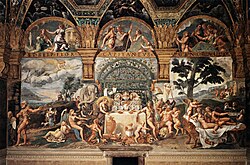 Giulio Romano's Banquet of Amor and Psyche, which depicts Voluptas and her parents (at far right). | |
| Other names | Volupta |
| Parents | Cupid and Anima |
| Equivalents | |
| Greek | Hedone |
In Roman mythology, Voluptas or Volupta is the daughter born from the union of Cupid and Psyche, according to Apuleius.1 The Latin word voluptas2 means 'pleasure' or 'delight';345 Voluptas is known as the goddess of "sensual pleasures". She is often found in the company of the Gratiae, or Three Graces.
Some Roman authors6789 mention a goddess named Volupia, a name which appears to signify "willingness".10 She had a temple, the Sacellum Volupiae, on the Via Nova, by the Porta Romana. Sacrifices were offered to the Diva Angerona there.
The corresponding goddess in Greek mythology is Hedone.
References
References
- Apuleius, The Golden Ass, 6. 24 ff
- “huic verbo (voluptatis) omnes qui Latine sciunt, duas res subiciunt, laetitiam in animo, commotionem suavem iucunditatis in corpore: Cic. Fin. 1, 11, 37
- Lewis & Short, "voluptas"
- Cicero, De natura deorum, II. 23
- Statius, Silvae 1. 3. 8
- Pliny the Elder, Letters, VII. 20
- Pliny the Elder, Naturalis Historia, III. 5
- Varro, De lingua Latina, V. 164
- Macrobius, Saturnalia, I. 10
- Robert E. A. Palmer, The Archaic Community of the Romans, Cambridge University Press 1970 pp.171ff.