VOACAP (Voice of America Coverage Analysis Program)1 is a radio propagation model that uses empirical data to predict the point-to-point path loss and coverage of a given transceiver if given as inputs: two antennas (configuration and position), solar weather, and time/date. Written in Fortran, it was originally designed for Voice of America.
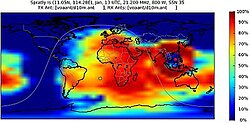
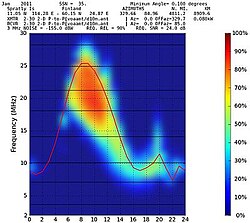
Some movies on the coverage during daytime can be found here.2
Simulating HF propagation conditions
Currently versions based on the original source tree exist for Windows, Linux (voacapl)3 and OSX.4 The program core uses text files for I/O and a bunch of wrappers now exist.
Besides commercial visualization tools, there are also Open Source implementations with GUI:
- VOACAP online using ITS' IONCAP model, available at http://www.voacap.com/prediction.html
- the PropagationPython Project.5 a.k.a. "Proppy" which is an evolution and alternate to VOACAP using the new ITURHFProp prediction model (formerly REC533) and always in development by James Watson6
For immediate results, VOACAP provides a web interface for both the coverage7 and the prediction.8
References
References
- Official Homepage: http://www.voacap.com/
- Movies of the HF coverage during daytime http://gerolfziegenhain.wordpress.com/2012/07/22/qrp-propagation-simulation-one-day-on-all-ham-bands/
- Voacap under Linux http://www.qsl.net/hz1jw/voacapl/index.html
- Installing Voacap under OSX http://gerolfziegenhain.wordpress.com/2012/07/installation-of-voacap-under-osx
- "Proppy" (PropagationPython) can be download from http://www.qsl.net/hz1jw/pythonprop/
- Installing "Proppy" under Debian Linux http://gerolfziegenhain.wordpress.com/2012/07/16/installation-of-pythonprop-under-debian/
- Online Voacap coverage http://www.voacap.com/coverage.html
- Online Voacap prediction http://www.voacap.com/prediction.html