| Viola canina | |
|---|---|
| |
Scientific classification 
| |
| Kingdom: | Plantae |
| Clade: | Embryophytes |
| Clade: | Tracheophytes |
| Clade: | Spermatophytes |
| Clade: | Angiosperms |
| Clade: | Eudicots |
| Clade: | Rosids |
| Order: | Malpighiales |
| Family: | Violaceae |
| Genus: | Viola |
| Species: | V. canina
|
| Binomial name | |
| Viola canina | |
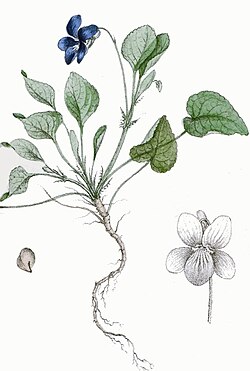
Viola canina, commonly known as heath dog-violet2 and heath violet, is a species of the flowering plant in the violet family Violaceae. It is native to Europe, where it is found in heaths, fens, and moist woodlands, especially on acidic soils.3
It is a herbaceous perennial plant growing to 5–15 cm (2.0–5.9 in) tall. The flowers are pale blue, produced from April to July. Colonies of plants may be extensive.3
It is host to the pathogenic fungi Puccinia violae and Ramularia lactea.4
References
References
- Viola canina was first described and published in Species Plantarum 2: 935. 1753 "Name - Viola canina L." Tropicos. Saint Louis, Missouri: Missouri Botanical Garden. Retrieved August 21, 2011.
- BSBI List 2007 (xls). Botanical Society of Britain and Ireland. Archived from the original (xls) on 2015-06-26. Retrieved 2014-10-17.
- Blamey, M. & Grey-Wilson, C. (1989). Flora of Britain and Northern Europe. Hodder & Stoughton. ISBN 0-340-40170-2.
- Helgi Hallgrímsson & Guðríður Gyða Eyjólfsdóttir (2004). Íslenskt sveppatal I - smásveppir [Checklist of Icelandic Fungi I - Microfungi. Fjölrit Náttúrufræðistofnunar. Náttúrufræðistofnun Íslands [Icelandic Institute of Natural History]. ISSN 1027-832X