| Vimalanatha | |
|---|---|
13th Jain Tirthankara | |
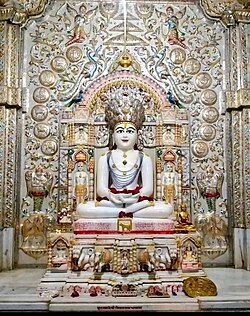 Tirthankara Vimalanatha at Kampilji Shwetambar Jain Temple, Uttar Pradesh | |
| Venerated in | Jainism |
| Predecessor | Vasupujya |
| Successor | Anantanatha |
| Symbol | Boar1 |
| Height | 60 bows (180 meters) |
| Age | 6,000,000 years |
| Color | Golden |
| Genealogy | |
| Born | |
| Died | |
| Parents |
|
| Dynasty | Ikṣvākuvaṁśa |
Vimalanatha was the thirteenth Jain Tirthankara of the present age (Avasarpini). According to Jain beliefs, he became a Siddha, a liberated soul which has destroyed all of its karma. Vimalanatha was born to King Kratavarma and Queen Shyamadevi at Kampilya of the Ikshvaku dynasty. His birth date was the third day of the Magh Sukla month of the Indian calendar.
Life and legends
According to Jain tradition, Vimalanatha is venerated as the 13th tirthankara of the present cosmic age (avasarpini).23 Jain universal history states that he was born into the ancient Ikshvaku dynasty to King Kratavarma and Queen Shyamadevi in the city of Kampilya.4 His birth is traditionally observed on the third day of the Magha Shukla month of the lunisolar Jain calendar.3 Within the expansive framework of Jain cosmology, texts attribute to him a symbolic lifespan of 6,000,000 years and a towering physical height of 60 bows (dhanushas).56 After a period of ruling his kingdom, traditional narratives describe him renouncing worldly attachments to become an ascetic, eventually attaining omniscience (Kevala Jnana).4 Following his period of preaching, he ultimately achieved liberation from the cycle of rebirth (moksha) on the sacred peaks of Mount Shikharji in modern-day Jharkhand.7
Vimalantha is said to have been born 30 sagara after his predecessor, Vasupujya.6 His successor, Anantanatha, is said to have been born 9 sagara after him.6
Iconography
In Jain art and sculpture, Vimalanatha is traditionally depicted in a meditative posture with a golden complexion.8 He is distinctly identified by his unique iconographic emblem, the boar, which is typically carved or stamped onto the pedestal beneath his idols.9 As with all tirthankaras, he is depicted alongside his dedicated guardian deities (Shashan-devatas).10 According to the Digambara tradition, his accompanying male guardian deity (yaksha) is Shanmukha, while his female guardian (yakshi) is Anantamati.10 Conversely, the Śvētāmbara tradition identifies his guardian deities as Bhrikuti and Vidita, respectively.10
Temples and legacy
As the 13th tirthankara, Vimalanatha is heavily venerated, resulting in the establishment of several significant historical and modern temple complexes dedicated to his worship.2 The ancient city of Kampilya in Uttar Pradesh, traditionally identified in Jain universal history as his royal birthplace, serves as a primary center for his pilgrimage and houses historically significant shrines dedicated to his early life.1 In Maharashtra, the Shree Vimalnath Bhagwan Tirth in Dhule acts as a major regional spiritual center, alongside a prominent Śvētāmbara temple complex situated in Bibwewadi, Pune.11 Reflecting the global expansion of the modern Jain diaspora, a significant contemporary Jain Derasar dedicated to his worship has also been established in Dubai.12 Furthermore, marking the geographic site of his ultimate spiritual liberation, a dedicated shrine (tonk) enshrining his footprints (charan) is actively venerated by pilgrims on the peaks of Mount Shikharji.7
Gallery
-
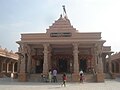 Shri vimalnatha swami jain shwetambar temple, Bibwewadi
 -
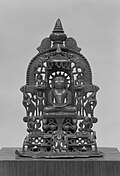 Jain Altarpiece with Vimalanatha in Los Angeles County Museum of Art, 15th century
 -
 Miniature painting from Jodhpur ca. 1800 of 13th Tirthankara or Jina of Jainism
 -
 Bhagwan Vimalnathji idol of Bishangarh
References
References
Citations
- Tandon 2002, p. 45.
- Dundas 2002, p. 40.
- Tukol 1980, p. 31.
- Natubhai Shah 2004, p. 16.
- Wiley 2009, p. 240.
- Finegan 1952, p. 190.
- Cort 2001a, p. 23.
- Titze & Bruhn 1998, p. 250.
- Umakant P. Shah 1987, p. 148.
- Umakant P. Shah 1987, pp. 148–149.
- Titze & Bruhn 1998, p. 175.
- Flugel 2006, p. 412.
Sources
- Cort, John E. (2001a), Jains in the World : Religious Values and Ideology in India, Oxford University Press, ISBN 978-0-19-513234-2
- Dundas, Paul (2002) [1992], The Jains (Second ed.), London and New York: Routledge, ISBN 0-415-26605-X
- Finegan, Jack (1952), The archeology of world religions, Princeton University Press
- Flügel, Peter (2006), Studies in Jaina History and Culture: Disputes and Dialogues, Routledge, ISBN 978-1-134-23552-0
- Shah, Natubhai (2004) [First published in 1998], Jainism: The World of Conquerors, vol. I, Motilal Banarsidass, ISBN 81-208-1938-1
- Shah, Umakant Premanand (1987), Jaina-rūpa-maṇḍana: Jaina iconography, Abhinav Publications, ISBN 81-7017-208-X
- Tandon, Om Prakash (2002) [1968], Jaina Shrines in India (1 ed.), New Delhi: Publications Division, Ministry of Information and Broadcasting, Government of India, ISBN 81-230-1013-3
- Titze, Kurt; Bruhn, Klaus (1998), Jainism: A Pictorial Guide to the Religion of Non-Violence (2 ed.), Motilal Banarsidass, ISBN 978-81-208-1534-6
- Tukol, T. K. (1980), Compendium of Jainism, Dharwad: University of Karnataka
- Wiley, Kristi L. (2009) [1949], The A to Z of Jainism, vol. 38, Scarecrow Press, ISBN 978-0-8108-6337-8