| Vatica rynchocarpa | |
|---|---|
Scientific classification 
| |
| Kingdom: | Plantae |
| Clade: | Embryophytes |
| Clade: | Tracheophytes |
| Clade: | Spermatophytes |
| Clade: | Angiosperms |
| Clade: | Eudicots |
| Clade: | Rosids |
| Order: | Malvales |
| Family: | Dipterocarpaceae |
| Genus: | Vatica |
| Species: | V. rynchocarpa
|
| Binomial name | |
| Vatica rynchocarpa | |
| Synonyms2 | |
| |
Vatica rynchocarpa is a tree in the family Dipterocarpaceae, native to Borneo. The specific epithet rynchocarpa means "snout fruit", referring to the beak-like shape of the nut.3
Description
Vatica rynchocarpa grows up to 30 metres (100 ft) tall, with a trunk diameter of up to 100 cm (40 in). Its coriaceous leaves are elliptic to lanceolate and measure up to 8.5 cm (3 in) long. The ovoid nuts, tapering to a sharp end, measure up to 1.8 cm (0.7 in) long.3
Distribution and habitat
Vatica rynchocarpa is endemic to Borneo. Its habitat is lowland mixed dipterocarp forests, at elevations to 200 m (700 ft).1
Conservation
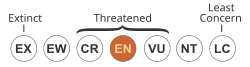
Vatica rynchocarpa has been assessed as endangered on the IUCN Red List. It is threatened mainly by conversion of land for plantations and urban expansion. Logging for its timber also threatens the species.1
References
References
- Bodos, V.; Kusumadewi, Y.; Hoo, P.K.; Maycock, C.R.; Randi, A.; Julia, S.; Robiansyah, I. (2019). "Vatica rynchocarpa". IUCN Red List of Threatened Species. 2019 e.T31937A149070757. doi:10.2305/IUCN.UK.2019-3.RLTS.T31937A149070757.en. Retrieved 20 November 2021.
- "Vatica rynchocarpa". Plants of the World Online. Royal Botanic Gardens, Kew. Retrieved 31 July 2021.
- Ashton, P. S. (2004). "Vatica L.". In Soepadmo, E.; Saw, L. G.; Chung, R. C. K. (eds.). Tree Flora of Sabah and Sarawak. Vol. 5. Forest Research Institute Malaysia. pp. 382–383. ISBN 983-2181-59-3.