
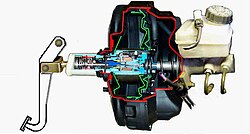
A vacuum servo (also called a brake booster, power booster, or power brake unit) is a component used on motor vehicles in their braking system, to provide assistance to the driver by decreasing the braking effort. It uses a vacuum, usually supplied by the engine, to multiply the driver's pedal effort and apply that effort to the master cylinder.1
Because the servo depends on the vacuum supplied by a running engine, a check valve is typically used in the vacuum line to maintain residual vacuum without engine support, allowing limited use even after parking.
The system was invented by Albert Dewandre2 who, together variously with Bosch and Clayton-Dewandre Ltd. took out further patents as it was refined.3
Notes
Notes
- "Learn about Hydraulic Brakes - How a vacuum brake servo/booster works". edumech.co.uk. Archived from the original on 2016-04-25. Retrieved 2025-06-25.
- "History Bosch servo brakes". Bosch Global. Retrieved 23 October 2025.
- "Improvements in or relating to hydraulic braking systems". 30 March 1936. Retrieved 23 October 2025 – via google.
External links
External links
- What is a brake booster? Archived 2023-12-28 at the Wayback Machine
- Nice, Karim (22 August 2000). "How Power Brakes Work". HowStuffWorks.com. Retrieved 2025-06-25.