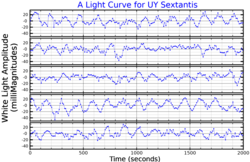
 A white light light curve for UY Sextantis, adapted from Billeres et al. (1997).1 All five panels form a single 10,000 second light curve, with the top panel continued on the second panel, etc. | |
| Observation data Epoch J2000.0 Equinox J2000.0 | |
|---|---|
| Constellation | Sextans |
| Right ascension | 10h 50m 02.826s2 |
| Declination | −00° 00′ 36.88″2 |
| Apparent magnitude (V) | 13.493 |
| Characteristics | |
| Evolutionary stage | horizontal branch4 |
| Spectral type | sdO9VII:He65 |
| Variable type | V361 Hya1 |
| Astrometry | |
| Radial velocity (Rv) | 13.66 km/s |
| Proper motion (μ) | RA: −20.528 mas/yr2 Dec.: −38.421 mas/yr2 |
| Parallax (π) | 1.4559±0.0789 mas2 |
| Distance | 2,200 ± 100 ly (690 ± 40 pc) |
| Details | |
| Mass | 0.490±0.0144 M☉ |
| Radius | 0.17±0.014 R☉ |
| Luminosity | 25.86+3.28 −2.614 L☉ |
| Surface gravity (log g) | 5.83±0.016 cgs |
| Temperature | 34,850±906 K |
| Rotation | 24.6±3.5 d4 |
| Other designations | |
| UY Sex, GSC 04914-00003, 2MASS J10500281-0000369, PG 1047+0037 | |
| Database references | |
| SIMBAD | data |
UY Sextantis is a blue-white subdwarf star, located in the constellation of Sextans. The star is classed as member of the V361 Hydrae type (or also called sdBVr type) class of pulsators in the field of asteroseismology,1 although it is now generally classified as class O.5 No additional stellar companion has been detected in tight orbit or imaged around the subdwarf star.89 It is thought to be an extreme horizontal-branch star, fusing helium in its core and with an unusually thin hydrogen atmosphere causing it to be hotter than most horizontal-branch stars.4
The star's variability was discovered in 1998 by D. O'Donoghue et al..10 It was given its variable star designation in 2000.11 It has an apparent magnitude of 13.5 and the brightness changes amount to less than 0.1 magnitudes,3 with a typical period of 142 seconds.1
References
References
- Billeres; et al. (1997). "Discovery of p-mode Instabilities in the Hot Subdwarf B Star PG 1047+003". Astrophysical Journal Letters. 487 (1): 81–84. Bibcode:1997ApJ...487L..81B. doi:10.1086/310882.
- Brown, A. G. A.; et al. (Gaia collaboration) (August 2018). "Gaia Data Release 2: Summary of the contents and survey properties". Astronomy & Astrophysics. 616. A1. arXiv:1804.09365. Bibcode:2018A&A...616A...1G. doi:10.1051/0004-6361/201833051. Gaia DR2 record for this source at VizieR.
- Samus', N. N.; Kazarovets, E. V.; Durlevich, O. V.; Kireeva, N. N.; Pastukhova, E. N. (2017). "General catalogue of variable stars: Version GCVS 5.1". Astronomy Reports. 61 (1): 80. Bibcode:2017ARep...61...80S. doi:10.1134/S1063772917010085.
- Reed, M. D.; et al. (March 2020). "K2 observations of the pulsating subdwarf B stars UY Sex and V1405 Ori". Monthly Notices of the Royal Astronomical Society. 492 (4): 5202–5217. Bibcode:2020MNRAS.492.5202R. doi:10.1093/mnras/staa144.
- Drilling, J. S.; et al. (2013). "An MK-like system of spectral classification for hot subdwarfs". Astronomy & Astrophysics. 551: A31. Bibcode:2013A&A...551A..31D. doi:10.1051/0004-6361/201219433.
- Lei, Zhenxin; et al. (November 2018). "New Hot Subdwarf Stars Identified in Gaia DR2 with LAMOST DR5 Spectra". The Astrophysical Journal. 868 (1): 9. arXiv:1810.09625. Bibcode:2018ApJ...868...70L. doi:10.3847/1538-4357/aae82b. S2CID 250892206. 70.
- "UY Sex". SIMBAD. Centre de données astronomiques de Strasbourg. Retrieved 2022-01-26.
- O'Donoghue; Koen; Lynas-Gray; Kilkenny; Van Wyk (1998). "The EC14026 stars - VI. PG1047+003". Monthly Notices of the Royal Astronomical Society. 296 (2): 306–316. Bibcode:1998MNRAS.296..306O. doi:10.1046/j.1365-8711.1998.01311.x.
- Otani, Tomomi; Baran, A. S.; Spence, Lindsay C.; von Hippel, Ted; Lozano, E. Lynum-; Clark, Julia. M. (2025-09-02). "A Search for Subdwarf B Binaries Using Pulsation Timing from TESS". The Astronomical Journal. 170 (4): 199. doi:10.3847/1538-3881/adf73c. ISSN 0004-6256.
- O'Donoghue, D.; Koen, C.; Lynas-Gray, A. E.; Kilkenny, D.; van Wyk, F. (May 1998). "The EC14026 stars - VI. PG1047+003". Monthly Notices of the Royal Astronomical Society. 296 (2): 306–316. Bibcode:1998MNRAS.296..306O. doi:10.1046/j.1365-8711.1998.01311.x.
- Kazarovets, E. V.; Samus, N. N.; Durlevich, O. V. (March 2000). "The 75th Name-List of Variable Stars" (PDF). Information Bulletin on Variable Stars. 4870: 1. Bibcode:2000IBVS.4870....1K. Retrieved 11 October 2024.