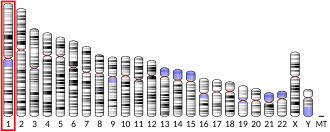
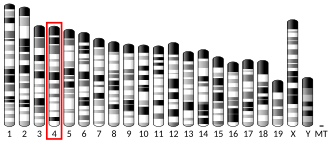
Ubiquitin carboxyl-terminal hydrolase 48 is an enzyme that in humans is encoded by the USP48 gene.56
This gene encodes a protein containing domains that associate it with the peptidase family C19, also known as family 2 of ubiquitin carboxyl-terminal hydrolases. Family members function as deubiquitinating enzymes, recognizing and hydrolyzing the peptide bond at the C-terminal glycine of ubiquitin. Enzymes in peptidase family C19 are involved in the processing of poly-ubiquitin precursors as well as that of ubiquitinated proteins. Alternate transcriptional splice variants, encoding different isoforms, have been characterized.6
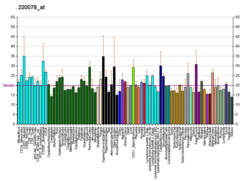
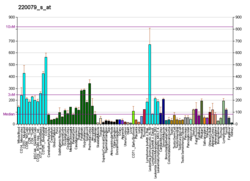
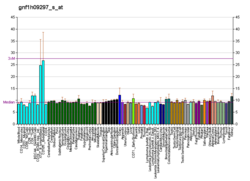
In melanocytic cells USP48 gene expression may be regulated by MITF.7
References
References
- GRCh38: Ensembl release 89: ENSG00000090686 – Ensembl, May 2017
- GRCm38: Ensembl release 89: ENSMUSG00000043411 – Ensembl, May 2017
- "Human PubMed Reference:". National Center for Biotechnology Information, U.S. National Library of Medicine.
- "Mouse PubMed Reference:". National Center for Biotechnology Information, U.S. National Library of Medicine.
- Puente XS, Sanchez LM, Overall CM, Lopez-Otin C (Jul 2003). "Human and mouse proteases: a comparative genomic approach". Nat Rev Genet. 4 (7): 544–58. doi:10.1038/nrg1111. PMID 12838346. S2CID 2856065.
- "Entrez Gene: USP48 ubiquitin specific peptidase 48".
- Hoek KS, Schlegel NC, Eichhoff OM, et al. (2008). "Novel MITF targets identified using a two-step DNA microarray strategy". Pigment Cell Melanoma Res. 21 (6): 665–76. doi:10.1111/j.1755-148X.2008.00505.x. PMID 19067971.
Further reading
Further reading
- Wilkinson KD (1998). "Regulation of ubiquitin-dependent processes by deubiquitinating enzymes". FASEB J. 11 (14): 1245–56. doi:10.1096/fasebj.11.14.9409543. PMID 9409543. S2CID 11788220.
- Strausberg RL, Feingold EA, Grouse LH, et al. (2003). "Generation and initial analysis of more than 15,000 full-length human and mouse cDNA sequences". Proc. Natl. Acad. Sci. U.S.A. 99 (26): 16899–903. Bibcode:2002PNAS...9916899M. doi:10.1073/pnas.242603899. PMC 139241. PMID 12477932.
- Ota T, Suzuki Y, Nishikawa T, et al. (2004). "Complete sequencing and characterization of 21,243 full-length human cDNAs". Nat. Genet. 36 (1): 40–5. doi:10.1038/ng1285. PMID 14702039.
- Quesada V, Díaz-Perales A, Gutiérrez-Fernández A, et al. (2004). "Cloning and enzymatic analysis of 22 novel human ubiquitin-specific proteases". Biochem. Biophys. Res. Commun. 314 (1): 54–62. doi:10.1016/j.bbrc.2003.12.050. PMID 14715245.
- Suzuki Y, Yamashita R, Shirota M, et al. (2004). "Sequence comparison of human and mouse genes reveals a homologous block structure in the promoter regions". Genome Res. 14 (9): 1711–8. doi:10.1101/gr.2435604. PMC 515316. PMID 15342556.
- Lockhart PJ, Hulihan M, Lincoln S, et al. (2004). "Identification of the human ubiquitin specific protease 31 (USP31) gene: structure, sequence and expression analysis". DNA Seq. 15 (1): 9–14. doi:10.1080/10855660310001638197. PMID 15354349. S2CID 36992328.
- Gerhard DS, Wagner L, Feingold EA, et al. (2004). "The status, quality, and expansion of the NIH full-length cDNA project: the Mammalian Gene Collection (MGC)". Genome Res. 14 (10B): 2121–7. doi:10.1101/gr.2596504. PMC 528928. PMID 15489334.
- Tzimas C, Michailidou G, Arsenakis M, et al. (2006). "Human ubiquitin specific protease 31 is a deubiquitinating enzyme implicated in activation of nuclear factor-kappaB". Cell. Signal. 18 (1): 83–92. doi:10.1016/j.cellsig.2005.03.017. PMID 16214042.
- Gregory SG, Barlow KF, McLay KE, et al. (2006). "The DNA sequence and biological annotation of human chromosome 1". Nature. 441 (7091): 315–21. Bibcode:2006Natur.441..315G. doi:10.1038/nature04727. PMID 16710414.
- Olsen JV, Blagoev B, Gnad F, et al. (2006). "Global, in vivo, and site-specific phosphorylation dynamics in signaling networks". Cell. 127 (3): 635–48. doi:10.1016/j.cell.2006.09.026. PMID 17081983. S2CID 7827573.