 | |
| Names | |
|---|---|
| IUPAC name
Uranium(VI) chloride
| |
| Other names
Uranium hexachloride
Peruranic chloride | |
| Identifiers | |
3D model (JSmol)
|
|
| ChemSpider | |
PubChem CID
|
|
| |
| |
| Properties | |
| UCl6 | |
| Molar mass | 450.745 g/mol |
| Appearance | dark green crystalline solid |
| Density | 3.6 g/cm3 |
| Melting point | 177 °C (351 °F; 450 K) |
| Related compounds | |
Other anions
|
Uranium hexafluoride |
Other cations
|
Tungsten hexachloride |
Related uranium chlorides
|
|
Except where otherwise noted, data are given for materials in their standard state (at 25 °C [77 °F], 100 kPa).
| |
Uranium hexachloride is the inorganic compound with the formula UCl6. It features uranium in the +6 oxidation state.1 UCl6 hydrolyzes readily but is stable under inert atmosphere. It is soluble in carbon tetrachloride (CCl4). It is a multi-luminescent dark green or black solid with a vapor pressure between 1-3 mmHg at 373.15 K.2
Structure and bonding
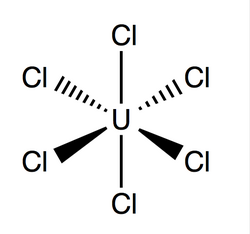
Uranium hexachloride has an octahedral geometry, with point group Oh.34 Its lattice (dimensions: 10.95 ± 0.02 Å x 6.03 ± 0.01 Å) is hexagonal in shape with three molecules per cell; the average theoretical U-Cl bond is 2.472 Å long (the experimental U-Cl length found by X-ray diffraction is 2.42 Å),5 and the distance between two adjacent chlorine atoms is 3.65 Å.
Chemical properties
UCl6 is stable up to temperatures between 120 °C and 150 °C. The decomposition of UCl6 results in a solid phase transition from one crystal form of UCl6 to another more stable form,6 before fully decomposing into UCl5. It decomposes as follows:
- 2 UCl6 (g) → 2 UCl5 (s) + Cl2 (g)
The activation energy for this reaction is about 40 kcal per mole.
Solubility
UCl6 is not a very soluble compound. It dissolves in CCl4 to give a brown solution. It is slightly soluble in isobutyl bromide and in fluorocarbon (C7F16).6
| Solvents | Temperature (°C) | Grams of UCl6/100g of solution |
|---|---|---|
| CCl4 | −18 | 2.64 |
| CCl4 | 0 | 4.9 |
| CCl4 | 20 | 7.8 |
| 6.6% Cl2 : 93.4% CCl4 | −20 | 2.4 |
| 12.5% Cl2 : 87.5% CCl4 | −20 | 2.23 |
| 12.5% Cl2 : 87.5% CCl4 | 0 | 3.98 |
| Liquid Cl2 | −33 | 2.20 |
| CH3Cl | −24 | 1.16 |
| Benzene | 80 | Insoluble |
| Freon 113 | 45 | 1.83 |
Reaction with hydrogen fluoride
When treated with liquid hydrogen fluoride (HF) at room temperature, UCl6 produces UF5.6
- 2 UCl6 + 10 HF → 2 UF5 + 10 HCl + Cl2
Synthesis
Uranium hexachloride is efficiently prepared from uranium hexafluoride by halide exchange using boron trichloride according to the following idealized equation:1
- UF6 + 2 BCl3 → UCl6 + 2 BF3
Uranium hexachloride can also be synthesized from the reaction of uranium trioxide (UO3) with a mixture of liquid CCl4 and hot chlorine (Cl2). The yield can be increased if the reaction carried out in the presence of UCl5.7 The UO3 is converted to UCl5, which in turn reacts with the excess Cl2 to form UCl6. It requires a substantial amount of heat for the reaction to take place; the temperature range is from 65 °C to 170 °C depending on the amount of reactant (ideal temperature 100 °C - 125 °C). The reaction is carried out in a closed gas-tight vessel (for example a glovebox) that can withstand the pressure that builds up.
Step 1: 2 UO3 + 5 Cl2 → 2 UCl5 + 3 O2
Step 2: 2 UCl5 + Cl2 → 2 UCl6
Overall reaction: 2 UO3 + 6 Cl2 → 2 UCl6 + 3 O2
This metal hexahalide also form upon combining Cl2 and UCl4 at 350 °C.8
Step 1: 2 UCl4 + Cl2 → 2 UCl5
Step 2: 2 UCl5 + Cl2 → 2 UCl6
Overall Reaction: UCl4 + Cl2 → UCl6
References
References
- O'Donnell, T. A.; Wilson, P. W. (1976). "Uranium Hexachloride: ( Hexachlorouranium )". Uranium Hexachloride: (Hexachlorouranium ). Inorganic Syntheses. Vol. 16. p. 143. doi:10.1002/9780470132470.ch39. ISBN 978-0-470-13178-7.
- Van Dyke, R. E.; Evers, E. C. (1955). "Preparation of Uranium Hexachloride". Google Patents: 2.
- Zachariasen, W. H. (1948). "Crystal Chemical studies of the 5f-series of elements. V. The Crystal structure of Uranium hexachloride". Acta Crystallographica. 1 (6): 285–287. Bibcode:1948AcCry...1..285Z. doi:10.1107/S0365110X48000788.
- Taylor, J. C.; Wilson, P. W. (1974). "Neutron and X-ray powder diffraction studies of the structure of uranium hexachloride". Acta Crystallographica Section B. 30 (6): 1481. Bibcode:1974AcCrB..30.1481T. doi:10.1107/S0567740874005115.
- Batista, E. R.; Martin, R. L.; Hay, P. J. (2004). "Density Functional Investigations of the Properties and Thermodynamics of UFn and UCln (n=1,...,6)". J. Chem. Phys. 121 (22): 11104–11. doi:10.1063/1.1811607. PMID 15634063.
- Katz, J.J.; Rabinowitch, E. (1951). The Chemistry of Uranium. Ann Arbor: The McGraw-Hill Book Company.
- Van Dyke, R. E.; Evers, E. C. (1955). "Preparation of Uranium Hexachloride". Google Patents: 2.
- Thornton, G.; Edelstein, N.; Rösch, N.; Woodwark, D.R.; Edgell, R.G. (1979). "The Electronic Structure of UCl6: Photoelectron Spectra and Scattered Wave Xα Calculations". J. Chem. Phys. 70 (11): 6. Bibcode:1979JChPh..70.5218T. doi:10.1063/1.437313.