  | |
| Observation data Epoch J2000 Equinox J2000 | |
|---|---|
| Constellation | Ophiuchus1 |
| Right ascension | 16h 27m 48.17331s2 |
| Declination | −08° 22′ 18.4156″2 |
| Apparent magnitude (V) | 4.621 |
| Characteristics | |
| Spectral type | kA2hA5VmA53 |
| U−B color index | +0.064 |
| B−V color index | +0.164 |
| Astrometry | |
| Radial velocity (Rv) | −30.605 km/s |
| Proper motion (μ) | RA: −97.5262 mas/yr Dec.: −33.972 mas/yr |
| Parallax (π) | 25.0819±0.2300 mas2 |
| Distance | 130 ± 1 ly (39.9 ± 0.4 pc) |
| Absolute magnitude (MV) | 1.751 |
| Orbit6 | |
| Primary | Aa1 |
| Name | Aa2 |
| Period (P) | 27.218±0.0005 d |
| Semi-major axis (a) | ≥ 0.0583 AU |
| Eccentricity (e) | 0.744±0.002 |
| Periastron epoch (T) | 2,438,914.84±0.01 JD |
| Argument of periastron (ω) (secondary) | 333.7±0.7° |
| Semi-amplitude (K1) (primary) | 34.9±0.3 km/s |
| Semi-amplitude (K2) (secondary) | 41.1±0.3 km/s |
| Orbit7 | |
| Primary | Aa |
| Name | Ab |
| Period (P) | 82.8±1.4 yr |
| Semi-major axis (a) | 0.79±0.03″ |
| Eccentricity (e) | 0.45±0.03 |
| Inclination (i) | 31.2±5.7° |
| Longitude of the node (Ω) | 86.8±6.9° |
| Periastron epoch (T) | B 1994.1±1.0 |
| Argument of periastron (ω) (secondary) | 177.9±7.4° |
| Details | |
| Aa1 | |
| Mass | 1.838 M☉ |
| Radius | 1.68a R☉ |
| Luminosity | 16.561 L☉ |
| Surface gravity (log g) | 4.459 cgs |
| Temperature | 8,3649 K |
| Metallicity [Fe/H] | +0.141 dex |
| Rotational velocity (v sin i) | 4410 km/s |
| Age | 508 Myr |
| Aa2 | |
| Mass | 1.478 M☉ |
| Radius | 1.48a R☉ |
| Age | 508 Myr |
| Ab1 | |
| Mass | 0.828 M☉ |
| Radius | 0.868a R☉ |
| Age | 458 Myr |
| Ab2 | |
| Mass | 0.708 M☉ |
| Radius | 0.698a R☉ |
| Age | 458 Myr |
| Other designations | |
| Alkarab, υ Oph, 3 Ophiuchi, BD−08°4243, FK5 3299, GC 22134, HD 148367, HIP 80628, HR 6129, SAO 141187, CCDM J16278-0822AB, WDS J16278-082211 | |
| Database references | |
| SIMBAD | data |
| Aa1 | |||||||||||
| Period = 27.s d | |||||||||||
| Ab2 | |||||||||||
| Period = 82.8 yr | |||||||||||
| Ab1 | |||||||||||
| Sep = 0.06 au | |||||||||||
| Ab2 | |||||||||||
Hierarchy of orbits8
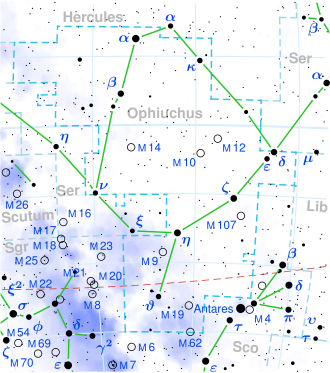
Upsilon Ophiuchi is a quadruple star system in the equatorial constellation of Ophiuchus. It has a white hue and is faintly visible to the naked eye with an apparent visual magnitude of 4.62. The distance to this system is approximately 130 light years based on parallax. It is drifting closer with a radial velocity of −30.6 km/s.
The variable radial velocity of the brighter component was first observed by H. A. Abt in 1961. It is a double-lined spectroscopic binary system with an orbital period of 27.2 days and an eccentricity of 0.74.6 They have a combined magnitude of 4.71. Both components are similar stars with a combined stellar classification of kA2hA5VmA5, and one or both are Am stars.3 The fainter component has an 82.8 year orbit with the brighter pair at an eccentricity of 0.45,7 and is itself binary, making the system a quadruple.8 The system is a source for X-ray emission.12
This system forms part of the Upsilon Ophiuchi cluster, a small group of six stars which share similar kinematics and are spread over about eight degrees. The two brightest stars, apart from Upsilon Ophiuchi itself, are sometimes listed as components B and C: B is HD 148300, and C is HD 144660.8 Both are 9th-magnitude K-class dwarfs.13
Notes
Notes
- Calculated using angular diameters (0.37, 0.33, 0.20 and 0.16 milliarcseconds) and a distance of 39.9 parsecs via the equation R/R☉ = (107.5 • 𝜃 • d)/1000, where 𝜃 is the angular diameter and d is the distance.
References
References
- Anderson, E.; Francis, Ch. (2012). "XHIP: An extended hipparcos compilation". Astronomy Letters. 38 (5): 331. arXiv:1108.4971. Bibcode:2012AstL...38..331A. doi:10.1134/S1063773712050015. S2CID 119257644. Vizier catalog entry
- Vallenari, A.; et al. (Gaia collaboration) (2023). "Gaia Data Release 3. Summary of the content and survey properties". Astronomy and Astrophysics. 674: A1. arXiv:2208.00211. Bibcode:2023A&A...674A...1G. doi:10.1051/0004-6361/202243940. S2CID 244398875. Gaia DR3 record for this source at VizieR.
- Abt, Helmut A.; Morrell, Nidia I. (1995). "The Relation between Rotational Velocities and Spectral Peculiarities among A-Type Stars". Astrophysical Journal Supplement. 99: 135. Bibcode:1995ApJS...99..135A. doi:10.1086/192182.
- Mallama, A. (2014). "Sloan Magnitudes for the Brightest Stars". The Journal of the American Association of Variable Star Observers. 42 (2): 443. Bibcode:2014JAVSO..42..443M.Vizier catalog entry
- Wilson, R. E. (1953). "General Catalogue of Stellar Radial Velocities". Carnegie Institute Washington D.C. Publication. Carnegie Institution for Science. Bibcode:1953GCRV..C......0W. ISBN 9780598216885. LCCN 54001336.
{{cite journal}}: ISBN / Date incompatibility (help) - Gutmann, F. (1965). "A study of the spectroscopic binary 3nu Ophiuchi (HD 148367)". Publications of the Dominion Astrophysical Observatory Victoria. 12: 391–399. Bibcode:1965PDAO...12..391G.
- "Sixth Catalog of Orbits of Visual Binary Stars". United States Naval Observatory. Archived from the original on 1 August 2017. Retrieved 24 May 2017.
- Waisberg, Idel; Klein, Ygal; Katz, Boaz (2025-01-01). "Hidden Companions to Intermediate-mass Stars. Upgraded Multiplicity 3 → 4. XXIV. Discovery of a 0.70 M⊙, 0.06 au Companion to Upsilon Ophiuchi Ab (Plus Discovery of the υ Oph Mini-cluster)". Research Notes of the American Astronomical Society. 9 (1): 1. Bibcode:2025RNAAS...9....1W. doi:10.3847/2515-5172/ada35c. ISSN 2515-5172.
- David, Trevor J.; Hillenbrand, Lynne A. (2015). "The Ages of Early-Type Stars: Strömgren Photometric Methods Calibrated, Validated, Tested, and Applied to Hosts and Prospective Hosts of Directly Imaged Exoplanets". The Astrophysical Journal. 804 (2): 146. arXiv:1501.03154. Bibcode:2015ApJ...804..146D. doi:10.1088/0004-637X/804/2/146. S2CID 33401607. Vizier catalog entry
- Hoffleit, D.; Warren, W. H. (1995). "VizieR Online Data Catalog: Bright Star Catalogue, 5th Revised Ed. (Hoffleit+, 1991)". VizieR On-line Data Catalog: V/50. Originally Published in: 1964BS....C......0H. 5050. Bibcode:1995yCat.5050....0H.
- "ups Oph", SIMBAD, Centre de données astronomiques de Strasbourg, retrieved 2019-10-21.
- Schröder, C.; Schmitt, J. H. M. M. (November 2007), "X-ray emission from A-type stars", Astronomy and Astrophysics, 475 (2): 677–684, Bibcode:2007A&A...475..677S, doi:10.1051/0004-6361:20077429
- Kharchenko, N. V. (2001). "All-sky compiled catalogue of 2.5 million stars". Kinematika I Fizika Nebesnykh Tel. 17 (5): 409. Bibcode:2001KFNT...17..409K.