  | |
| Observation data Epoch J2000.0 Equinox J2000.0 (ICRS) | |
|---|---|
| Constellation | Centaurus |
| Right ascension | 14h 01m 43.49909 s1 |
| Declination | −45° 36′ 12.2767″1 |
| Apparent magnitude (V) | +4.332 |
| Characteristics | |
| Spectral type | F7 II/III3 |
| U−B color index | +0.262 |
| B−V color index | +0.612 |
| Variable type | None4 |
| Astrometry | |
| Radial velocity (Rv) | −7.8±7.45 km/s |
| Proper motion (μ) | RA: +8.64±1.09 mas/yr1 Dec.: −16.25±0.88 mas/yr1 |
| Parallax (π) | 2.57±1.05 mas1 |
| Distance | approx. 1,300 ly (approx. 400 pc) |
| Absolute magnitude (MV) | −3.514 |
| Orbit6 | |
| Period (P) | 207.357 d |
| Eccentricity (e) | 0.55 |
| Periastron epoch (T) | 2423880.5 JD |
| Argument of periastron (ω) (secondary) | 88° |
| Semi-amplitude (K1) (primary) | 12.7 km/s |
| Details | |
| Mass | 6.86±0.397 M☉ |
| Luminosity (bolometric) | 3,9197 L☉ |
| Surface gravity (log g) | 2.008 cgs |
| Temperature | 6,4957 K |
| Rotational velocity (v sin i) | 0.08 km/s |
| Age | 45.9±4.09 Myr |
| Other designations | |
| υ2 Cen, CD−44°9040, GC 18939, HD 122223, HIP 68523, HR 5260, SAO 22462110 | |
| Database references | |
| SIMBAD | data |
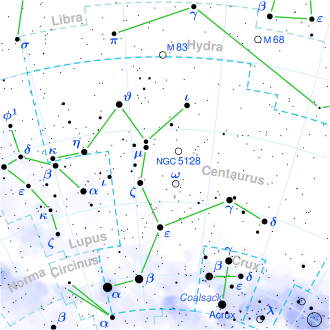
Upsilon2 Centauri is a binary star6 system in the southern constellation Centaurus. Its name is a Bayer designation that is Latinized from υ2 Centauri, and abbreviated Upsilon2 Cen or υ2 Cen. This system is visible to the naked eye as a point of light with a combined apparent visual magnitude of +4.33.2 Based upon an annual parallax shift of 2.57 mas as seen from Earth,1 this star is located roughly 1,300 light years from the Sun. Relative to its neighbors, the system has a peculiar velocity of 39.2+8.8
−15.2 km/s and it may form a runaway star system.9
This is a single-lined spectroscopic binary star system with an orbital period of 207.357 days and an eccentricity of 0.55.6 The primary component has the spectrum of an evolved F-type giant/bright giant hybrid with a stellar classification of F7 II/III.3 It is around 469 million years old with 6.9 times the mass of the Sun. The star is radiating 3,919 times the Sun's luminosity from its photosphere at an effective temperature of 6,495 K.7
References
References
- van Leeuwen, F. (2007), "Validation of the new Hipparcos reduction", Astronomy and Astrophysics, 474 (2): 653–664, arXiv:0708.1752, Bibcode:2007A&A...474..653V, doi:10.1051/0004-6361:20078357, S2CID 18759600.
- Fernie, J. D. (1983), "New UBVRI photometry for 900 supergiants", Astrophysical Journal Supplement Series, 52: 7, Bibcode:1983ApJS...52....7F, doi:10.1086/190856.
- Houk, N. (1987), "Michigan Catalogue of two dimensional spectral types for the HD stars", Michigan Spectral Survey, 2, Bibcode:1978mcts.book.....H.
- Eggen, O. J. (July 1985), "Cepheids and nonvariable supergiants", Astronomical Journal, 90: 1260–1277, Bibcode:1985AJ.....90.1260E, doi:10.1086/113834.
- de Bruijne, J. H. J.; Eilers, A.-C. (October 2012), "Radial velocities for the HIPPARCOS-Gaia Hundred-Thousand-Proper-Motion project", Astronomy & Astrophysics, 546: 14, arXiv:1208.3048, Bibcode:2012A&A...546A..61D, doi:10.1051/0004-6361/201219219, S2CID 59451347, A61.
- Pourbaix, D.; et al. (2004), "SB9: The Ninth Catalogue of Spectroscopic Binary Orbits", Astronomy & Astrophysics, 424: 727–732, arXiv:astro-ph/0406573, Bibcode:2004A&A...424..727P, doi:10.1051/0004-6361:20041213, S2CID 119387088.
- Hohle, M. M.; et al. (April 2010), "Masses and luminosities of O- and B-type stars and red supergiants", Astronomische Nachrichten, 331 (4): 349, arXiv:1003.2335, Bibcode:2010AN....331..349H, doi:10.1002/asna.200911355, S2CID 111387483.
- Mallik, Sushma V.; et al. (October 2003), "Lithium and rotation in F and G dwarfs and subgiants", Astronomy and Astrophysics, 409: 251–261, Bibcode:2003A&A...409..251M, doi:10.1051/0004-6361:20031084.
- Tetzlaff, N.; et al. (January 2011), "A catalogue of young runaway Hipparcos stars within 3 kpc from the Sun", Monthly Notices of the Royal Astronomical Society, 410 (1): 190–200, arXiv:1007.4883, Bibcode:2011MNRAS.410..190T, doi:10.1111/j.1365-2966.2010.17434.x, S2CID 118629873.
- "ups02 Cen", SIMBAD, Centre de données astronomiques de Strasbourg, retrieved 2017-08-29