  | |
| Observation data Epoch J2000.0 Equinox ICRS | |
|---|---|
| Constellation | Centaurus1 |
| Right ascension | 13h 58m 40.75s2 |
| Declination | −44° 48′ 12.9″2 |
| Apparent magnitude (V) | +3.871 |
| Characteristics | |
| Spectral type | B2 IV/V3 |
| B−V color index | −0.208±0.0111 |
| Astrometry | |
| Radial velocity (Rv) | +9.2±1.44 km/s |
| Proper motion (μ) | RA: −27.51±0.15 mas/yr2 Dec.: −22.44±0.13 mas/yr2 |
| Parallax (π) | 7.63±0.16 mas2 |
| Distance | 427 ± 9 ly (131 ± 3 pc) |
| Absolute magnitude (MV) | −1.721 |
| Details | |
| Mass | 7.9±0.15 M☉ |
| Radius | 3.74±0.346 R☉ |
| Luminosity | 1,8841 L☉ |
| Surface gravity (log g) | 4.15±0.076 cgs |
| Temperature | 21,411±3776 K |
| Rotational velocity (v sin i) | 1244 km/s |
| Age | 13.0±2.05 Myr |
| Other designations | |
| υ1 Cen, CD−44°9010, FK5 3112, HD 121790, HIP 68282, HR 5249, SAO 2245857 | |
| Database references | |
| SIMBAD | data |
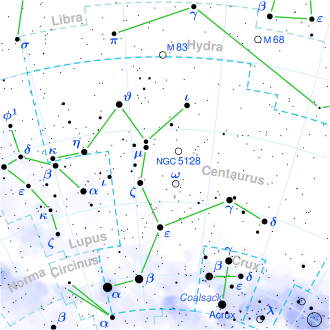
Upsilon1 Centauri is a single8 star in the southern constellation of Centaurus. Its name is a Bayer designation that is Latinized from υ1 Centauri, and abbreviated Upsilon1 Cen or υ1 Cen. This star has a blue-white hue and is visible to the naked eye with an apparent visual magnitude of +3.87.1 The distance to this object is approximately 427 light years based on parallax,2 and is receding with a radial velocity of +9 km/s.4 It is a member of the Lower Centaurus Crux group of the Scorpius–Centaurus association.1
The stellar classification of this object is B2 IV/V,1 matching a massive B-type star with a luminosity class displaying mixed traits of a main sequence and a subgiant star. It is 135 million years old and is spinning with a projected rotational velocity of 124 km/s.4 The star has 7.95 times the mass of the Sun and 3.76 times the Sun's radius. It is radiating 1,8841 times the luminosity of the Sun from its photosphere at an effective temperature of 21,411 K.6
References
References
- Anderson, E.; Francis, Ch. (2012), "XHIP: An extended hipparcos compilation", Astronomy Letters, 38 (5): 331, arXiv:1108.4971, Bibcode:2012AstL...38..331A, doi:10.1134/S1063773712050015 XHIP record for this object at VizieR.
- van Leeuwen, F. (2007), "Validation of the new Hipparcos reduction", Astronomy and Astrophysics, 474 (2): 653–664, arXiv:0708.1752, Bibcode:2007A&A...474..653V, doi:10.1051/0004-6361:20078357, S2CID 18759600. Vizier catalog entry
- Hiltner, W. A.; et al. (July 1969), "MK Spectral Types for Bright Southern OB Stars", Astrophysical Journal, 157: 313–326, Bibcode:1969ApJ...157..313H, doi:10.1086/150069.
- Jilinski, E.; et al. (March 2006), "Radial velocity measurements of B stars in the Scorpius–Centaurus association", Astronomy and Astrophysics, 448 (3): 1001–1006, arXiv:astro-ph/0601643, Bibcode:2006A&A...448.1001J, doi:10.1051/0004-6361:20041614, S2CID 17818058.
- Tetzlaff, N.; et al. (2011), "A catalogue of young runaway Hipparcos stars within 3 kpc from the Sun", Monthly Notices of the Royal Astronomical Society, 410 (1): 190–200, arXiv:1007.4883, Bibcode:2011MNRAS.410..190T, doi:10.1111/j.1365-2966.2010.17434.x, S2CID 118629873.
- Fitzpatrick, E. L.; Massa, D. (March 2005), "Determining the Physical Properties of the B Stars. II. Calibration of Synthetic Photometry", The Astronomical Journal, 129 (3): 1642–1662, arXiv:astro-ph/0412542, Bibcode:2005AJ....129.1642F, doi:10.1086/427855, S2CID 119512018.
- "ups01 Oph", SIMBAD, Centre de données astronomiques de Strasbourg, retrieved 2019-10-21
- Eggleton, P. P.; Tokovinin, A. A. (2008), "A catalogue of multiplicity among bright stellar systems", Monthly Notices of the Royal Astronomical Society, 389 (2): 869, arXiv:0806.2878, Bibcode:2008MNRAS.389..869E, doi:10.1111/j.1365-2966.2008.13596.x, S2CID 14878976.