In statistics, a univariate distribution is a probability distribution of only one random variable.1 This is in contrast to a multivariate distribution, the probability distribution of a random vector (consisting of multiple random variables). Univariate distributions can be characterized by their probability mass function for discrete variables, probability density function for continuous variables, or their cumulative distribution function, which applies to all types of random variables.
Characterization
A univariate distribution can be described by different functions depending on whether the random variable is discrete or continuous.
- The probability mass function gives the probability that a discrete random variable is equal to a specific value.2
- For a continuous random variable, the probability density function represents the density of probability. Its integral over a range gives the probability that the variable will fall within that range.3
- The cumulative distribution function is defined for any kind of random variable (discrete, continuous, and mixed) and gives the probability that the variable X will take a value less than or equal to x.4
Examples

One of the simplest examples of a discrete univariate distribution is the discrete uniform distribution, where all elements of a finite set are equally likely. It is the probability model for the outcomes of tossing a fair coin, rolling a fair die, etc. The univariate continuous uniform distribution on an interval [a, b] has the property that all sub-intervals of the same length are equally likely.
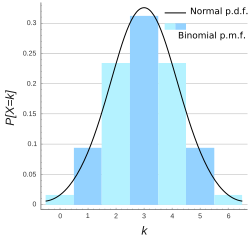
Other examples of discrete univariate distributions include the binomial, geometric, negative binomial, and Poisson distributions.5 At least 750 univariate discrete distributions have been reported in the literature.6
Examples of commonly applied continuous univariate distributions7 include the normal distribution, Student's t distribution, chisquare distribution, F distribution, exponential and gamma distributions.
References
References
- "Univariate Distribution - Statistics How To". Statistics How To. 23 February 2021. Retrieved 19 June 2026.
- "3.1.3 Probability Mass Function (PMF)". probabilitycourse.com. Retrieved 19 June 2026.
- "4.1.1 Probability Density Function (PDF)". probabilitycourse.com. Retrieved 19 June 2026.
- "3.2.1 Cumulative Distribution Function (CDF)". probabilitycourse.com. Retrieved 19 June 2026.
- Johnson, N.L., Kemp, A.W., and Kotz, S. (2005) Discrete Univariate Distributions, 3rd Edition, Wiley, ISBN 978-0-471-27246-5.
- Wimmer G, Altmann G (1999) Thesaurus of univariate discrete probability distributions. STAMM Verlag GmbH Essen, 1st ed XXVII ISBN 3-87773-025-6
- Johnson N.L., Kotz S, Balakrishnan N. (1994) Continuous Univariate Distributions Vol 1. Wiley Series in Probability and Statistics.
Further reading
Further reading
- Leemis, L. M.; McQueston, J. T. (2008). "Univariate Distribution Relationships" (PDF). The American Statistician. 62: 45–53. doi:10.1198/000313008X270448.