 | |
 | |
| Names | |
|---|---|
| Preferred IUPAC name
Undecan-1-ol | |
| Other names
Undecanol, 1-Undecanol, Undecyl alcohol, 1-Hendecanol
| |
| Identifiers | |
| |
3D model (JSmol)
|
|
| Abbreviations | UnOH n-UnOH nUnOH nUnOH |
| ChEBI | |
| ChEMBL | |
| ChemSpider |
|
| ECHA InfoCard | 100.003.609 |
PubChem CID
|
|
| UNII | |
CompTox Dashboard (EPA)
|
|
| |
| |
| Properties | |
| C11H24O | |
| Molar mass | 172.312 g·mol−1 |
| Appearance | Colorless liquid |
| Density | 0.8298 g/mL |
| Melting point | 19 °C (66 °F; 292 K) |
| Boiling point | 243 °C (469 °F; 516 K) |
| Insoluble | |
| Solubility in Ethanol and diethyl ether | Soluble |
| Hazards | |
| GHS labelling: | |
 
| |
| Warning | |
| H315, H319, H400, H411 | |
| P264, P264+P265, P273, P280, P302+P352, P305+P351+P338, P321, P332+P317, P337+P317, P362+P364, P391, P501 | |
| NFPA 704 (fire diamond) | |
| Flash point | 108 to 113 °C (226 to 235 °F; 381 to 386 K) |
| 253 °C (487 °F; 526 K) | |
Except where otherwise noted, data are given for materials in their standard state (at 25 °C [77 °F], 100 kPa).
| |



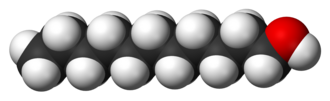
Undecanol, also known by its IUPAC name 1-undecanol or undecan-1-ol, and by its trivial names undecyl alcohol and hendecanol, is a fatty alcohol. Undecanol is a colorless, water-insoluble liquid of melting point 19 °C and boiling point 243 °C.
Industrial uses and production
It has a floral citrus like odor, and a fatty taste and is used as a flavoring ingredient in foods. It is commonly produced by the reduction of undecanal, the analogous aldehyde.2
Natural occurrence
1-Undecanol is found naturally in many foods such as fruits (including apples and bananas), butter, eggs and cooked pork.2
Toxicity
Undecanol can irritate the skin, eyes and lungs. Ingestion can be harmful, with the approximate toxicity of ethanol.3
References
References
- CRC Handbook of Chemistry and Physics, 60th Edition, 1980
- Burdock, George A. (1997). Encyclopedia of Food and Color Additives. CRC Press. p. 2879. ISBN 978-0-8493-9416-4.
{{cite book}}: CS1 maint: deprecated archival service (link) - "MSDS Safety Sheet". Archived from the original on 2009-01-15. Retrieved 2009-06-14.