| Uncle Was a Vampire | |
|---|---|
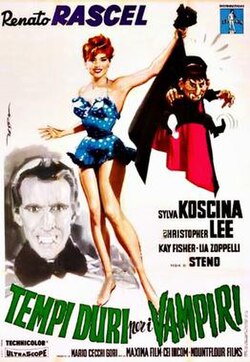 Italian theatrical release poster | |
| Directed by | Steno |
| Screenplay by | |
| Story by |
|
| Based on | |
| Produced by | Mario Cecchi Gori1 |
| Starring |
|
| Cinematography | Marco Scarpelli2 |
| Edited by | Eraldo Da Roma2 |
| Music by |
|
Production companies |
|
| Distributed by | C.E.I.-Incom |
Release date |
|
Running time | 90 minutes |
| Country | Italy1 |
| Box office | ₤ 385 million |
Uncle Was a Vampire (Italian: Tempi duri per i vampiri, lit. 'Hard Times for Vampires'3) is a 1959 Italian comedy horror film, directed by Steno.2 A novelty song by Bruno Martino, Dracula Cha Cha Cha, written for this film, later became a widely covered hit.
Plot
Baron Osvaldo Lambertenghi is forced to sell his ancestral castle to pay his debts. The manor is ingloriously transformed into a frivolous hotel, and Osvaldo is allowed to continue to live there working as a bellhop.
One day Osvaldo receives a visit from his uncle, Baron Roderico da Frankurten, who turns out to be a real vampire. Osvaldo tries to warn the various guests of the hotel, with the only result being that he is taken for a madman.
Bitten by his uncle, Osvaldo will also turn into a vampire, but his beloved, Lellina, will also be able to free him from the curse.
Cast
- Renato Rascel as Baron Osvaldo Lambertenghi
- Christopher Lee as Baron Roderico da Frankurten
- Sylva Koscina as Carla
- Kai Fischer as Lellina
- Lia Zoppelli as Letizia
- Franco Scandurra as Professor Stricker
- Carl Wery as Director
- Antje Geerk
- Rik Van Nutter as Carla's fiancé
- Susanne Loret as Susan
- Mario Cecchi Gori as Civil law notary
- Franco Giacobini
Production
Uncle Was a Vampire was Christopher Lee's first appearance in an Italian film production.4
Release
Uncle Was a Vampire was released in Italy on October 28, 1959 where it was distributed by C.E.I.-Incom. It grossed a total of 385 million lire in Italy.
The film was released in the United States in 1964 on television through Embassy Pictures.1
Reception
In his book Italian Horror Film Directors, Louis Paul described the film as "obviously modeled on the slapstick efforts of the comedies featuring the character Totò".5
Notes
Notes
- Curti 2015, p. 31.
- Curti 2015, p. 30.
- Paul 2005, p. 338.
- Curti 2015, p. 32.
- Paul 2005, pp. 13–4.
References
- Curti, Roberto (2015). Italian Gothic Horror Films, 1957-1969. McFarland. ISBN 978-1476619897.
- Paul, Louis (2005). Italian Horror Film Directors. McFarland. ISBN 978-0-7864-8749-3.