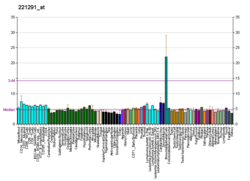
UL16 binding protein 2 (ULBP2) is a cell surface glycoprotein encoded by ULBP2 gene located on the chromosome 6.34 ULBP2 is related to MHC class I molecules, but its gene maps outside the MHC locus.34 The domain structure of ULBP2 differs significantly from those of conventional MHC class I molecules. It does not contain the α3 domain and the transmembrane segment. ULBP2 is thus composed of only the α1α2 domain which is linked to the cell membrane by the GPI anchor.34
ULBP2 functions as a stress-induced ligand for the NKG2D killer activation receptor on natural killer cells.54
References
References
- GRCh38: Ensembl release 89: ENSG00000131015 – Ensembl, May 2017
- "Human PubMed Reference:". National Center for Biotechnology Information, U.S. National Library of Medicine.
- Cosman D, Müllberg J, Sutherland CL, Chin W, Armitage R, Fanslow W, Kubin M, Chalupny NJ (Feb 2001). "ULBPs, novel MHC class I-related molecules, bind to CMV glycoprotein UL16 and stimulate NK cytotoxicity through the NKG2D receptor". Immunity. 14 (2): 123–33. doi:10.1016/S1074-7613(01)00095-4. PMID 11239445.
- Radosavljevic M, Cuillerier B, Wilson MJ, Clément O, Wicker S, Gilfillan S, Beck S, Trowsdale J, Bahram S (Jan 2002). "A cluster of ten novel MHC class I related genes on human chromosome 6q24.2-q25.3". Genomics. 79 (1): 114–23. doi:10.1006/geno.2001.6673. PMID 11827464.
- Song P, Zhao Q, Zou M (2020). "Targeting senescent cells to attenuate cardiovascular disease progression". Ageing Research Reviews. 60 101072. doi:10.1016/j.arr.2020.101072. PMC 7263313. PMID 32298812.
Further reading
Further reading
- Cerwenka A, Lanier LL (May 2003). "NKG2D ligands: unconventional MHC class I-like molecules exploited by viruses and cancer". Tissue Antigens. 61 (5): 335–43. doi:10.1034/j.1399-0039.2003.00070.x. PMID 12753652.
- Onda H, Ohkubo S, Shintani Y, Ogi K, Kikuchi K, Tanaka H, Yamamoto K, Tsuji I, Ishibashi Y, Yamada T, Kitada C, Suzuki N, Sawada H, Nishimura O, Fujino M (Jul 2001). "A novel secreted tumor antigen with a glycosylphosphatidylinositol-anchored structure ubiquitously expressed in human cancers". Biochemical and Biophysical Research Communications. 285 (2): 235–43. doi:10.1006/bbrc.2001.5149. PMID 11444831.
- Steinle A, Li P, Morris DL, Groh V, Lanier LL, Strong RK, Spies T (2001). "Interactions of human NKG2D with its ligands MICA, MICB, and homologs of the mouse RAE-1 protein family". Immunogenetics. 53 (4): 279–87. doi:10.1007/s002510100325. PMID 11491531. S2CID 33695596.
- Sutherland CL, Chalupny NJ, Schooley K, VandenBos T, Kubin M, Cosman D (Jan 2002). "UL16-binding proteins, novel MHC class I-related proteins, bind to NKG2D and activate multiple signaling pathways in primary NK cells". Journal of Immunology. 168 (2): 671–9. doi:10.4049/jimmunol.168.2.671. PMID 11777960.
- Radosavljevic M, Cuillerier B, Wilson MJ, Clément O, Wicker S, Gilfillan S, Beck S, Trowsdale J, Bahram S (Jan 2002). "A cluster of ten novel MHC class I related genes on human chromosome 6q24.2-q25.3". Genomics. 79 (1): 114–23. doi:10.1006/geno.2001.6673. PMID 11827464.
- Dunn C, Chalupny NJ, Sutherland CL, Dosch S, Sivakumar PV, Johnson DC, Cosman D (Jun 2003). "Human cytomegalovirus glycoprotein UL16 causes intracellular sequestration of NKG2D ligands, protecting against natural killer cell cytotoxicity". The Journal of Experimental Medicine. 197 (11): 1427–39. doi:10.1084/jem.20022059. PMC 2193902. PMID 12782710.
- Rölle A, Mousavi-Jazi M, Eriksson M, Odeberg J, Söderberg-Nauclér C, Cosman D, Kärre K, Cerboni C (Jul 2003). "Effects of human cytomegalovirus infection on ligands for the activating NKG2D receptor of NK cells: up-regulation of UL16-binding protein (ULBP)1 and ULBP2 is counteracted by the viral UL16 protein". Journal of Immunology. 171 (2): 902–8. doi:10.4049/jimmunol.171.2.902. PMID 12847260.
- Eleme K, Taner SB, Onfelt B, Collinson LM, McCann FE, Chalupny NJ, Cosman D, Hopkins C, Magee AI, Davis DM (Apr 2004). "Cell surface organization of stress-inducible proteins ULBP and MICA that stimulate human NK cells and T cells via NKG2D". The Journal of Experimental Medicine. 199 (7): 1005–10. doi:10.1084/jem.20032194. PMC 2211882. PMID 15051759.
- Rohner A, Langenkamp U, Siegler U, Kalberer CP, Wodnar-Filipowicz A (Oct 2007). "Differentiation-promoting drugs up-regulate NKG2D ligand expression and enhance the susceptibility of acute myeloid leukemia cells to natural killer cell-mediated lysis". Leukemia Research. 31 (10): 1393–402. doi:10.1016/j.leukres.2007.02.020. PMID 17391757.