| Type 10 grenade | |
|---|---|
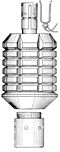 Drawing of a Type 10 grenade | |
| Type | |
| Place of origin | Empire of Japan |
| Service history | |
| In service | 1921–1945 |
| Used by | See § Users |
| Wars | |
| Production history | |
| Variants | See § Variants |
| Specifications | |
| Mass | 526 g (18.6 oz)1 |
| Length | 110 mm (4.3 in)1 |
| Diameter | 50 mm (2.0 in)1 |
| Filling | TNT |
| Filling weight | 50 g (1.8 oz) |
Detonation mechanism | 7-second timer |
The Type 10 grenade (十年式手榴弾, Jyūnen-shiki Teryūdan) was one of the earliest purpose-made fragmentation grenade designed and deployed by the Imperial Japanese Army.1
History and development
During the Russo-Japanese War, the Japanese made use of improvised designs such as empty pottery jars, meat cans or even bamboo segments filled with guncotton or picric acid, alongside pipe bombs and empty artillery shell cases filled with guncotton. Introduced in 1921, the Type 10 was one of the earliest purpose-made grenades made by the Japanese, capable of being either thrown by hand or via the Type 10 or the later Type 89 grenade discharger.2
The Type 10 was used by the Imperial Japanese ground forces, with signalling flare grenades widely used by battalion and regimental headquarter units.3 The high-explosive (HE) grenade was replaced in 1931 by the Type 91, but remained in limited use into the 1940s,1 with the United States intelligence reporting that the Type 10 discharger was primarily used in the signalling role during World War II.4
Design
The Type 10 was a multi-purpose grenade, capable of being hand-thrown or launched from the Type 10 or the later Type 89 grenade discharger. When hand-thrown, the percussion cap-type fuze had to be struck against a hard surface after pulling the safety pin. When launched from a Type 10 or 89 discharger, a plug containing the propellant charge and primer was screwed on the bottom of the grenade.1
The main issues of the Type 10 included the need for a loose fit for the grenade to slide into the barrel (resulting in gas leaks) and the poor aerodynamic shape of the grenade reduced range and accuracy of the grenade discharger; in the hand-thrown role, the Japanese recognized that the 7-second delay fuze was too longa while the 50 g (1.8 oz) TNT payload was too small.5 Another issue with the design was the highly variable and inaccurate fuse timing, which could result in premature detonation: US troops were instructed to immediately throw captured grenades after activating them.1
In the dedicated hand grenade role, the Type 10 was replaced by the Type 91 grenade, which had a larger explosive filling; in rifle grenade role the Type 89 HE shell replaced it, having a superior range and triple the TNT payload.6
Variants
The following munition types were made for the Type 10 grenade discharger:5
Users

References
References
- Rottman 2015, p. 34.
- Rottman 2015, pp. 8, 34.
- Ness 2014, pp. 53–54.
- War Department 1944, p. 198.
- Ness 2014, p. 53.
- Ness 2014, p. 54.
Bibliography
- Ness, Leland (2014). Rikugun: Volume 2 - Weapons of the Imperial Japanese Army & Navy Ground Forces (eBook ed.). Solihull, England: Helion. ISBN 978-1-912174-58-4 – via Google Books.
- Rottman, Gordon L. (2015). The Hand Grenade (PDF eBook ed.). Oxford, United Kingdom: Osprey Publishing. ISBN 978-1-4728-0735-9 – via Google Books.
- War Department (1944). TM E 30-480: Handbook On Japanese Military Forces. Washington D.C.: United States Government Printing Office – via Internet Archive.