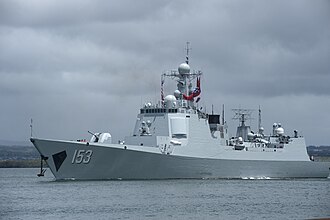
 Xi'an at Pearl Harbor in 2016 | |
| Class overview | |
|---|---|
| Builders | Jiangnan Shipyard |
| Operators |  PLA Navy Surface Force PLA Navy Surface Force |
| Preceded by | Type 052B destroyer (based on hull family and commissioning date) |
| Succeeded by | |
| Built | 2002–2015 |
| In service | September 2005–present |
| Planned | 6 |
| Completed | 6 |
| Active | 61 |
| General characteristics | |
| Type | Guided-missile destroyer |
| Displacement | 7,000 tons2 |
| Length | 155 m (508 ft 6 in)2 |
| Beam | 17 m (55 ft 9 in)2 |
| Draught | 6 m (19 ft 8 in)2 |
| Propulsion | |
| Speed | 29 knots (54 km/h; 33 mph)2 |
| Range | 4,500 nautical miles (8,300 km; 5,200 mi) at 15 knots2 |
| Complement | 28042 |
| Sensors & processing systems |
|
| Electronic warfare & decoys | |
| Armament | |
| Aircraft carried | 1 helicopter (Kamov Ka-28 or Harbin Z-9)45 |
| Aviation facilities | |
The Type 052C destroyer (NATO/OSD Luyang II-class destroyer) is a class of guided-missile destroyers in the Chinese People's Liberation Army Navy Surface Force (PLAN). The Type 052C introduced both fixed active electronically scanned array (AESA) radar and vertically launched surface-to-air missiles into PLAN service,6 making it the first Chinese warship with area air defence capability.7
Program
The first two ships, Lanzhou and Haikou, were laid down at the Jiangnan Shipyard in Shanghai in 2002, and entered service in 2004 and 2005 respectively.2 No further ships were laid down until 2010;8 the pause may have been due to the relocation of the shipyard.9 By 2019, six were operational.1
Design
The Type 052C appears to share the same basic hull design as the Type 052B destroyer, which in turn is based on the Type 051B destroyer. Stealth features are incorporated.2
The Type 052C uses predominantly Chinese systems derived from earlier foreign technology; the preceding Type 052 and Type 052B destroyers used a mixture of Russian and Chinese systems.9
Missiles
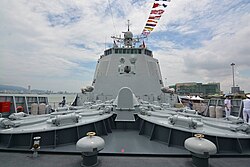
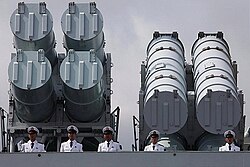
The Type 052C carries 48 HHQ-9 naval surface-to-air missiles (SAM),2 each with a slant range of 110 nautical miles (200 km; 130 mi).10 The SAMs are cold launched11 from eight revolver-type vertical launchers, with six missiles per launcher.8
Eight YJ-62 anti-ship missiles are carried in two quad-canister launchers just forward of the hangar.2 Each missile has a range of 250 nautical miles (460 km; 290 mi).10
Guns
The main gun is a 100 mm (4 in) PJ-87. The gun suffered from jamming and may have influenced the decision to adopt a different weapon for the Type 052D destroyer.312 The weapon has a rate of fire of 25 rounds per minute.2
Close-in defence is provided by two seven-barrel 30 mm (1.2 in) Type 730 CIWS, one mounted forward of the bridge and one atop the hangar. Each gun has a maximum rate of fire of 4200 rounds per minute.2
Anti-submarine systems
Two triple 324 mm (13 in) torpedo tubes are carried; these are copies or derivatives of the Whitehead Alenia Sistemi Subacquei B515/ILAS-3.213 This launcher may fire the Yu-7 ASW torpedo.13
Radar
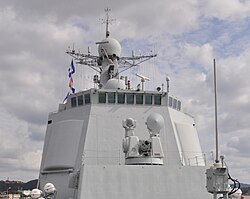
The Type 052C is the first PLAN warship to mount3 the G-band2 Type 346 AESA radar.6 The four phased array antennas are mounted on the taller forward superstructure. The Type 346 is used for air search, and provides fire control for the HHQ-9.2 The combination of AESA radar and VLS SAMs produces a marked increase in anti-aircraft firepower over previous Chinese warships.6
Aircraft
A Kamov Ka-28 or Harbin Z-9 helicopter may operate from the rear hangar and flight deck.5 The Ka-28 is equipped with a search radar and dipping sonar and can also employ sonobuoys, torpedoes, depth charges, or mines.14 The Z-9 is a variant of the Airbus Helicopters AS365 Dauphin. The naval variant of the Z-9, the Z-9C, is equipped with the KLC-1 search radar, dipping sonar, and is typically armed with a single, lightweight torpedo.15 Either helicopter significantly improves the anti-submarine capabilities of the Type 052C.
Propulsion
The Type 052C propulsion is in the combined diesel or gas (CODOG) arrangement, with two Ukrainian DA80 gas turbines and two2 MTU 20V 956TB92 diesel engines.3
The DA80s had blade problems and may have contributed to the last two Type 052Cs sitting pierside at the shipyard for two years without being accepted by the PLAN.3
The MTU 20V 956TB92 engines were license-produced by Shaanxi Diesel Engine Works.3
Ships of class
| Hull no. | Name | Builder | Launched | Commissioned | Fleet | Status |
|---|---|---|---|---|---|---|
| 1701 | 兰州 / Lanzhou1 | Jiangnan Shipyard, Shanghai2 | 29 April 20032 | 18 July 20042 | South Sea Fleet2 | Active1 |
| 1711 | 海口 / Haikou1 | Jiangnan Shipyard, Shanghai2 | 30 October 20032 | 20 July 20052 | South Sea Fleet2 | Active1 |
| 1501 | 长春 / Changchun1 | Jiangnan Shipyard, Changxingdao16 | 28 November 201016 | 31 January 201317 | East Sea Fleet17 | Active1 |
| 1511 | 郑州 / Zhengzhou1 | Jiangnan Shipyard, Changxingdao16 | 20 July 201116 | 26 December 201316 | East Sea Fleet16 | Active1 |
| 1521 | 济南 / Jinan1 | Jiangnan Shipyard, Changxingdao16 | 18 October 201116 | 22 December 201416 | East Sea Fleet16 | Active1 |
| 1531 | 西安 / Xi'an1 | Jiangnan Shipyard, Changxingdao16 | 28 May 201216 | 9 February 201516 | East Sea Fleet16 | Active1 |
Gallery
-
 Type 052C Zhengzhou (151)
 -
 Xi'an (153) and Z-9 at RIMPAC 2016
 -
 Changchun (150) in the East China Sea
See also
See also
Equivalent destroyers of the same era
References
References
- United States Navy Office of Naval Intelligence (2018). PLA Navy Identification Guide (Report). Archived from the original on 30 April 2019. Retrieved 29 April 2019.
- Saunders, Stephan, ed. (2009). Jane's Fighting Ships 2009-2010. Jane's Information Group. p. 137. ISBN 978-0710628886.
- Bussert, James C. (1 November 2015). "China Develops Aircraft Carrier Group Leader". Afcea International. AFCEA. Retrieved 24 May 2019.
- Wertheim, Eric (June 2021). "Air-Defense Destroyers for the PLAN". Proceedings. U.S. Naval Institute. Archived from the original on 11 July 2025. Retrieved 3 June 2026.
- McDevitt: pages 61
- McDevitt: pages 59-60
- Cole, Bernard D. (July 2017). "What Do China's Surface Fleet Developments Suggest about Its Maritime Strategy?". CSMI Red Book. 14. United States Naval War College: 23. ISBN 978-1-935352-45-7. Retrieved 22 May 2019.
- Li: page 44
- McDevitt: pages 59
- McDevitt 2017, p. 60.
- Bussert, James C. (1 December 2013). "China Destroyer Consolidates Innovations, Other Ship Advances". Afcea International. AFCEA. Retrieved 22 May 2019.
- O'Rourke, Ronald (21 March 2013). CRS Report for CongressPrepared for Members and Committees of Congress China Naval Modernization: Implications for U.S. Navy Capabilities—Background and Issues for Congress (PDF). RL33153 (Report). Congressional Research Service. p. 28. Archived from the original (PDF) on 29 August 2017. Retrieved 24 May 2019.
- "Undersea dragon: Chinese ASW capabilities advance" (PDF). Jane's. 2017. Archived from the original (PDF) on 8 September 2017. Retrieved 24 May 2019.
- United States Navy Office of Naval Intelligence: The PLA Navy, pages 20-21
- United States Navy Office of Naval Intelligence: The PLA Navy, pages 20
- Jane's Fighting Ships, 2023-24 Edition, ISBN 978-0-7106-3428 3, page 142.
- Qian, Xiaohu (5 February 2013). "Changchun' warship commissioned to PLA Navy". People's Daily Online. Archived from the original on 15 February 2013. Retrieved 22 March 2013.
Bibliography
Bibliography
- Li, Nan (July 2017). "Why Is the Surface Fleet Gaining Importance?". CSMI Red Book. 14. United States Naval War College: 43–54. ISBN 978-1-935352-45-7. Retrieved 22 May 2019.
- McDevitt, Michael (July 2017). "The Modern PLA Navy Destroyer Force". CSMI Red Book. 14. United States Naval War College: 55–65. ISBN 978-1-935352-45-7. Retrieved 22 May 2019.
- United States Navy Office of Naval Intelligence (2015). The PLA Navy: New Capabilities and Missions for the 21st Century (PDF) (Report). Retrieved 22 May 2019.